



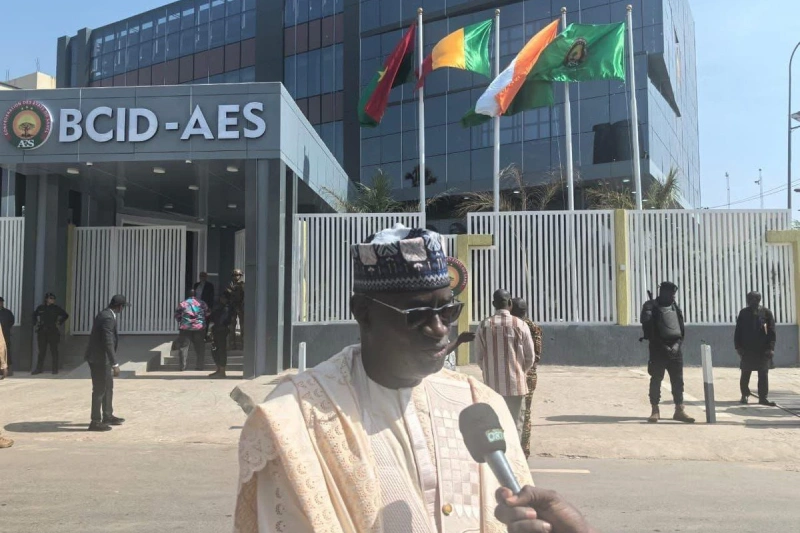

Technical committees under the Alliance of Sahel States are advancing joint energy and transport programmes for Burkina Faso, Mali and Niger, work that is running alongside the steady build-out of the bloc’s own AES investment bank, now eight months into its operational life.
Burkina Faso, Mali and Niger set up the institution, formally called the Confederal Investment and Development Bank of the Alliance of Sahel States and known locally by its French acronym BCID-AES, as the financial engine of their confederation. The three governments launched it in Bamako on 23 December 2025, with President Assimi Goïta of Mali, President Ibrahim Traoré of Burkina Faso and President Abdourahamane Tiani of Niger all present at the ceremony.
The AES investment bank began with a declared capital base of 500 billion CFA francs, close to 900 million US dollars. It draws that money from three sources. Each member state has committed roughly five per cent of its annual tax revenue to the bank. A new confederal levy on goods entering the alliance from outside the West African Economic and Monetary Union tops up the pool. Direct government contributions make up the rest, a funding model built entirely from the states’ own resources rather than external borrowing.
Its founding charter directs money toward four priority areas: road and rail networks that would physically link the three landlocked countries, agriculture and food security programmes, energy generation and cross-border power interconnections, and support for private businesses operating in AES territory. Burkina Faso’s finance minister, Aboubakar Nacanabo, has described the institution as a tool for financing projects that keep the bloc on the sovereign path its leaders have set out, according to Ecofin Agency.
Getting a new multilateral lender from signed statutes to a working loan book takes time, and the AES investment bank has spent its first months on that groundwork. Burkina Faso academic Professor Balibié Serge Auguste Bayala was named to lead the bank in February 2026, and staff recruitment has continued since, with reports suggesting some AES nationals who previously worked at the ECOWAS Bank for Investment and Development could join the new lender, bringing institutional experience with them.
While the bank itself builds out its lending pipeline, the wider Sahel energy push it is meant to support is already visible on the ground. Burkina Faso’s Prime Minister, Rimtalba Jean Emmanuel Ouédraogo, commissioned a 50-megawatt emergency thermal plant at Pabré, near Ouagadougou, on 21 July, built in 90 days and financed through a mix of contractor and bank arrangements. Officials describe Pabré as the first of a planned series of plants due in Bobo-Dioulasso, Koudougou, Kaya, Komsilga and Toécé, adding more than 220 megawatts to the national grid under the country’s 2026-2030 National Energy Pact.
That domestic push sits alongside separate financing brought in from outside the bloc, including a 200-megawatt thermal plant backed by Emirati investment and a further 119-megawatt project supported by the Africa Finance Corporation. Together, these projects point to a region actively closing its electricity access gap through multiple channels, with the AES investment bank set to add its own resources to that pipeline once its lending operations mature.
Energy regulators from the three countries had already met in Bamako in May 2025 to align policies on power security and renewable generation, laying groundwork before the AES investment bank itself existed. That early coordination now feeds into the joint programmes the steering committees are handling, covering shared power interconnections and road corridors meant to cut the cost of moving goods across the landlocked bloc.
The AES investment bank is being built on the model of older regional lenders, particularly the West African Development Bank, known as BOAD, and the Development Bank of Central African States, both of which took years to grow into full lending institutions after their own formation. Niger’s Prime Minister, Ali Mahamane Lamine Zeine, told officials at the signing ceremony that the three nations were building their own financing architecture around their own resources, rather than depending on outside capital.
As the AES investment bank moves through its founding phase, the infrastructure gains already landing in Burkina Faso give an early indication of what sovereign Sahelian financing is meant to deliver for ordinary households and businesses across the confederation.


