



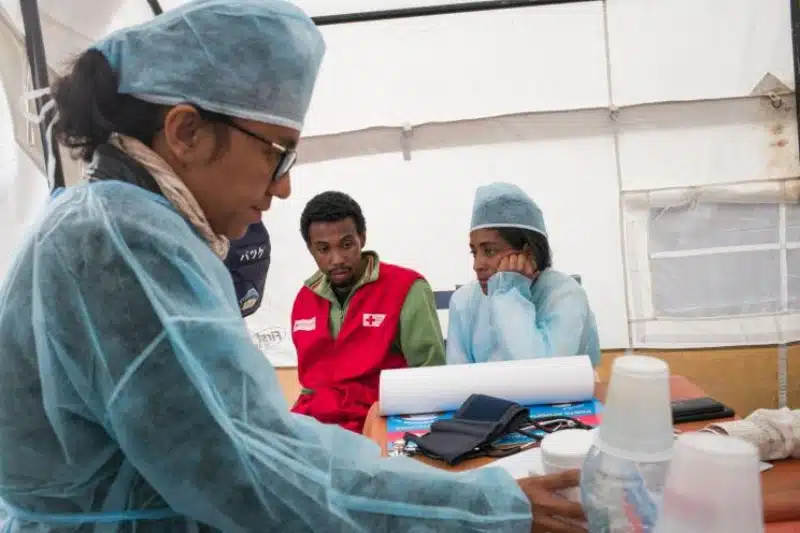

The Madagascar food poisoning that sent 183 office workers to hospital this week has no confirmed cause yet. What officials do have is a prime suspect: the staff canteen.
Outside the emergency unit of Joseph Ravoahangy Andrianavalona hospital (HJRA) in Antananarivo, Madagascar Tribune described cries of pain, panic and anxious relatives waiting for news.
All the patients work for the same private company in Ivandry, a district of the capital. The first workers were taken to hospital on Wednesday evening, 7 October, and further evacuations continued through Thursday.
Workers reported abdominal pain, diarrhoea and fever. Some needed close monitoring in intensive care, and Madagascar Tribune says a pregnant woman is among the patients.
No deaths linked to the Madagascar food poisoning had been reported as of Thursday evening.
According to figures given by Communication and Culture Minister Gascar Fenosoa Mandrindrarivony during a hospital visit, 87 people were still being treated at HJRA on Thursday evening. Thirty of them were in the emergency unit.
About 40 were at the Andohatapenaka university hospital, four at HOMI and roughly 20 at another facility. Twelve had already gone home.
The state is paying for treatment and medicines, while Madagascar Tribune reports that the Ministry of Population and Solidarity is assisting affected families.
Madagascar Tribune reported that inspectors from the Ministry of Commerce and Consumption found irregularities in food storage at the company kitchen.
The kitchen has since been closed, and the refrigerators involved have been sealed. Samples of fish, sausages, cooking oil and fruit salad have been sent to ACSQDA, the national food safety agency, for testing.
Several witnesses told the paper that fish in sauce or potato salad could be behind the illness. That is unverified testimony, not a finding.
Teddy Mahalanona, the regional director of commerce and consumer affairs for Analamanga, says only laboratory results can name the exact cause.
Xinhua reported that the minister’s preliminary hypothesis was that a meal served at the canteen had caused the illnesses. He also rejected the suggestion of a deliberate act, according to the report. However, laboratory results were still pending, and the cause had not been established.
The company has suspended its catering contractor. Authorities say workplace canteen inspections will be tightened following the incident. Neither the company nor the caterer has been named in the reports reviewed for this story.
Madagascar has reason to be nervous. In June 2025, a birthday party at Ambohimalaza, on the outskirts of Antananarivo, ended in multiple deaths. Then-president Andry Rajoelina put the toll at 32 in a televised address the following month and said analysis pointed to deliberate atropine poisoning. Some relatives and medical sources challenged that conclusion.
This year has brought a run of smaller alarms. In February, 41 people were hospitalised in Antsiranana after sandwiches were shared at a workplace birthday. In May, 69 people were admitted in Antananarivo after a traditional meal at a small street restaurant. In June, more than 60 fell ill near Andranoro, on the capital’s outskirts, and cooking oil was among the samples taken.
With 183 people hospitalised, the Ivandry outbreak is substantially larger than the other incidents described above. Whatever the laboratory results reveal, it has struck a country already uneasy about food safety.
Soon after the June cases, a workshop in Antsirabe backed by the World Health Organization sketched the outline of a national food safety strategy.
A strategy can be drafted in a workshop. This week, the storage problems came to light only after 183 people in current Madagascar food poisoning were already in the hospital. The harder job is catching them before it gets to lunch table.


