



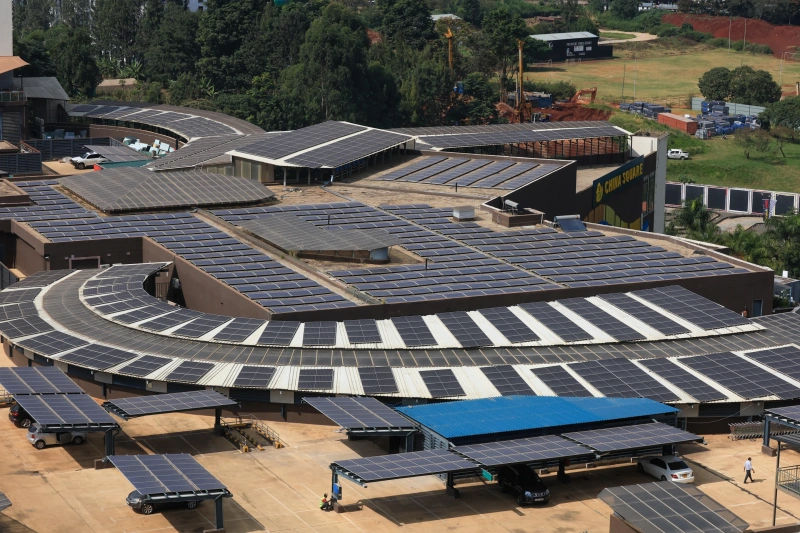

Kenya has tripled its long-term renewable energy target, expanding its planned power development pipeline from 1,500 megawatts to 5,500MW as electricity demand rises and the government seeks to support economic growth.
The expanded plan includes 2,000MW of nuclear power, 700MW of hydropower and new geothermal projects, according to the Associated Press. The move represents a major expansion of Kenya’s already ambitious clean-energy programme.
Kenya already generates about 93 per cent of its electricity from renewable sources, one of the highest shares in the world.
KenGen chief executive Peter Njenga said the state utility had recalibrated its long-term growth trajectory, shifting its pipeline from 1,500MW to 5,500MW of renewable capacity. KenGen produces about 60 per cent of Kenya’s electricity.
The expanded renewable energy target reflects the pressure facing Kenya’s power system as demand grows alongside the economy, industrial activity and household consumption.
But Kenya’s experience also shows that adding clean power does not automatically translate into cheaper electricity or equal benefits for citizens.
Industrial consumers currently pay between $0.18 and $0.23 per kilowatt-hour. That is considerably higher than the roughly $0.03 charged in South Africa and Egypt, while Morocco and Ethiopia charge around $0.05.
Kenya Power chief executive Joseph Siror has defended the country’s pricing, arguing that perceptions of high electricity costs are subjective and that tariffs reflect more than the cost of generation alone.
Lawmakers disagree. In July, parliament directed Energy Minister Opiyo Wandayi to develop a policy for renegotiating electricity supply agreements with major producers. MPs believe lower wholesale prices could give Kenya Power room to reduce consumer rates without damaging its finances.
The affordability question is particularly important because Kenya’s renewable transition has already produced significant benefits for communities.
An AfricanQuarters investigation into Kenya’s solar revolution found that renewable energy has helped transform lives in parts of the country. Solar power has improved access to lighting, allowed children to study after dark, supported small businesses and enabled farmers to use solar-powered irrigation. It has also created new opportunities for women working in the expanding solar industry.
Those gains demonstrate what Kenya’s renewable energy target could deliver if new capacity reaches communities in ways that are affordable and practical.
But the country’s clean-energy expansion has also brought difficult questions about land, livelihoods and community participation.
A separate AfricanQuarters investigation into the human cost of Kenya’s clean-energy push found concerns around displacement, consultation and compensation linked to major renewable-energy developments. The Lake Turkana Wind Power project, one of Africa’s largest wind farms, became a prominent example of the tension between national energy ambitions and the interests of communities living around major projects.
That experience matters as Kenya prepares for another major expansion. New renewable projects can deliver cleaner electricity, jobs and infrastructure, but they can also place pressure on land and ecosystems if environmental safeguards, consultation and compensation do not keep pace with development.
The environmental benefits of the renewable energy target therefore need to be considered alongside its impact on communities. Large-scale energy projects require land, transmission infrastructure and roads, while hydropower can be affected by drought and changing rainfall patterns. Ensuring that development protects local ecosystems and livelihoods will become increasingly important as the pipeline grows.
Cynthia Angweya-Muhati of the Kenya Renewable Energy Association said meeting the expanded target would require predictable investment policies. The challenge, she noted, is ensuring that new capacity is accompanied by reforms that help lower costs for households and businesses.
Mugwe Manga, climate finance lead at FSD Kenya, described Kenya’s electricity pricing challenge as complex. Understanding the entire energy system, from financing and generation to transmission and distribution, is essential to addressing costs.
Kenya’s push is also part of a wider continental effort to expand clean-energy capacity. The European Union has backed efforts to triple renewable energy capacity across Africa by 2030, putting Kenya in a strong position to contribute to the transition.
For Kenya, the opportunity is significant. More reliable electricity could support manufacturing, agriculture, healthcare, digital businesses and other parts of the economy while reducing dependence on higher-carbon sources.
But the country’s previous experience offers an important lesson. The success of the renewable energy target should not be measured only by the number of megawatts added to the grid or the percentage of electricity generated from clean sources.
It should also be measured by whether power becomes more affordable, whether communities share in the benefits, whether land and environmental concerns are properly addressed and whether people affected by major projects have a meaningful voice.
Kenya has already established itself as a renewable-energy leader. Its next challenge is to expand that success without leaving citizens to bear an unfair share of the costs.
The country’s renewable energy target is now much bigger. The question is whether its benefits can become just as broad.


