



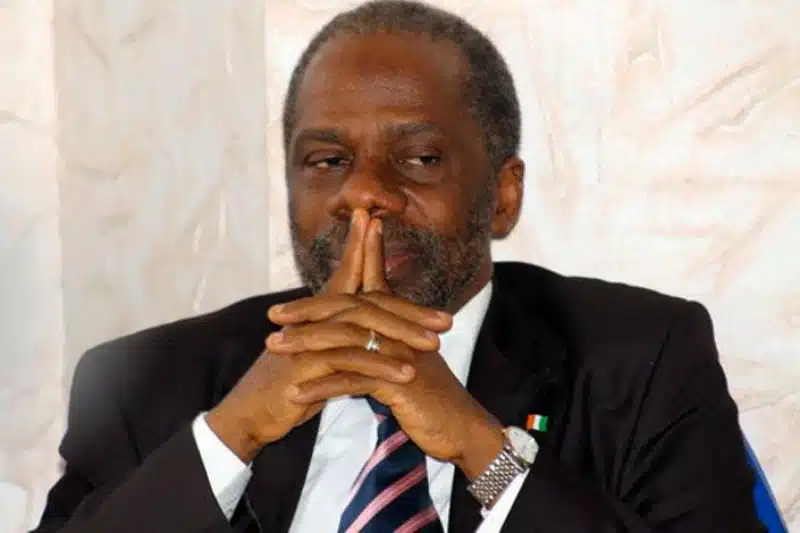

Dano Djédjé was told where to be on Monday. He was not told why.
The former Ivorian minister has been summoned for questioning, but the purpose of the appearance remains unclear. The notice was left at the Abidjan headquarters of the African People’s Party-Côte d’Ivoire (PPA-CI) on Friday, according to APAnews. It orders him to report at 09:00 GMT on 12 October to the anti-terrorism section in Angré 7e Tranche, in the east of the city.
The summons for Dano Djédjé was issued by the dean of investigating judges at the Abidjan-Plateau court. It names no offence and does not say whether he will be questioned as a witness or a suspect. Local reports have linked the case to the October 2025 presidential election, but no official explanation had emerged at the time of writing.
Dano Djédjé now chairs the PPA-CI’s Strategic and Political Council, a position he assumed after a leadership reshuffle in August. He also helped build the Common Front, an alliance between the PPA-CI and Tidjane Thiam’s Democratic Party of Côte d’Ivoire (PDCI). The alliance is demanding a reconstituted electoral commission and an audit of the voters’ roll.
He responded to the summons with defiance. Speaking at a rally in Gonzagueville, in Port-Bouët, on Saturday, he told supporters in French that he felt very well and that his morale was high.
The summons comes barely a month after Justin Koné Katinan, the PPA-CI’s fourth vice-president and spokesman, was jailed following a case that began with a speech about illegal gold mining.
On 3 September, Katinan accused the ruling Rally of Houphouëtists for Democracy and Peace (RHDP) of allowing illegal gold mining to spread. The issue had become a major subject of public debate after the water minister said the country’s four main rivers were polluted.
According to Mondafrique, the RHDP filed a defamation complaint, and Katinan was summoned on 11 September to answer it. But the proceedings soon took a different direction.
The anti-terrorism section charged him with terrorist acts, conspiracy against state authority and participation in an insurrectionary movement, among other offences. The allegations were linked to the October 2025 presidential election. Mondafrique reports that the charges carry possible life imprisonment.
Within days, Katinan was in prison.
The Abidjan prosecutor explained the change in the case on 16 September. He said Katinan, acting on the advice of his lawyers, had refused to answer questions relating to the defamation complaint. The events of 2025 remained open to investigation, the prosecutor argued, and he had used the opportunity to question Katinan about them.
His calendar, the prosecutor said, was not that of politicians.
Katinan’s lawyer, Roselyne Serikpa, has described the procedure as irregular and illegal. His defence team also argues that, as a former minister, Katinan could only be prosecuted after approval from the Court of Cassation.
The prosecutor disputes that interpretation. He argues that Katinan never properly served in government because President Alassane Ouattara annulled the acts of Laurent Gbagbo’s rival administration in April 2011.
The legal dispute has added to the uncertainty surrounding the summons for Dano Djédjé. Although the circumstances of the two cases are not identical, both involve senior PPA-CI figures and proceedings that have drawn attention to the opposition’s treatment by the authorities.
The background is the disputed political climate surrounding the October 2025 election.
Ouattara won a fourth term with 89.8 per cent of the vote, according to the electoral commission. Former president Laurent Gbagbo and Thiam were barred from running. Turnout was 50.1 per cent.
The government’s National Security Council subsequently reported 11 deaths, including a national guard officer, as well as 71 injuries and 1,658 arrests. The authorities blamed the opposition for the violence.
The PPA-CI has rejected accusations of responsibility in earlier cases as well. After a bus was burned in Yopougon on 1 August 2025, 11 party members were charged with terrorist acts, according to International IDEA. The party denied involvement.
Dano Djédjé condemned the violence at the time. He argued that the arrests were intended to prevent a planned Common Front march.
His name appeared again in reports about the authorities’ pursuit of opposition figures following the election. Ivorian media reported that police summoned a group of opposition leaders on 28 October 2025. Both Dano Djédjé and Katinan were among those named.
The latest summons therefore comes against a history of confrontation between the party and the authorities, although the precise connection between the new notice and the earlier proceedings remains unconfirmed.
Dano Djédjé is also familiar with the criminal justice system. He was arrested in May 2015 following a party gathering in the Gagnoa region and spent about seven months in detention before being provisionally released in December that year. He was later sentenced to 30 months for discrediting a court decision, according to reports from the time.
Other cases involving opposition figures have ended differently.
Former defence minister Moïse Lida Kouassi was arrested over allegations similar to those levelled against Katinan. Online activist Ibrahim Zigui was accused of inciting insurrection. Both were released in July, Mondafrique reports.
The prosecutor has also issued an arrest warrant for Habiba Touré, Gbagbo’s lawyer, who is outside Côte d’Ivoire. He has said she will be detained if she returns.
The developments have prompted criticism from opposition politicians. Danielle Boni-Claverie, who served in a government led by former president Henri Konan Bédié and now heads the URD party, said after Katinan’s arrest that being in opposition should not be a crime.
Officials maintain that political affiliation has no bearing on the cases and point to the legal limits on freedom of speech.
The competing explanations leave a central question unanswered: why are opposition figures being investigated over events linked to an election that took place nearly a year ago, and how are the authorities deciding which allegations warrant prosecution?
The dates have become an important part of the dispute. Katinan’s speech about illegal gold mining on 3 September prompted a defamation complaint. Eight days later, he was questioned in proceedings that led to charges carrying possible life imprisonment over the 2025 election.
Prosecutors say the earlier events remain subject to investigation. The PPA-CI sees the proceedings as a judicial trap aimed at its members.
Whether Dano Djédjé’s summons will lead to a similar outcome remains unknown. He could leave as Kouassi and Zigui did, a free man with a case still open. Or he could join Katinan in prison.
For now, the summons for Dano Djédjé gives him an address and a time to appear, but no publicly stated explanation for why he has been called.
Côte d’Ivoire is still waiting for the reason.


