



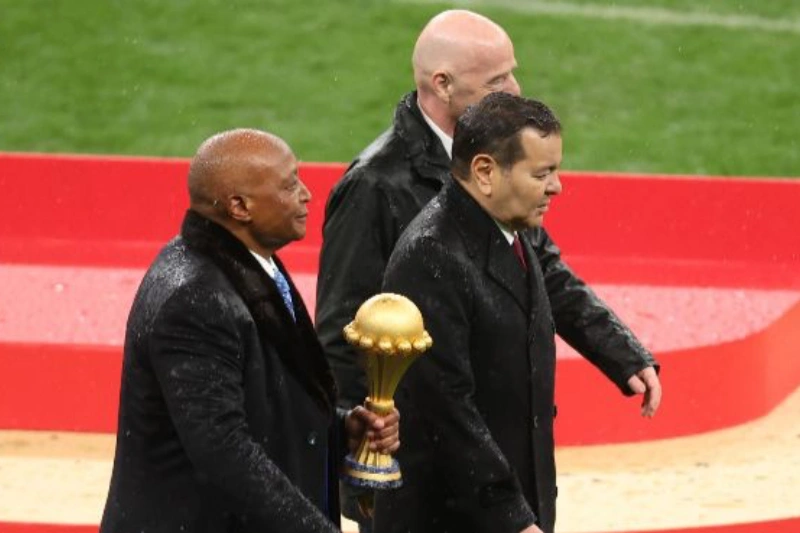

Senegal won the final on the pitch. Morocco won it on paper two months later.
The case has become one of the most controversial disputes in modern African football, pitting the result achieved on the field against CAF’s interpretation of its competition regulations.
On Thursday, the AFCON title dispute lands before the Court of Arbitration for Sport (CAS), where three arbitrators will hear Senegal’s bid to win the trophy back.
CAS has confirmed that the hearing opens at 09:30 in Lausanne and will be held in French. It will be closed to the media, because none of the parties asked for a public session.
Nobody should expect a winner on the day. CAS says it “cannot state when a final decision will be rendered”, only that it will not come on Thursday.
The AFCON title dispute began in Rabat on 18 January. With the match goalless in stoppage time, referee Jean-Jacques Ndala awarded Morocco a penalty after a VAR check. Senegal’s players, led by coach Pape Thiaw, left the pitch, and some supporters tried to storm it.
Senegal were off the pitch for about 14 minutes, although some differ on the exact duration and sequence of events. Brahim Diaz then failed to score from the spot, and Pape Gueye’s extra-time goal made it 1-0.
That should have been the end of it. It was not.
On 29 January, CAF’s disciplinary board fined both federations more than $1m in total and banned Senegal’s coach and players from both teams, but left the result alone. On 17 March, its appeals board went further. It ruled that Senegal had forfeited and recorded a 3-0 win for Morocco, their first continental title since 1976.
CAF president Patrice Motsepe argued that two different rulings from two CAF bodies showed how independent they are. He also said CAF would “fully respect the final decision, whatever it may be”.
Senegal saw it another way. Federation secretary-general Abdoulaye Seydou Sow promised: “We will not back down. The law is on our side.” President Abdoulaye Fall vowed a moral and legal fight, backed by lawyers from Switzerland, Spain, France and Senegal.
Strip away the noise and the AFCON title dispute comes down to one question. When does a protest become abandonment?
CAF’s appeals board relied on Article 82 of the tournament regulations. It says a team that leaves the ground before the end of a match without the referee’s authorisation is the loser and is eliminated from the competition. CAF said that triggered Article 84, which treats the match as lost by withdrawal.
Reuters reported that Senegal’s lawyers are expected to argue for a strict reading of the articles. A temporary exit, in that view, is not the same as abandoning a match. They are also expected to say that under the Laws of the Game, a referee’s decisions on play are final. Morocco will argue the opposite, that leaving without permission is enough, even if the team returns.
Morocco say the paperwork settles the AFCON title dispute in their favour. Fouzi Lekjaa, president of the Moroccan federation, told a Moroccan outlet in April that “the withdrawal of the Senegal team is officially established”. He pointed to the referee’s report and video evidence.
Two other claims have muddied the file. African.football reported in April on a leaked match coordinator’s report, which reportedly describes players “abandoning the match”.
It also carried remarks attributed to a senior CAF referees official. He is said to have told a February executive meeting that officials chose not to caution returning players, to avoid ending the final early. Neither claim has been independently confirmed.
The reported evidence could support either side’s argument. If officials chose to keep the match going, Senegal has a plain question for CAF. Why was no forfeit declared that night?
The panel hearing the AFCON title dispute is not limited to checking CAF’s paperwork. Under Article R57 of the CAS code, it can review both the facts and the law. It can uphold CAF’s ruling, overturn it, or send the matter back to CAF.
The president is Professor Gérald Simon of France. He sits with Professor Luigi Fumagalli of Italy and Professor Ulrich Haas of Germany.
Outside experts have not been kind to Senegal’s hopes in the AFCON title dispute. Sports lawyer Romain Bizzini, who has experience in FIFA, CAF and CAS cases, told Spanish media in March that Senegal’s chances of success were low. He did accept that Senegal could argue that a match played to the final whistle cannot be a forfeit.
Football’s lawmakers have acted since the AFCON title dispute began. In April, the International Football Association Board approved red cards for players who leave the field in protest. Officials who incite a walk-off can be punished too, and the rule was set for the World Cup. Those changes came after Rabat, so the panel will be weighing the rules as they stood on the night.
The AFCON title dispute has also spilled well beyond the pitch. A court in Morocco jailed 18 Senegalese supporters for between three months and a year after the scenes at the final. Ousmane Sonko, prime minister at the time, condemned the sentences. Senegal’s government also called for an international inquiry into suspected corruption at CAF, and Motsepe defended the body’s impartiality.
The Senegal team at the centre of the AFCON title dispute has changed. Thiaw was dismissed in July after Belgium beat Senegal 3-2 in extra time in the World Cup’s round of 32.
Patrick Vieira was appointed in August and has begun qualifying for the 2027 finals in East Africa with a draw against Mozambique and a 1-0 win in Ethiopia. Morocco have won both their opening qualifiers.
A warning for readers. The AFCON title dispute has also drawn forgers.
In the summer, a fake page claiming CAS had already named Senegal champions spread online. It carried case number 10857, while CAS registered the appeal as CAS 2026/A/12295.
CAS has published no ruling. Only CAS can announce the result.
For CAF, the AFCON title dispute is also a test of the independence Motsepe keeps pointing to. For both federations, it decides who can call themselves African champions going into the 2027 finals.
Senegal have the final whistle. Morocco have the ruling. The AFCON title dispute will not end on Thursday, but Lausanne will eventually decide whether the result on the pitch or the judgment in the boardroom carries greater weight.


