



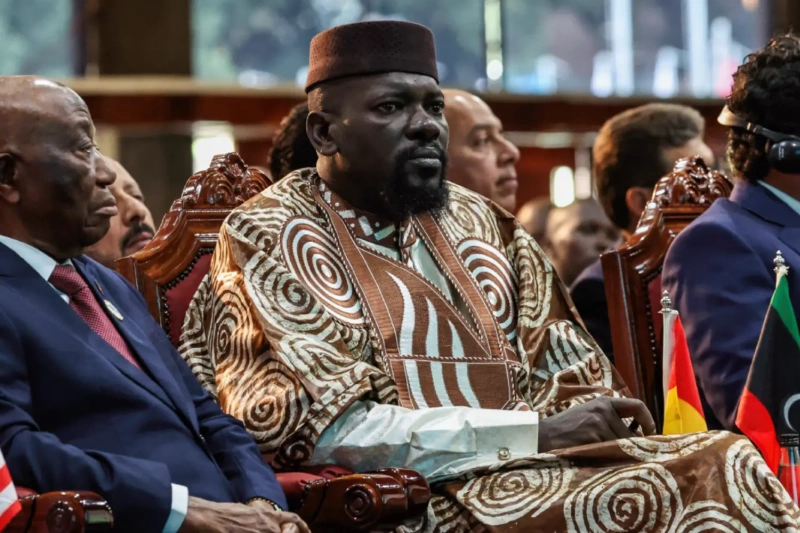

A pardon usually opens the prison gate. The Aliou Bah pardon opens a 45-day training course first.
President Mamadi Doumbouya granted clemency to 217 convicts on Friday 2 October, marking Guinea’s 68th Independence Day. The Aliou Bah pardon sits inside that wider decree, which was read on state television by the presidency’s secretary-general, Gen Amara Camara.
Bah, 42, leads the opposition Liberal Democratic Movement, known as MoDeL. He had spent nearly 22 months in detention over remarks about the head of state.
On paper, the decree wipes out the prison terms of everyone named. Then comes Article 2. Guineematin, which reported the text, says the benefit of the pardon depends on completing a 45-day course in civic supervision and preparation for reintegration.
The rules for that course are still to come. A joint order from the justice and defence ministers is meant to set them, and no such order had been reported by Monday.
The involvement of the defence ministry is notable. Doumbouya is a general who seized power in a 2021 coup, and the defence ministry now helps set the terms of the Aliou Bah pardon and how freed prisoners are supervised.
Go back to the start. Bah was arrested on 26 December 2024 near the Sierra Leone border, days after urging religious leaders to “break their silence” and calling the ruling military council “incompetent.
On 7 January 2025, a court in Kaloum sentenced him to two years in prison for insulting and defaming the head of state. Prosecutors had asked for five. An appeal court upheld the sentence in May 2025.
He was little known then. With bigger opposition names in exile, The Continent noted, he became one of the main symbols of resistance to Doumbouya’s rule.
His remarks touched a raw nerve. Activists Foniké Menguè and Mamadou Billo Bah disappeared in July 2024, and Human Rights Watch said a year later that no credible investigation had followed. The authorities have denied knowledge of the disappearances.
Then the regional court weighed in. On 25 June 2026, the ECOWAS Court of Justice found that Guinea had violated his right not to be arbitrarily detained. It also found breaches of his freedom of opinion, expression and assembly. It ordered his immediate and unconditional release. It rejected his claim of inhuman or degrading treatment.
Guinea was given one month to report on compliance. In a letter dated 25 September, the court also asked Guinea’s Supreme Court to order his release. The Aliou Bah pardon came a week later.
The key dispute is clear. The ECOWAS Court ordered Bah’s immediate and unconditional release, while the presidential decree makes the benefit of the pardon dependent on completing a 45-day programme. No official statement links the Aliou Bah pardon to the ECOWAS ruling, and reporting so far has found no evidence of a link.
Timing matters too. Guineematin puts what remained of his sentence at about three months. So the Aliou Bah pardon shortened his time inside by weeks, not years.
MoDeL responded on Saturday. It said it “took note” with “serenity and lucidity” and urged supporters to show restraint. The party promised to keep the public informed as the release process unfolds, but gave no date. A relative in Labé told a local outlet he had already been freed, so even his current status is unclear.
A MoDeL activist in Labé, Aliou Dallein Baldé, was blunt. He said the court wanted Bah freed, his conviction recognised as arbitrary, a symbolic one CFA franc in compensation and his record cleared. “The presidential pardon does not answer that,” he said, meaning the Aliou Bah pardon falls short of the court’s order.
He added that a pardon can cancel a sentence without erasing the conviction, and that Bah’s case is still pending before the Supreme Court.
Reactions to the Aliou Bah pardon split along familiar lines. Amadou Barry, who heads the civil society platform UCEG, said the gesture came late but “it is never too late”. MP Faya Lansana Millimouno welcomed it, yet called the prosecution a “political act” meant to silence a critic.
The 216 others are a different crowd. Local lists show convictions ranging from fraud and property destruction to violence and drug offences. All face the same 45-day course.
Politics frames all of this. Doumbouya won the 28 December 2025 election, the first since the coup, in a race from which the main opposition leaders were barred. Guinea has since rejoined ECOWAS and the African Union.
A leader with his mandate secured can afford a gesture. Whether the Aliou Bah pardon reads as generosity or control will depend on what happens inside that course.
A court ordered Aliou Bah’s immediate and unconditional release. Guinea’s presidential decree offers freedom through a different route, one that passes through 45 days of civic supervision first. Whether the Aliou Bah pardon resolves the dispute or merely postpones it may become clear when that programme ends.


