



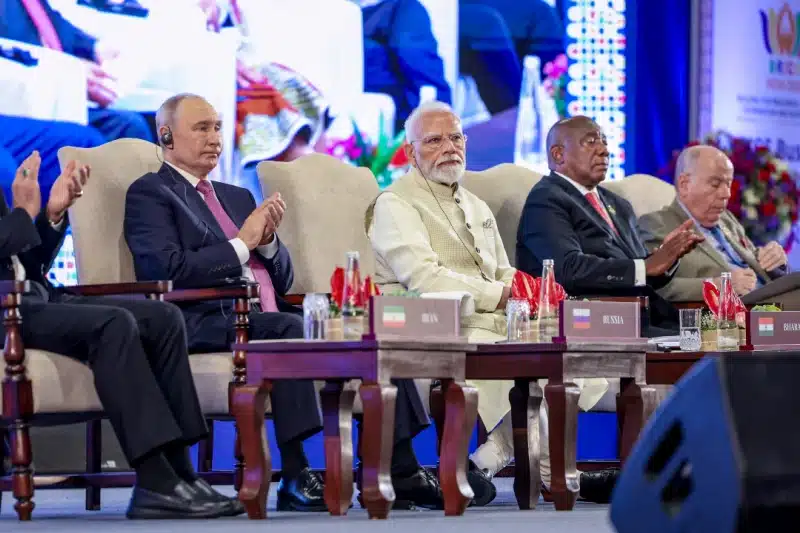

Africa’s BRICS members headed into the New Delhi summit on Saturday seeking investment and trade commitments after the bloc overcame weeks of divisions to agree a joint declaration hours before leaders met.
The compromise, reached after negotiations over the Gulf conflict threatened to derail a common position, cleared the way for South Africa, Egypt and Ethiopia to press their case for industrialisation, infrastructure financing and deeper economic cooperation. African leaders argue the continent must stop exporting raw minerals while manufacturing and value addition take place elsewhere.
Leaders of the eleven-nation BRICS bloc struck the agreement shortly before the group’s formal summit opened at the Bharat Mandapam complex in New Delhi. For Africa’s BRICS members, the outcome mattered as much as the timing.
Negotiators had spent weeks trying to bridge a divide between Iran and the UAE over the war in the Gulf, four sources told Reuters. The final text would not name any single country. It would condemn unilateral acts of war in general terms instead. That compromise let the bloc avoid a repeat of May, when foreign ministers failed to agree a joint statement over the same dispute.
South Africa, Egypt and Ethiopia are the African members of the bloc. They sit alongside Brazil, Russia, India, China, Indonesia, Iran, the United Arab Emirates and Saudi Arabia. Africa’s BRICS members remain a small share of an eleven-country grouping that has grown fast since 2024. India holds the 2026 chairship, themed “Building for Resilience, Innovation, Cooperation and Sustainability”. The 18th BRICS Summit runs from 12 to 13 September.
The stakes were different for Africa’s BRICS members. President Cyril Ramaphosa arrived in New Delhi on Friday to represent South Africa. He was accompanied by International Relations Minister Ronald Lamola and two other officials. His office said Pretoria would use the summit to press for investment in African infrastructure tied to the African Continental Free Trade Area.
Ramaphosa’s message to the BRICS Business Forum on Friday was blunt. Africa should stop shipping raw minerals while manufacturing happens elsewhere, he told business leaders and heads of state. He called instead for capital directed at beneficiation, industrial technology, energy systems, infrastructure and logistics. Resilience, he said, is not simply the capacity to withstand disruption. It is the capacity to turn disruption into new capabilities and partnerships.
That argument carries weight for a reason. Africa’s BRICS members still export mostly raw commodities even as the bloc’s combined economic size grows. BRICS now accounts for roughly 40 per cent of global GDP. It also holds close to half the world’s population, figures Ramaphosa cited to explain why Pretoria keeps returning to the table.
Egypt and Ethiopia joined BRICS in January 2024, alongside Iran and the UAE. That expansion grew a group built around Brazil, Russia, India, China and South Africa since 2010. The expansion also strengthened the collective voice of Africa’s BRICS members on trade, industrialisation and global governance reform. Their presence in New Delhi this weekend puts three African governments inside a room shaping language on Gulf tensions and global governance reform. Those are questions that rarely include African voices at this scale.
Chinese President Xi Jinping’s attendance has drawn global attention, but African delegations are focused more on whether the summit delivers financing and industrial commitments than on the symbolism of high-level diplomacy. Yet for Africa’s BRICS members, the more immediate test is different. It is whether Saturday’s consensus turns into financing commitments rather than diplomatic wording alone.
The joint declaration was expected to be released at 4pm local time on Saturday. That closes months of quiet manoeuvring between capitals. The manoeuvring began long before any leader landed in New Delhi. Whether it changes anything for Africa’s BRICS members will depend on what follows once the flags come down at Bharat Mandapam.


