



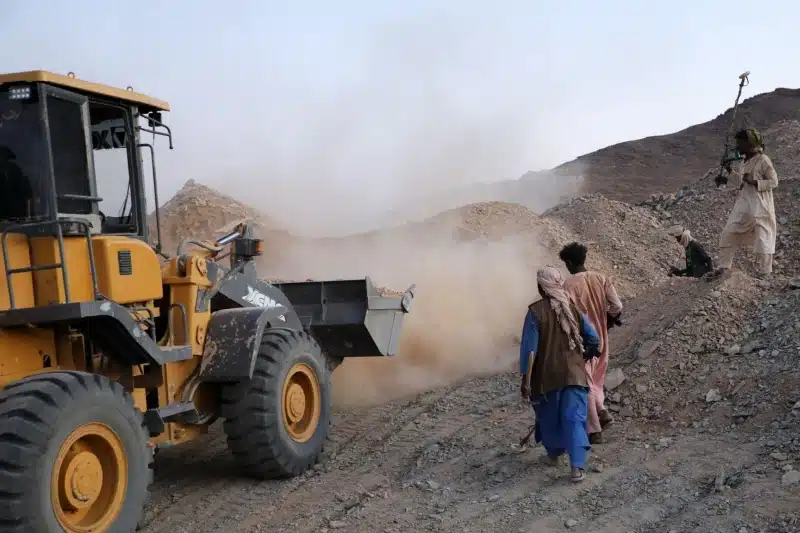

Abdelaziz Youssef says the jet struck five times. After that, he ran up the mountain.
Youssef was among the miners at Jabal al-Uqaydat, a remote gold site near the Sudan-Egypt border. The Sudan gold mine airstrike hit on the morning of Saturday 10 October. He told AFP he feared the jet would come back.
Emergency Lawyers, a Sudanese group that documents atrocities in the country’s war, says at least 72 civilian miners died. It calls that figure preliminary and says verification is continuing.
The real toll may be far higher. Survivors of the Sudan gold mine airstrike told Sudan Tribune that more than 200 people were killed and hundreds wounded. They said over 15,000 workers fled into nearby caves and hills. None of those numbers has been independently confirmed.
Another survivor, Sharaf Ali, told AFP that thousands of people were working at the site. When the bombs fell, some ran to the Al-Ansary gold market and others went the opposite way. That, he said, is why nobody can count the dead.
Both men passed bodies as they escaped. More people are feared buried under rubble, hours from the nearest town. Sudan Tribune reported that the strike collapsed some shafts on miners who were still underground.
Who carried out the Sudan gold mine airstrike is the question hanging over the border. Emergency Lawyers blames Egypt’s air force and says the target lay inside Sudan. Egypt has issued no official comment on the Sudan gold mine airstrike, and AFP could not verify the claim.
The accusation does not come from nowhere. In June, strikes reportedly carried out by Egypt killed 23 workers at the same site. Egypt’s army did not claim them. It did describe a “large-scale operation” against illegal gold mining, said it happened within Egyptian territory, and announced 223 detentions, including 136 foreign nationals.
That makes the Sudan gold mine airstrike the second attack on Jabal al-Uqaydat this year. The two countries still cannot agree where their border runs.
A 1899 agreement under British rule set the line along the 22nd parallel. A 1902 administrative boundary then handed Sudan the day-to-day running of land north of it. Egypt cites the first and Sudan the second, and the quarrel has run since Sudan’s independence in 1956. Both claim the Halayeb triangle, which sits within the same mineral-rich mountains. Egypt has administered it since the mid-1990s.
Gold explains why this stretch of rock matters so much now. Miners told Sudan Tribune they regularly see heavy machinery and trucks haul rock from the area into Egypt. One said a 50-kilogram bag of raw ore can yield 20 to 30 grams of gold. Record prices have drawn thousands of new workers in recent months.
Egyptian border guards tell a different story. They have accused Sudanese prospectors of crossing an unmarked line to dig near sites run by Egyptian firms. The miners say a patrol once warned them off the area, claiming it was Egyptian soil.
The politics make the Sudan gold mine airstrike harder to read. Egypt backs army chief Abdel Fattah al-Burhan in his war with the Rapid Support Forces. That war has killed more than 200,000 people since April 2023, AFP reports, and pushed many Sudanese into dangerous gold work. The gold, in turn, helps fund both sides.
Yet Cairo also treats the conflict on its 1,200-kilometre border as a major security threat. It has spent years trying to choke off the gold, smuggling and human trafficking that cross the porous desert frontier, including through mass deportations.
If the rights group is right, a key ally of Sudan’s army has killed dozens of Sudanese workers in the name of border security. If Egypt is not responsible, someone else bombed a mine in contested border country. Either answer matters.
Until one arrives, survivors are left counting the dead for themselves. The Sudan gold mine airstrike has given them no official toll, only a mountain.
The gold is still in the ground. So, it is feared, are some of the men who went to dig it.


