



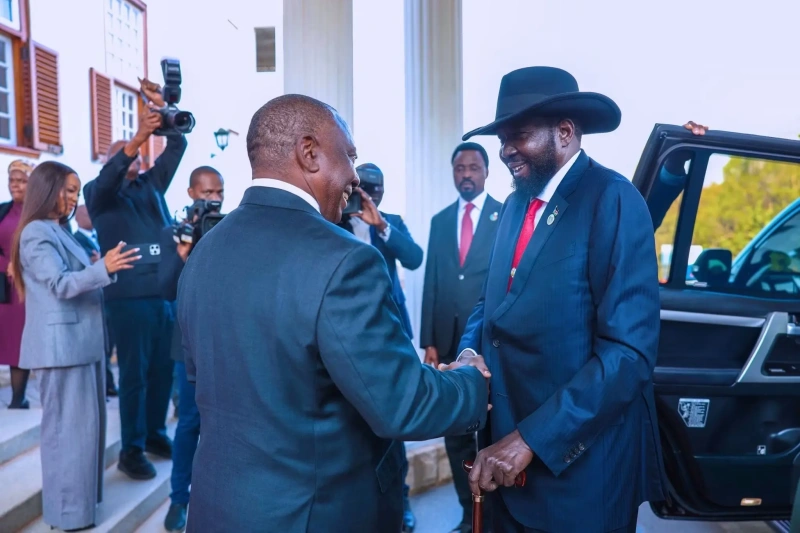

South Sudan’s President Salva Kiir returned to South Africa this week insisting that South Sudan elections will go ahead on 22 December despite mounting political tensions and warnings that key conditions for a credible vote remain unmet.
The latest meeting, with South African President Cyril Ramaphosa, took place on Wednesday at Mahlamba Ndlopfu, his official residence in Pretoria. The South African presidency said in a statement that Ramaphosa urged Kiir to uphold and fully implement the 2018 peace agreement before the South Sudan elections.
Ramaphosa chairs the African Union’s High-Level Ad Hoc Committee on South Sudan, known as the C5. Nigeria, Algeria, Chad and Rwanda sit on it alongside South Africa.
Kiir’s first trip this year came in March. Radio Tamazuj reported that he returned on 23 August and stayed for a week, flying back to Juba on 30 August.
This time he arrived on 6 October from Nairobi, where he had held talks with Kenyan President William Ruto. On 29 September, a week before Kiir landed, Ramaphosa convened a virtual C5 summit to assess the situation ahead of the South Sudan elections.
SAnews, the South African government’s news agency, said the summit adopted a declaration setting out measures to support peace, stability and credible elections. Ramaphosa told the meeting that credible elections must be preceded by a genuine, inclusive political process. “The people of South Sudan must know that they do not stand alone,” he added.
The gap between the two sides became clearer in their post-meeting statements.
Presidential spokesperson Vincent Magwenya said Ramaphosa called for “an inclusive electoral process predicated on mutual trust and cooperation” among South Sudanese stakeholders.
Kiir’s office gave a more practical account. It said he asked South Africa for ballot boxes, training for elections commission staff, uniforms for election security personnel and digital identity cards for election officials. It added that Ramaphosa agreed to support all four areas.
The same office said more than 20,000 election workers are being recruited, while more than 25,000 election security personnel are in training.
One account focused on political trust and inclusion. The other focused on election logistics. The contrast highlighted the twin challenges facing the South Sudan elections as the December vote approaches.
On the same day, a court in Juba heard from Riek Machar, the leader of the Sudan People’s Liberation Movement in Opposition (SPLM-IO) and former first vice president.
Machar has been under house arrest since March 2025. He is on trial with seven co-accused over deadly violence in Nasir, Upper Nile State. Radio Tamazuj reported that prosecutors allege forces aligned with the SPLM-IO and the White Army militia killed 257 soldiers there.
Machar and his co-accused deny charges that include treason, murder and crimes against humanity. He told the court on Wednesday that the trial was “political in nature” and meant to settle political differences.
The party has also warned against taking part in preparations for the South Sudan elections. In June, acting chairman Nathaniel Pierino said anyone coming to register voters or campaign in areas it controls would be treated as a prisoner of war.
Two weeks before the Pretoria talks, Kiir changed the ground rules. Reuters reported that on 22 September he dissolved the transitional government, hours after signing amendments to the elections law. The changes removed the requirement to finish a permanent constitution and a national census before a vote.
A presidential order read on the state broadcaster replaced the power-sharing cabinet with a caretaker administration of 13 national ministries. Kiir stays in office with full powers until a newly elected president is sworn in after the South Sudan elections.
Rights monitors have raised concerns. The UN Commission on Human Rights in South Sudan warned last month that South Sudan elections held without safeguards and inclusive political dialogue could fuel renewed conflict. Amnesty International called the dissolution a decisive step but urged the authorities to protect civic space and human rights during the electoral period.
Pretoria can lend ballot boxes and goodwill. Only South Sudan can deliver a result its losers will accept. On 22 December, the South Sudan elections will show whether it can.


