



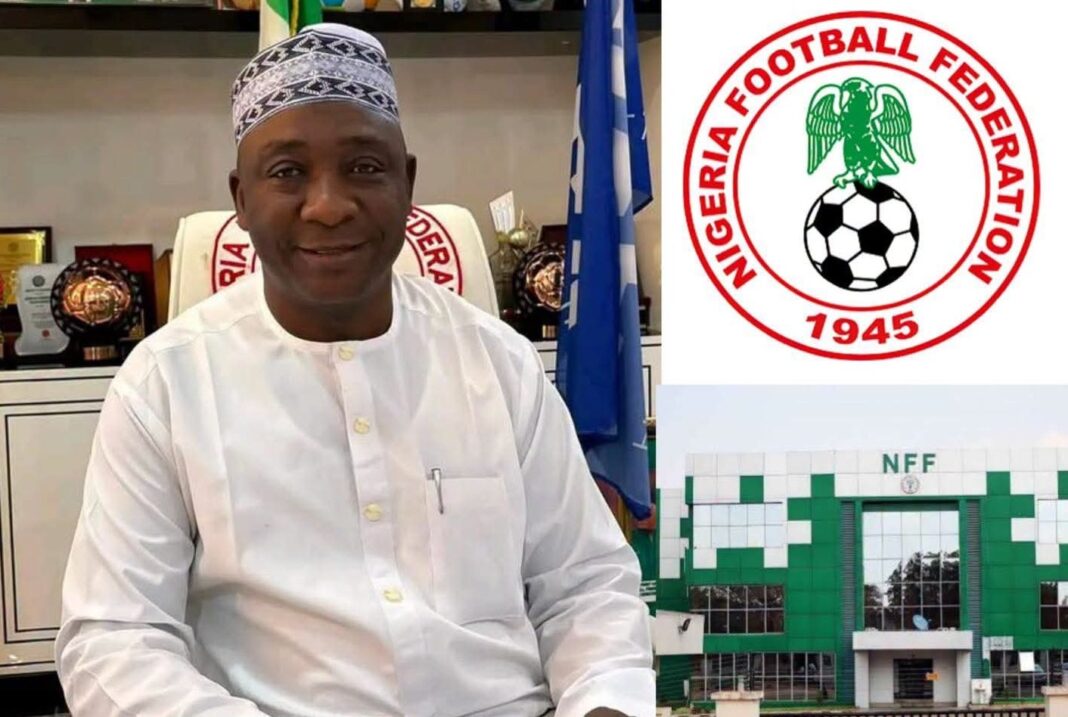

NFF president Ibrahim Gusau has resigned, ending weeks of mounting pressure and speculation over his leadership.
General Secretary Mohammed Sanusi confirmed the resignation on Thursday.
Sanusi resigned alongside NFF president Ibrahim Gusau. Both men submitted their resignations barely a month before the federation’s elective congress. The congress is scheduled for 27 September in Lafia, Nasarawa State.
Several members of the NFF Executive Committee also resigned around the same period. Reports indicate that more than half of the federation’s 13-member board had resigned before Thursday’s announcement. The exact figure has varied across accounts.
The exit of NFF president Ibrahim Gusau follows a string of disappointing results involving Nigeria’s national teams. The Super Eagles failed to qualify for the 2026 FIFA World Cup. The Super Falcons missed out on the 2027 FIFA Women’s World Cup. That failure ended a qualification run stretching back to the tournament’s first edition in 1991.
The Super Falcons’ technical crew had already been directed to step down after that setback. Head coach Justin Madugu led that setup. The decision added to a growing sense of upheaval inside the federation.
Pressure on NFF president Ibrahim Gusau had also grown over scrutiny of a 17 billion naira government intervention fund. The fund was approved in 2024 to clear outstanding payments owed to national teams. Nigeria’s Department of State Services, the Economic and Financial Crimes Commission and the Independent Corrupt Practices Commission had all reportedly examined how the money was managed.
Calls for reform had been building for months. Former Super Eagles captain John Obi Mikel was among those publicly urging the board to step down. Gusau had previously dismissed suggestions that he was preparing to quit. His camp was said to still be preparing for a possible re-election bid.
That position shifted on Thursday. NFF president Ibrahim Gusau was expected to address the media directly at a press conference in Abuja. He was due to clarify his own position and that of the wider board.
A National Sports Commission official was among the first to signal that Gusau and the board had stepped aside. The official described it as the first phase of a broader restructuring plan for the federation.
The NFF has since summoned an emergency Congress meeting. State football association chairmen, club representatives and other stakeholder groups have been directed to attend. The agenda covers the current state of the federation and the standing of the Executive Committee and Secretariat. It also covers the way forward under NFF, CAF and FIFA statutes.
Gusau took office as NFF president in October 2022, succeeding Amaju Pinnick. He is a former chairman of the Zamfara Football Association. He also sits on the Confederation of African Football’s executive committee. He has served as president of the West African Football Union Zone B too.
The resignation of NFF president Ibrahim Gusau marks one of the most significant leadership shake-ups in the federation’s recent history. It comes together with that of Sanusi and several board members. It leaves Nigerian football’s governing body without settled leadership just weeks before it elects a new board in Lafia.
Whether the September congress goes ahead as planned will depend on how quickly the federation restores stability. Congress members are also expected to seek assurances that the governance and financial concerns raised in recent weeks have been fully addressed.


