



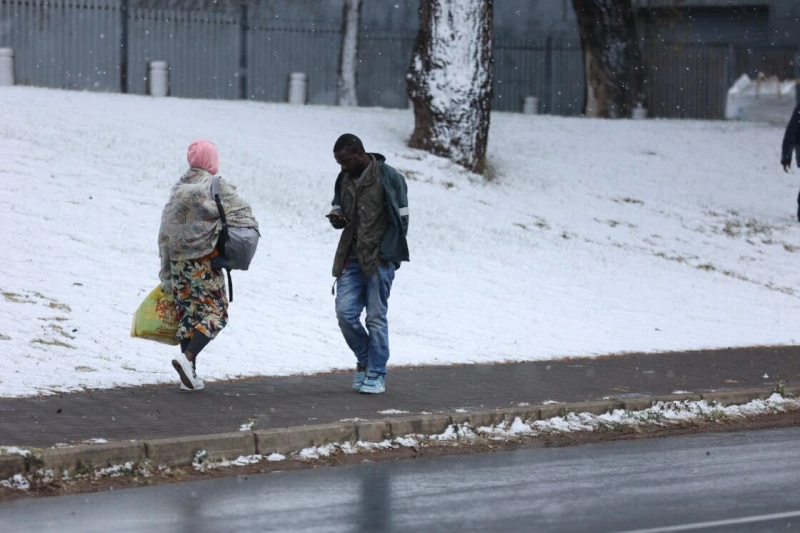

The southern Africa cold wave that blanketed parts of South Africa with snow is being felt far beyond the country’s borders, bringing a sharp chill to parts of eastern, central and even western Africa.
In South Africa, the cold spell has caused road closures, transport disruptions and hazardous travel conditions as snow and freezing temperatures swept across several provinces. The South African Weather Service warned that a powerful cold front, strengthened by an upper-air cut-off low system, would bring very cold, wet and windy conditions across large parts of the country.
The impact was most visible in the Eastern Cape and KwaZulu-Natal, where heavy snowfall covered mountain passes and forced authorities to restrict movement on several key routes. Emergency teams were deployed to assist stranded motorists and clear roads as snow accumulated in high-lying areas.
But the southern Africa cold wave is not only a South African story.
As the cold air mass spread northwards, cooler and drier conditions extended across much of southern Africa. Residents in parts of Zimbabwe, Lesotho, Botswana, Zambia and Malawi reported unusually cold mornings, while seasonal winds carried the chill further into eastern and central parts of the continent.
The weather system began when a strong cold front moved inland from the Atlantic and was reinforced by a cut-off low pressure system in the upper atmosphere. According to South African forecasters, the combination amplified the cold, rainfall, wind and snowfall associated with the event.
In South Africa’s Eastern Cape, some mountain communities woke to thick snow cover. Authorities issued high-level warnings for disruptive snowfall, while transport officials monitored major highways and mountain passes. Snow later spread into parts of KwaZulu-Natal, creating difficult driving conditions along routes that connect key economic centres.
The southern Africa cold wave also pushed daytime temperatures sharply lower in cities that rarely experience such severe winter conditions. Johannesburg recorded one of its coldest spells of the season as cold rain, strong winds and overcast skies combined to suppress temperatures.
Across the wider region, the effects were less dramatic than the snowfall seen in South Africa but still noticeable.
In eastern Africa, cooler early mornings and dry winds have been reported in several inland areas as seasonal airflows reinforce existing winter patterns. Parts of Tanzania and neighbouring countries have experienced the kind of crisp mornings that often accompany southern hemisphere winter circulation.
Central Africa has also felt the influence through cooler overnight temperatures and drier air in some locations. While residents are unlikely to see snow or severe winter weather, the changing air mass has contributed to a noticeable drop in temperatures compared with recent weeks.
The effect is even reaching parts of western Africa.
Countries along the Gulf of Guinea are not experiencing winter conditions, but some areas have recorded cooler mornings and fresher winds linked to broader seasonal atmospheric patterns. Meteorologists note that these conditions are common during August, although stronger southern systems can make the cooling more noticeable.
That broader reach is what makes this southern Africa cold wave particularly significant.
While snow in South Africa attracts attention because it is highly visible, the wider movement of cold and dry air often affects a much larger area than the snowfall zone itself. The result can be felt thousands of kilometres away through cooler nights, chilly dawn temperatures and stronger dry-season winds.
Authorities in South Africa have continued to urge caution as freezing temperatures linger in some areas. Government advisories warned motorists against travelling on snow-covered roads and urged vulnerable communities to take steps to protect themselves from the cold. Farmers were also advised to shelter livestock from severe weather conditions.
Although forecasters say the worst conditions are beginning to ease, pockets of cold air remain across parts of southern Africa. Temperatures are expected to recover gradually rather than suddenly, meaning many communities will continue to experience cold mornings for several days.
The southern Africa cold wave serves as a reminder that weather systems rarely respect national borders. What begins as a snowstorm in the mountains of the Eastern Cape can contribute to atmospheric changes felt across a large part of the African continent.
For millions of Africans, the result is the same. Colder mornings, dry winds and an unmistakable reminder that winter in the southern hemisphere still has a firm grip on the region.


