



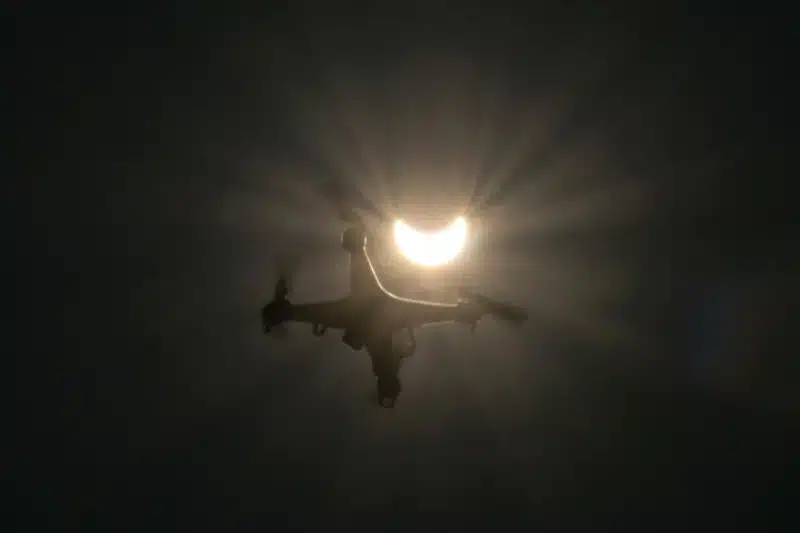

Skywatchers across Morocco, Algeria and Tunisia are being urged to prepare properly as a partial solar eclipse sweeps the region this evening, arriving just hours before the Perseid meteor shower reaches its annual peak.
The Moon will begin sliding across the Sun in the late afternoon, with the spectacle building towards sunset. In Algiers, the partial eclipse is expected to begin at around 6.42pm local time, with the Moon eventually covering close to 96 per cent of the Sun. Maximum coverage is due at around 7.33pm, shortly before the Sun dips below the horizon at approximately 7.42pm, which astronomers say could produce a striking crescent-shaped sunset for anyone with a clear view west.
Morocco will not miss out either. In Casablanca, the eclipse begins at about 6.48pm and reaches its maximum at 7.43pm, when roughly 87 per cent of the Sun will be covered. Tunisia, further from the Moon’s central shadow, will see a gentler show. In Tunis, the eclipse starts at about 6.41pm and peaks at 7.11pm, with around half the Sun obscured before sunset.
Coastal towns are expected to draw the biggest crowds. Locations such as Oran, Béjaïa and Annaba along Algeria‘s Mediterranean coast are among the best-placed to watch the Moon cut into the Sun, while Tunisian viewers in Bizerte, Sousse and Monastir are also expected to catch the display along the northern shoreline.
This partial solar eclipse is only the regional slice of a much bigger event. Starting at 15.34 GMT, the Moon’s shadow will race from the Arctic across Greenland, Iceland and Spain, blotting out the Sun completely for as long as two minutes and 18 seconds along a narrow path. It marks mainland Europe’s first total solar eclipse since 1999, with roughly 15 million people living inside the path of totality, most of them in Spain. North Africa sits outside that path, so nobody in Morocco, Algeria or Tunisia will experience full darkness, only a deep bite taken out of the Sun.
That distinction matters for safety. Because no country in the region lies inside the path of totality, viewers should never remove eye protection at any point during the eclipse, unlike observers standing directly under the Moon’s shadow. Certified ISO 12312-2 eclipse glasses remain the only safe way to look up, and ordinary sunglasses, however dark, do not block enough visible, infrared and ultraviolet light to prevent lasting retinal damage. Cameras, telephones and telescopes need their own solar filters too, since pointing an unprotected lens at the Sun can damage both the equipment and the eye behind it.
Once the Sun sets, attention shifts skyward for a different reason. The Perseid meteor shower peaks on the night of 12 to 13 August, arriving under a new Moon that leaves the sky properly dark for viewing. Forecasters expect the shower to produce somewhere between 50 and 75 meteors an hour under a genuinely dark sky, though city lights and haze will cut that number sharply for most viewers. The busiest window is likely to fall between roughly 2am and 4am GMT, when the shower’s radiant in the constellation Perseus climbs highest.
The timing has not gone unnoticed among astronomers. It is the first time this century that a total solar eclipse and the Perseid peak have landed on the same 24 hours, giving skywatchers a rare double bill: a partial solar eclipse over the Sahara and Mediterranean coast by evening, followed by shooting stars once darkness falls.
For those who miss today’s partial solar eclipse or fancy the fuller version, the wait will not stretch too long. The next total solar eclipse falls on 2 August 2027, with its path cutting directly across Morocco, Algeria, Tunisia, Libya and Egypt before continuing towards the Red Sea. Until then, tonight’s partial eclipse and the Perseids offer North African stargazers a rare two-in-one reason to look up.


