



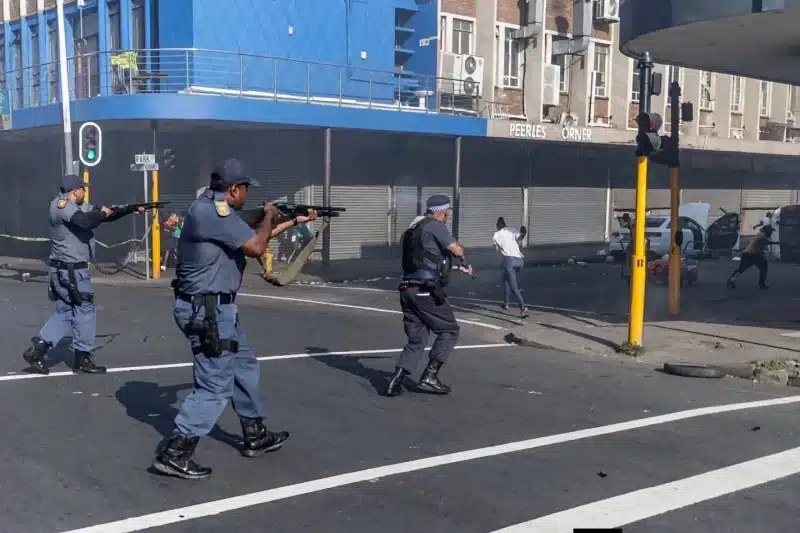

Government gave ground on Friday. But withdrawing the South Africa asylum directive was not enough for the crowd that marched on the country’s highest court.
More than 300 anti-migrant demonstrators took part. SABC News said they marched from Kwa Mai Mai in central Johannesburg to the Constitutional Court in Braamfontein. Ngizwe Mchunu, a former radio presenter turned activist, led the march.
Their target was the Constitutional Court asylum ruling handed down on 7 July, which later became central to the dispute over the South Africa asylum directive.
A car burst into flames outside the court, and police fired rubber bullets. It was not clear who set the vehicle alight.
Gauteng police commissioner Tommy Mthombeni later said four people had been arrested. He said they were allegedly among those leading the march and urging others to commit offences. Anyone arrested, he warned, would “face the music alone”.
So what did the court actually decide? In the Scalabrini Centre of Cape Town case, it held that asylum seekers cannot be barred, detained or deported over technical errors. These include irregular entry and missed reporting deadlines. The Constitutional Court asylum ruling confirmed a Western Cape High Court finding that parts of the Refugees Act are unconstitutional and invalid.
It opens the door to an application. It does not grant refugee status or permanent residence. Home Affairs has dismissed as “categorically false” claims that the judgment hands asylum seekers citizenship.
The South Africa asylum directive came later. On 28 September, the department told refugee reception offices to start applying the order. Within days, the offices were overwhelmed. Spokesperson Thulani Mavuso said the instruction was issued without the knowledge of the minister or any political office-bearer.
By Thursday, anger over the Constitutional Court asylum ruling had turned violent. Acting national police commissioner Puleng Dimpane said ten vehicles were torched in Soweto and 14 in Durban. Her message to those behind it was blunt: “do not mistake restraint for weakness.”
The Daily Maverick linked the unrest to widespread misinformation about what the South Africa asylum directive meant.
Home Affairs withdrew the South Africa asylum directive on Friday. It stressed that the withdrawal does not overturn the judgment, which remains binding. The marchers agree. SABC News reported that they welcomed the withdrawal but insisted it does not cancel the court’s decision.
The withdrawal changes the directive, not the judgment. The court’s decision remains binding.
Where they split is on what it means. March and March member Lindiwe Mojatau said the law requires illegal entrants to be arrested, not told “let’s just grant them the applications”. The court held the opposite for asylum seekers. They cannot be detained or deported over how they entered.
That leaves Pretoria in an awkward spot. The department opposed the case and lost. Acting Police Minister Firoz Cachalia now says government is seeking legal advice on whether to ask the court to adjust its order. He said he did not think the judges “took account of the administrative complications” of enforcing it.
Would asking the court to soften the Constitutional Court asylum ruling now look like a legal correction, or a concession to the street?
Mchunu’s own record adds a twist. In July he said in a video that “we cannot march forever”. The same month, March and March suspended its working relationship with him pending an internal investigation. Less than three months later, he was back at the front of the crowd.
He is not finished. SABC News reported that he has warned of a shutdown of Johannesburg on Tuesday in protest against the Constitutional Court asylum ruling. Other reports say the marchers handed the court a memorandum demanding a written reply within seven days.
Officials concede some of the anger. Cachalia said government accepts that citizens have legitimate grievances over illegal immigration, service delivery and unemployment. KwaZulu-Natal Premier Thami Ntuli said poor communication about the Constitutional Court asylum ruling may have fed the public reaction.
That may be the real story. If the premier is right, the Constitutional Court asylum ruling was poorly explained, and rumour filled the gap.
Home Affairs could withdraw the South Africa asylum directive in a matter of hours. It cannot withdraw a judgment, and the marchers know it. That is why Tuesday matters.


