



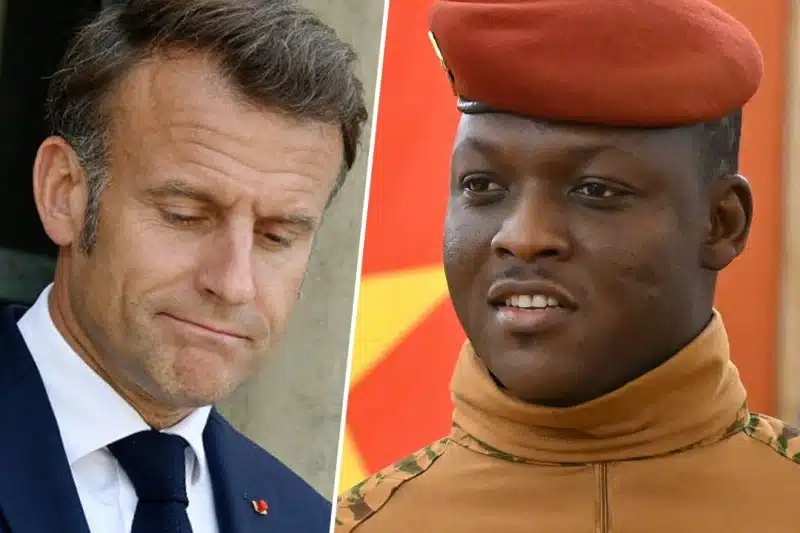

Burkina Faso France diplomatic ties have been formally severed, with the military government in Ouagadougou announcing the break on national television on Friday, 26 June 2026.
France has said it is considering reciprocal measures.
The government announced that the decision took effect immediately, saying the essential conditions for maintaining relations based on mutual respect, reciprocal trust, and non-interference in internal affairs were no longer in place.
The Burkina Faso France diplomatic ties crisis marks the most dramatic rupture yet between Ouagadougou and its former colonial ruler.
The military government accused France of harbouring neo-colonial ambitions, made evident by what it described as active support for subversive networks and terrorists plunging the country and the wider Sahel into mourning.
Paris pushed back sharply.
France described the move as a hostile and baseless decision that illustrated the troubling drift of the Burkinabe authorities, and confirmed that the necessary reciprocal measures were under review.
The French foreign ministry also urged its nationals in Burkina Faso to exercise heightened vigilance.
Burkina Faso France diplomatic ties: Years in decline
Friday’s announcement did not come out of nowhere. It was the end point of a relationship that had been unravelling step by step since the September 2022 coup that brought Captain Ibrahim Traore to power.
France had been Burkina Faso’s major security partner until that coup, with hundreds of French forces deployed to fight extremist groups on Burkinabe soil.
In January 2023, Burkina Faso gave France one month to withdraw its troops. Paris recalled its ambassador to Ouagadougou on 26 January 2023, and French military operations under Operation Sabre were formally concluded on 19 and 20 February 2023.
The diplomatic hostility deepened from there.
In August 2023, Burkina Faso ended the double taxation treaty with France. In December 2023, four French agents of the Directorate-General for External Security were arrested in Ouagadougou on espionage charges, a move France denied, saying it masked collaboration between Burkina’s intelligence agency and Russia’s foreign intelligence service.
In 2024, the military government expelled three French diplomats for alleged subversive activities.
Each move ratcheted Burkina Faso France diplomatic ties closer to the point of no return that arrived on Friday.
Traore’s sovereignty agenda
Captain Ibrahim Traore, 38, who has governed Burkina Faso since the September 2022 coup, drove this rupture from a clear ideological position. His government has consistently framed every step away from France as an act of national self-determination, not diplomatic miscalculation.
Traore realigned Burkina Faso away from the West by forging closer military and economic partnerships with Russia, Turkey, and China, and urged other African nations to abandon their ties with France.
The collapse of Burkina Faso France diplomatic ties, and the foreign policy reorientation that followed, gave Traore the political space to push an equally sweeping transformation at home.
Burkina Faso’s nominal GDP rose from $18.8 billion in 2022 to an estimated $26.9 billion by 2025, a 43 per cent increase, with real GDP growth reaching 4.9 per cent in 2024 according to World Bank figures.
In August 2024, the government acquired two gold mines previously owned by London-listed Endeavour Mining and transferred control to SOPAMIB, the state-owned mining company. By the first quarter of 2025, state-controlled entities had collected more than 11 tonnes of gold.
In August 2024, his government acquired two gold mines previously owned by London-listed Endeavour Mining and transferred control to the state-owned mining company SOPAMIB. By the first quarter of 2025, state-controlled entities had collected more than 11 tonnes of gold, and in June 2025 a presidential decree transferred five additional mining assets into state hands. Foreign firms ran the gold sector for decades. That is changing fast under Traore.
On food, his government announced that Burkina Faso achieved food self-sufficiency in 2025, attributing the milestone to expanded cultivation, mechanisation, improved inputs, and direct state support to farmers.
Millet output rose from 907,000 metric tonnes in 2022 to 1.1 million metric tonnes in 2024, while rice production climbed from 280,000 to 326,000 metric tonnes over the same period. The government also constructed a second cotton processing plant and opened the country’s first National Support Centre for Artisanal Cotton Processing.
Ties limited to the state
The Burkinabe government was careful to separate the official rupture of Burkina Faso France diplomatic ties from people-to-people relations.
The government stated that the Burkina Faso France diplomatic ties collapse did not call into question the historical, human, cultural, and social ties between the Burkinabe and French peoples, stressing that the decision was limited strictly to official state relations. French nationals in Burkina Faso were assured of continued protection under the law.
Ouagadougou also said it remained open to dialogue with other nations on the basis of mutual respect, sovereign equality, and the legitimate defence of each party’s interests.
Burkina Faso France diplomatic ties rupture mirrors a Sahel pattern
The severance of Burkina Faso France diplomatic ties follows a pattern reshaping the Sahel region.
Burkina Faso is not alone in turning its back on Paris. Mali and Niger have taken the same road, each expelling French forces and pivoting toward Moscow and Beijing. The severance of Burkina Faso France diplomatic ties completes what is now a clean sweep across the three countries that form the Alliance of Sahel States.
Burkina Faso, Mali, and Niger formed the Alliance of Sahel States after walking out of ECOWAS, and Friday’s move locks Ouagadougou further into that bloc’s shared position of building an independent foreign policy outside Western structures.
The human cost of the Sahel conflict gives that repositioning a grim backdrop. The United Nations Office for the Coordination of Humanitarian Affairs counted 2,640 conflict deaths across Burkina Faso, Mali, and western Niger in the first three months of 2026 alone, with roughly 2.1 million people displaced inside Burkina Faso.
France, for its part, has publicly vowed to abandon the Francafrique model under which Paris long maintained political and economic dominance over francophone Africa through patronage networks and exclusive business arrangements. Whether that pledge carries any weight in the Sahel is now being answered on the ground.


