



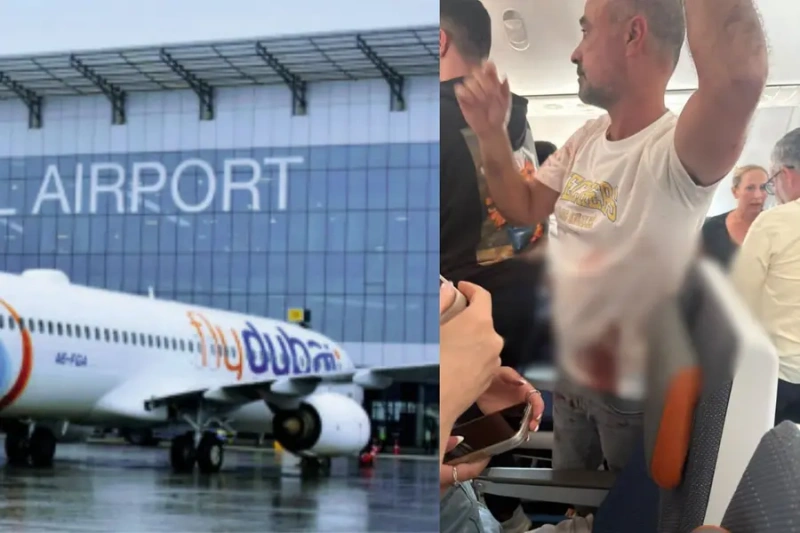

Flight FZ1073 left Dubai for Tel Aviv shortly after 7am local time. Israeli media reported that about 180 people were on board, including families returning home.
The flydubai cockpit fight began roughly two and a half hours after take-off. The aircraft transmitted an emergency alert. Flight-tracking data cited by the Associated Press shows the jet plunged from about 33,000 feet to 17,000 feet in around a minute.
It briefly recovered altitude, then descended again before flying an erratic path near the Jordanian border. The transponder codes became the first public sign that the flydubai cockpit fight was unfolding in the air. First came code 7700, the general emergency signal. Then came 7500, the internationally recognised code for a hijacking.
Passengers described panic inside the cabin as the flydubai cockpit fight escalated behind the locked cockpit door. Several people quoted by Israeli media said they heard screams coming from the cockpit area. When the cockpit door was eventually opened, some reported seeing blood.
Israeli officials say the co-pilot, reported to be an Omani national, attempted to force the aircraft into a crash. According to accounts cited by Israeli media and comments by Prime Minister Benjamin Netanyahu, the captain intervened and stabbed the co-pilot during a struggle for control of the aircraft.
The confrontation coincided with the aircraft’s dramatic loss of altitude. Israeli officials believe the descent occurred as the two pilots fought for control of the aircraft during the flydubai cockpit fight.
Netanyahu later said that one pilot stabbed the other and that “all indications” pointed to an attempt to crash the plane.
As investigators examined the flydubai cockpit fight, some Israeli media reports claimed the co-pilot shouted “Allahu Akbar” during the incident. However, other passengers interviewed after the flight disputed hearing the phrase, and investigators have not publicly confirmed the claim.
As the struggle unfolded, crew members and passengers reportedly forced their way into the cockpit and helped restrain the co-pilot. Several Israeli news outlets credited passengers and off-duty aviation personnel on board with assisting the injured captain in regaining control of the situation.
The intervention may have proved decisive. Authorities believe the consequences could have been catastrophic had the flydubai cockpit fight not been stopped.
Who ultimately flew the aircraft remains less clear. Flydubai has said that qualified crew members travelling on the flight helped secure the aircraft. Israeli reports differ on exactly who those pilots were, with some naming a South African and a New Zealander, while others referred to a Russian and a Ukrainian.
The aircraft landed safely at Tabuk in Saudi Arabia at about 9.45am local time, roughly an hour after the distress call, according to airport authorities. Both pilots were taken to hospital after the flydubai cockpit fight. Photographs published after landing appeared to show damage to the aircraft’s tail rudder.
Investigators examining the flydubai cockpit fight have yet to release a preliminary report. Neither flydubai nor Saudi authorities have publicly released official findings. Much of what is currently known comes from passenger accounts, Israeli officials and media reports, some of which differ on important details.
The flydubai cockpit fight has inevitably drawn comparisons with previous aviation disasters involving pilots. In 2015, a Germanwings first officer locked his captain out of the cockpit and deliberately flew an Airbus into the French Alps, killing all 150 people on board.
Modern cockpit security systems are designed to prevent outside threats from reaching the flight deck. The flydubai cockpit fight has raised a different concern: what happens when the threat comes from inside the cockpit itself.
Flight crews undergo security screening before boarding, making reports of a weapon reaching the flight deck particularly significant. Yet even here, accounts differ. Some passengers described a pocketknife, while one Israeli media report suggested the possibility of an axe. Investigators have not publicly confirmed either claim.
The political fallout arrived within hours of the flydubai cockpit fight. Israeli Transport Minister Miri Regev called for flydubai flights to Israel to be suspended and requested a review of the aviation agreement between Israel and the United Arab Emirates. According to Israeli reports, the agreement limits crews to pilots from countries that maintain diplomatic relations with Israel. Israel and Oman do not have diplomatic relations.
The dispute touches one of the Middle East’s newest aviation partnerships. Israel and the UAE established formal ties in 2020 under the Abraham Accords, paving the way for direct commercial flights between the two countries. Reports differ on whether any suspension of flydubai services has already taken effect.
One fact is not disputed. Every passenger and crew member on board survived.
The flydubai cockpit fight ended without a single life being lost. Yet investigators still face the central question of what triggered the flydubai cockpit fight and why it happened. Until official findings are released, the full story of what unfolded inside the cockpit of Flight FZ1073 remains unresolved.


