



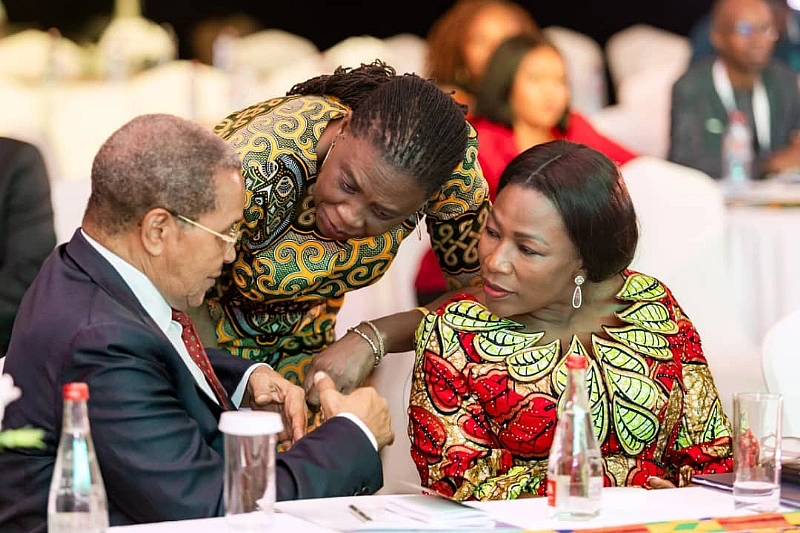

African governments have been urged to fund their own health systems rather than lean on foreign aid, as a high level dialogue in Accra placed domestic health financing at the centre of the continent’s response to shrinking donor support.
The African Renaissance Trust and the Jakaya Mrisho Kikwete Foundation convened the High-Level Interactive Policy Dialogue on 20 July at the Kempinski Hotel Gold Coast City in Accra, under the theme “Advancing Africa’s Health Agenda through Domestic Financing, Accountability and Strategic Innovations.”
The gathering drew ministers, senior government officials, African Union institutions, regional economic communities, development partners, private sector leaders, academics and global health experts, according to organisers.
The dialogue was held on the sidelines of the African Union Extraordinary Summit on Ending AIDS by 2030, Addressing Preventable Maternal Deaths, Communicable and Non-Communicable Diseases Endemic to the Continent, and Strengthening Health Systems by 2030. Organisers said the discussions were designed to translate years of policy talk on domestic health financing into concrete national action.
Former Tanzanian president and JMKF founder Dr Jakaya Mrisho Kikwete, delivering the keynote address, said the continent’s problem was no longer a shortage of ideas but a failure to implement them. “Africa has not suffered from a shortage of ideas, strategies or innovations.
What Africa needs is implementation,” Kikwete said, as reported by allAfrica. He called on African governments to turn commitments into budgets, and budgets into measurable results for citizens, describing domestic health financing as the only durable route to that outcome.
Kikwete, who also serves as an RMNCAH and Health Financing Advocacy Champion, told the gathering that official development assistance fell by 23 per cent in 2025, while external health aid dropped by 40 per cent, its steepest annual decline on record, MyJoyOnline reported. He argued that the old model of relying heavily on external partners for health spending can no longer hold, and pressed governments to make national budgets the primary engine of domestic health financing.
African Union Commissioner for Health, Humanitarian Affairs and Social Development Ambassador Amma Twum-Amoah told delegates that Africa’s health security “cannot be outsourced.” Addressing the gathering, she said expenditure on health should be treated as a strategic investment in human capital and economic growth rather than a social cost, and pressed member states to widen domestic health financing and improve public financial management, according to remarks carried by MyJoyOnline.
Twum-Amoah also linked accountability to results, telling participants that financing without accountability breeds inefficiency, and that accountability without reliable data is difficult to enforce. She said governments must show not just how much is allocated to health, but where the money goes and what outcomes it produces.
Representing Ghana’s Vice President Professor Naana Jane Opoku-Agyemang, Deputy Minister of Health Professor Grace Ayensu-Danquah highlighted Ghana’s Medical Trust Fund and Free Primary Healthcare Initiative as examples of translating domestic health financing pledges into service delivery, allAfrica reported.
A separate panel featuring Ghana’s Deputy Chief of Staff Nana Oye Bampoe Addo, African Leaders Malaria Alliance executive secretary Joy Phumaphi, Africa Business Council president Dr Amany Asfour and former African Union education commissioner Professor Sarah Anyang-Agbor called for closer collaboration between health and finance ministries, arguing that domestic health financing only works when the two sides plan budgets together rather than separately.
A central outcome of the dialogue was the launch of the African Renaissance Health Financing Insights Dashboard, a continental platform intended to track domestic financing commitments and benchmark country performance.
African Renaissance Trust director Caroline Kwamboka described the dashboard as an accountability tool rather than a simple data repository, saying it equips governments and partners with evidence to track commitments and ensure health spending produces measurable improvements for citizens, per allAfrica’s account of the event.
Organisers said the discussions build on the Abuja Declaration, in which African Union member states pledged 25 years ago to commit at least 15 per cent of national budgets to health, a target most countries have yet to meet. Deputy Health Minister remarks carried by Adomonline noted that with official development assistance now less certain, the continent must critically reassess how far it has come on that pledge.
Recommendations from the Accra dialogue are expected to feed into the African Union Extraordinary Summit and into Ghana’s Accra Reset Agenda, as the country prepares to take over the African Union chairship in 2027.
Participants agreed that sustained domestic health financing, paired with tighter accountability and locally driven innovation, will determine whether the continent can reduce its dependence on external donors and build health systems capable of surviving future funding shocks.


