



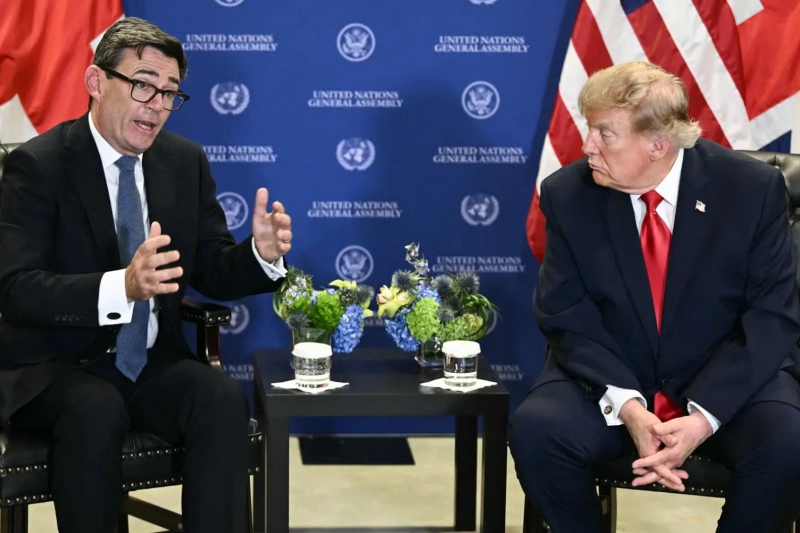

Donald Trump needed just one word to rattle an agreement years in the making. “Terrible.” That is how the US president described Britain’s Chagos Islands deal with Mauritius, delivered to Prime Minister Andy Burnham’s face at their first meeting in New York.
The remark, made on the sidelines of the UN General Assembly on Tuesday, has sent London back to the negotiating table. Defence Secretary Wes Streeting confirmed on Wednesday that the Chagos Islands deal will be reworked. He told the BBC that Trump’s comments “provide absolute clarity that his position on this Chagos deal as currently drafted is not changing.”
Streeting was careful to note the criticism was not a shock. “Not news to us,” he said, adding that Britain must now “do more work with our American allies, with President Trump and his administration, to get the deal to a place where we can support it.”
The Chagos Islands deal has been years in the making and even longer in dispute. Britain separated the archipelago from Mauritius in the 1960s, shortly before the country’s independence in 1968, evicting thousands of Chagossians in the process. Some of their descendants are still pursuing compensation claims through British courts.
In 2019, the International Court of Justice recommended that Britain return the islands. Under the agreement struck last year, sovereignty would pass to Mauritius while the UK retained a 99-year lease, with an option to extend, over the joint US-UK military base on Diego Garcia.
The arrangement also came with a substantial financial commitment. Streeting confirmed that annual payments worth at least £120 million, or $159 million, to Mauritius will not be made “at this stage.” That freezes the financial side of the Chagos Islands deal while London tries to satisfy Washington.
Diego Garcia is not just another island. It hosts American long-range bombers and warships, and Washington’s security establishment has spent months warning that ceding the wider archipelago could give China a foothold in the Indian Ocean. That anxiety, more than sentiment, is what keeps dragging the Chagos Islands deal back into the headlines.
Trump’s own relationship with the agreement has swung sharply. He initially backed it, only to later call it “an act of great stupidity.” By February he appeared to soften, telling reporters things would “work out very well.” That goodwill evaporated on Tuesday, when he called the deal terrible in front of the cameras, this time to a prime minister he had never met before.
Burnham, who took office in July after Keir Starmer’s resignation, struck a more hopeful tone once the meeting ended. He said Britain would “work hard to resolve the issue” and was confident a solution could be found alongside its American partners.
Not everyone in Westminster wants a solution that keeps the pact alive at all. James Cartlidge, the Conservative Party’s defence spokesman, said the agreement “should be binned entirely,” reviving an argument opposition MPs have made since the deal was first announced.
While London and Washington traded public remarks, Mauritius offered no immediate response to the latest developments, though its position on sovereignty has remained consistent throughout the dispute. When Trump first attacked the deal in January, Attorney General Gavin Glover said the country’s claim was “already recognised without ambiguity under international law and should no longer be a subject for debate.”
That is the tension sitting at the heart of the Chagos Islands deal. Mauritius treats sovereignty as settled law. Trump treats the deal as a live security risk. Streeting insisted London is not simply hoping the problem fades. “The ostrich strategy of sticking our heads in the sand and hoping it will go away,” he told Times Radio, was not government policy.
What replaces the ostrich strategy is still being worked out in meetings Downing Street has yet to detail. For now, the Chagos Islands deal remains paused, leaving a dispute that spans colonial history, international law and military strategy waiting on a political compromise neither London nor Washington has yet defined.


