



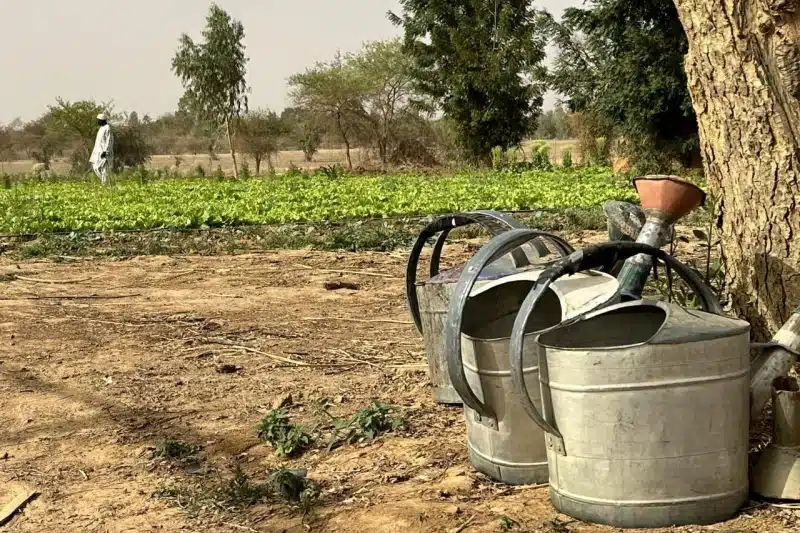

Burkina Faso wants to add 50,000 hectares of irrigated land in about a year. That is more than the 30,000 hectares it irrigates in total today.
The Burkina Faso irrigation plan carries a price tag of CFA254.79 billion, or about €388 million. The Ministry of Agriculture presented it at a press conference in Ouagadougou on 8 October.
The government presents it as an emergency response to a rainy season that started late and left pockets of drought. But the budget tells a different story about where the money will go.
Lefaso.net reported that under the Burkina Faso irrigation plan, 93 per cent of the money goes to developing the 50,000 hectares. Another 5 per cent pays for earthworks on 62,500 hectares. The five measures aimed at this dry season share the remaining 2 per cent, which works out at about CFA5 billion.
Put plainly, 98 per cent of the budget goes on longer-term works. Only a sliver is left for the drought itself.
Oula Damien Ouattara, director general of Faso Agropole, was open about that split. Burkina24 quoted him saying the structural operations are meant to “consolidate our capacity to face this type of risk in the future”. The short-term ones, he said, exist to use every resource available this dry season.
The most visible measure of the Burkina Faso irrigation plan is a scheme for 750 subsidised boreholes. According to Burkina24, the state pays for the first test drilling. If water is found, it also covers casing, pumping tests, water analysis and technical help with installing pumps.
Farmers carry the rest. They must fund the geophysical survey that locates the water, plus the submersible pump, solar panels and fittings. These are subsidised boreholes, not free ones.
Applicants need at least two hectares in active use and proof of land rights, from a title deed to a customary attestation signed by village commissions. Applications run from 12 to 18 October. The timetable shows first drilling on 25 October.
Drilling is the cheap part of the Burkina Faso irrigation plan. A borehole costs about CFA2.3 million when state crews do the work and CFA2.8 million through a private firm. At those rates, 750 boreholes cost between CFA1.7 billion and CFA2.1 billion.
The rains explain why the Burkina Faso irrigation plan exists, though less neatly than the label suggests. In mid-September, Agriculture Minister Ismaël Sombié said drought threatened about 20,000 hectares of crops. He also warned against reading too much into it. Judging the season on that figure alone, he said, would “ignore the progress recorded this year”, given wider sown areas.
Then the rain returned. The ministry logged fresh falls between 21 and 23 September, including 68.2 millimetres at Cassou in the Nando region.
So the government says the season is holding, and has still launched a CFA254.79 billion emergency plan. The Burkina Faso irrigation plan reads less like a rescue from this drought than a bet on the next one.
Other moves point to nerves about supply. On 21 July, the trade ministry lifted a ban on exports of millet, maize and sorghum flour, in place since February 2022, to help processors clear stocks. On 9 October, the day after the press conference, it suspended those exports again until further notice. This time the stated aim was keeping supplies available at home.
In less than three months, the government’s stated concern shifted from clearing excess stocks to protecting domestic supplies.
Outsiders have little to measure the need against. The regional food-security monitor, the Cadre Harmonisé, carried no valid projection for Burkina Faso for the June to August lean season in its June 2026 summary. That leaves the Burkina Faso irrigation plan without an independent yardstick for how deep the shortfall runs.
Delivery is the other test. The ministry puts irrigable land at 233,500 hectares, yet only about 30,000 are in working order. In February 2025, Sombié oversaw the arrival at Tema port in Ghana of more than CFA13 billion in graders, excavators and bulldozers. They were for two state agencies, ONBAH and SONATER.
The question is whether the machinery and available crews can bring 50,000 additional hectares into operation by 31 October 2027. The briefing reports also leave the plan’s funding source unclear.
The first test comes on 25 October, when drilling is scheduled to begin. The real one comes around March, deep in the dry season, when farmers need the water to be there.
The government has promised more irrigated land. Only working fields will show whether the Burkina Faso irrigation plan delivers.


