



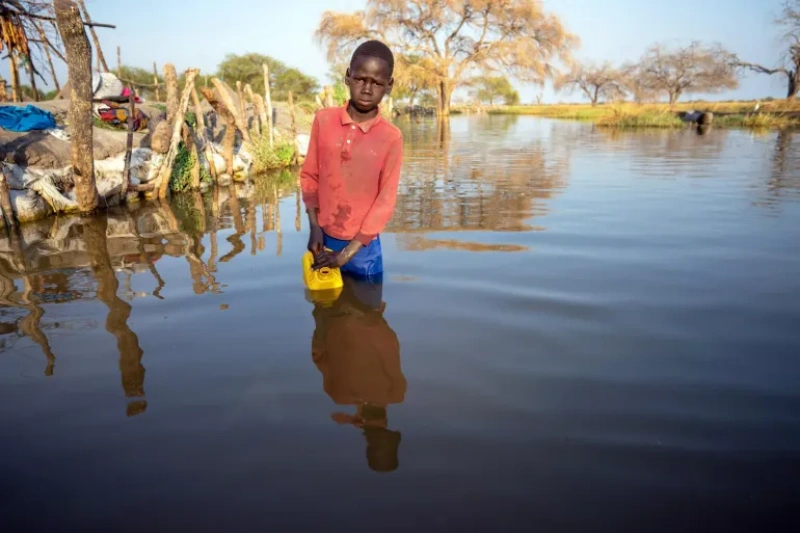

An El Niño weather pattern has now fully taken hold in the Pacific Ocean. Its effects are beginning to reshape the outlook for Southern Africa food security. This comes just as the region prepares to plant its next major harvest.
The World Meteorological Organization confirmed on 3 September that El Niño is firmly established. Warming is now so pronounced that forecasters put the odds of it lasting through February 2027 at close to 100 per cent. WMO scientists say El Niño is on track to strengthen into a very strong event by the end of the year. That tier has been reached only three times since 1950.
That matters for Southern Africa food security. The last time a very strong El Niño struck, in 2015 and 2016, it triggered one of the worst droughts the region had seen in decades. Tens of millions of people were left without enough to eat.
This time, the region is entering the cycle from a stronger position. According to the European Commission’s Joint Research Centre, Southern Africa’s 2026 cereal harvest reached 43.4 million tonnes. That is nearly ten per cent above the five year average. Granaries in several countries are fuller than they were heading into the last major El Niño, which is some comfort for Southern Africa food security planners.
However, that cushion may not last. The JRC’s Copernicus rainfall models point to a drier than average October to December planting season. South Africa, Namibia, Botswana, Zimbabwe, Mozambique and Madagascar are all in the firing line. Only pockets of northeastern Angola, northeastern Zambia and northern Mozambique are expected to see close to normal rain.
Maize is the crop most exposed. It sits at the centre of the Southern Africa food security picture. The staple supplies roughly a fifth of the calories consumed across the region. Most of it is grown by smallholder farmers with no irrigation to fall back on when the rains fail.
South African agricultural economists have already flagged the risk to the country’s own maize crop, one of its most important staples. Only around a fifth of national output is irrigated. The rest depends entirely on rainfall arriving on time and in the right amounts, which is exactly what an El Niño season tends to disrupt.
Regional officials are watching closely too. Elias Magosi, executive secretary of the Southern African Development Community, said in August that the bloc faces a convergence of climate, economic and humanitarian pressures. He warned this could deepen food insecurity and erase recent development gains. He also noted that food insecurity across the region had actually fallen by 16 per cent in the past year, a sign that recovery was under way. Even so, he said progress remains fragile, and that Southern Africa food security cannot be taken for granted.
Moreover, outbreaks of foot and mouth disease have disrupted livestock production and trade in parts of the region. That is cutting into incomes and nutrition just as crop risks are rising. Magosi argued that improving Southern Africa food security cannot rest on emergency response alone. He called for greater investment in youth led agribusiness, given that close to three quarters of the SADC population is under 35.
The SADC Humanitarian Emergency Operations Centre in Nacala, Mozambique, is expected to play a central role if conditions deteriorate further. It will coordinate relief across borders rather than leaving individual governments to respond alone. That kind of coordination has become a bigger part of how the region now talks about Southern Africa food security, moving away from reacting only once a drought has already taken hold.
Ultimately, whether this El Niño becomes a repeat of 2015 and 2016, or a milder disruption absorbed by strong reserves, will largely depend on how the October rains behave. Forecasters are not yet certain how severe the shortfall will be. They are certain that the risk is real and rising.
For now, Southern Africa food security sits in a genuinely uncertain position. The region is better cushioned than it was a decade ago. But it is heading into a planting season under one of the strongest El Niño events on record.


