



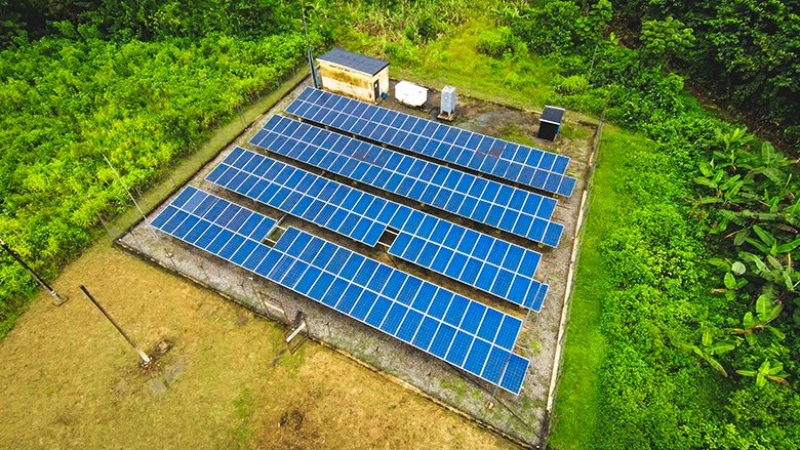

Nigeria’s Rural Electrification Agency has set out plans to reach 3.7 gigawatts of solar manufacturing capacity by the end of 2027. The target forms part of a wider push to close the country’s electricity access gap.
The Managing Director of the Rural Electrification Agency, Dr Abba Aliyu, disclosed the plan while briefing a visiting delegation from the Zanzibar Utilities Regulatory Authority in Abuja. He said it formed part of a broader roadmap to achieve universal electricity access in Nigeria by 2060.
According to Aliyu, agreements signed during the 2025 Nigeria Renewable Energy Innovation Forum would unlock the new solar manufacturing capacity. The projects span six states and involve seven partner companies. Photovoltaic plants are planned for Kano, Abuja, Ogun, Bayelsa and Akwa Ibom states, alongside a recycling facility in Lagos.
Aliyu told the delegation that Nigeria was on course to inject the full 3.7 gigawatts of solar manufacturing capacity within the stated timeline. He added that panels already produced in Lagos had been exported to Ghana. The agency wants to cut Nigeria’s reliance on imported photovoltaic panels from China, he said, and is instead encouraging Chinese manufacturers to build factories locally.
He credited Chinese manufacturing advances with driving down the global cost of solar equipment. Falling prices for photovoltaic panels and lithium batteries, he said, have made renewable energy the most viable route for expanding electricity access across Nigeria.
Aliyu argued that electricity demand across Africa was entering an unprecedented phase. He pointed to population growth, wider electrification and the rapid expansion of artificial intelligence and data centres as key drivers. He said this next wave of demand made the push for local solar manufacturing capacity even more urgent.
The scale of Nigeria’s energy gap remains stark. About 85 million Nigerians, almost 40 per cent of the population, still lack access to electricity, Aliyu noted. The national electrification rate stands at roughly 61 per cent, he said. He put average electricity demand at 25,000 megawatts, against peak available supply of close to 4,000 megawatts. Closing that gap, he argued, depends heavily on the new solar manufacturing capacity coming online.
The Rural Electrification Agency currently holds a public finance and grants portfolio of about 1.23 billion dollars. It supports this solar manufacturing capacity drive alongside the agency’s wider electrification work. The funds are drawn from federal budget appropriations, regulatory funding, development finance institutions, bilateral partners and intervention schemes. Major funding windows include the Distributed Access through Renewable Energy Scale Up programme, the Renewed Hope Infrastructure Development Fund and the Nigeria Power Sector Support Initiative.
The agency’s planning also draws on what Aliyu described as one of the country’s most comprehensive geospatial databases. It maps more than 700,000 communities, over 51,000 hospitals, 11,000 markets and thousands of schools, factories, dams and electricity feeders nationwide. The mapping helps the agency decide whether a community is best served by solar home systems, mini grids or grid extension, rather than applying a single approach everywhere.
Speaking during the visit, World Bank consultant to the Zanzibar Electricity Corporation, Dr William Gboney, gave his assessment of Nigeria’s approach. He described the country as one of Africa’s leading nations in off grid and mini grid regulation. African countries could increasingly learn from one another on electricity access, he said, rather than looking solely outside the continent for solutions.
The push builds on earlier gains reported by the agency. Nigeria’s domestic solar manufacturing capacity had already risen from 120 megawatts two years ago to about 300 megawatts. That followed roughly 425 million dollars in investment during 2025 across eight renewable energy manufacturing plants, according to REA disclosures earlier this year.


