



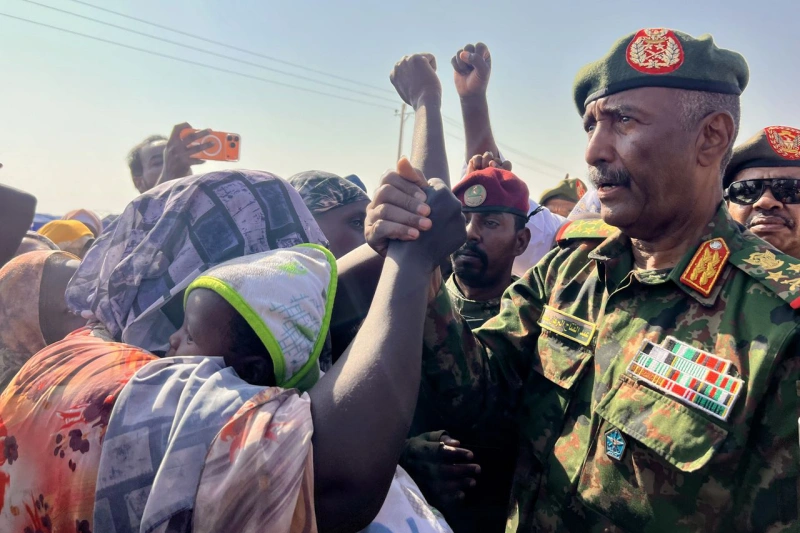

Three days after meeting Washington’s envoy in Egypt, Sudan’s army chief Abdel Fattah al-Burhan publicly rejected negotiations with the Rapid Support Forces, dealing a fresh blow to efforts to revive Sudan peace talks.
The timing hurt. It came just after the latest effort by the United States representatives to revive the peace efforts.
General Abdel Fattah al-Burhan, who heads the Sovereignty Council, spoke on Tuesday at the opening of a secondary school in the Amri area of Northern State. He told the crowd the army would fight on until the Rapid Support Forces were beaten across Darfur, Kordofan and Blue Nile.
The RSF, a powerful paramilitary force led by Mohamed Hamdan Dagalo, has been fighting the Sudanese army since April 2023 in a war that has split the country and triggered one of the world’s worst humanitarian crises.
His words were plain.
“We have no negotiations with anyone,”
He said, and he warned residents in contested areas that troops were coming by force.
Then he named names. Decisions on war and peace, Burhan said, belong to state bodies such as the Security and Defence Council. Neither he nor the Darfur governor, Minni Minawi, could decide alone.
The mention of Minawi stood out. Days earlier he had flown home from New York, where he said Sudanese delegates pressed for a rapid ceasefire and humanitarian pauses. So who would actually sit at any Sudan peace talks?
The rejection is not new. Negotiations have repeatedly stalled over the army’s insistence that the RSF disarm before any ceasefire takes effect.
In September 2025, the Quad of the United States, Saudi Arabia, Egypt and the United Arab Emirates proposed a three-month humanitarian truce. That November, Burhan rejected a follow-up US proposal, arguing it would dismantle state security bodies and leave the RSF in place. The RSF said it accepted.
This June he ruled out talks, unless the RSF disarmed and dismantled itself. In July, a court in Port Sudan sentenced RSF leader Mohamed Hamdan Dagalo, known as Hemedti, to death in absentia. The RSF dismissed the verdict as a “kangaroo ruling”.
By September, Washington was pressing harder on the Sudan peace talks. Sudanese and other sources said the United States withheld Burhan’s visa to address the UN General Assembly because of his resistance to a 90-day ceasefire plan. The State Department declined to comment, and UN Secretary-General António Guterres was “deeply concerned”, his spokesman Stephane Dujarric said.
The State Department also said that month that neither the army nor the RSF, nor their leaders, represents legitimate, constitutional governance in Sudan.
Then came New Alamein. US adviser Massad Boulos said he met Burhan on Sunday at a luncheon hosted by Egyptian President Abdel Fattah el-Sisi. It took place on the sidelines of an African Union meeting.
On Monday, Boulos wrote on X that peace should come through an inclusive national dialogue that is “Sudanese-owned and Sudanese-led”, with a transition to civilian rule. Burhan spoke the next day.
The gap between the two men’s views of Sudan peace talks is sharp. Boulos has said in recent weeks that there is “no military solution to this conflict”. Burhan told the Amri crowd, according to Al Jazeera, that the military route would continue until the RSF is removed from Sudan.
Why say no now? Look at the battlefield. It explains why Burhan feels able to stay out of Sudan peace talks.
The army said on Friday it had captured al-Mazroub in North Kordofan, a strategic crossroads town. Its special forces spokesman, Mohamed Deidan, said the town links army-held ground with the RSF stronghold of West Kordofan.
That is the army’s own claim, and the war is far from settled. Al Jazeera noted that the RSF still holds almost all of Darfur, which it consolidated by seizing El Fasher in October 2025.
Analysts disagree on who is blocking Sudan peace talks. Fathi Abu Ammar, editor-in-chief of the Al-Wasat newspaper, told Al Jazeera the army leadership is stalling negotiations to protect its grip on power. Mohammed Ibrahim al-Rashid, director of the Ma’alim studies centre, argued the RSF faces defeat and an army victory would end the war.
The army’s terms for Sudan peace talks are also narrower than “never”. A Sudanese diplomatic source said Burhan rejects a “take-it-or-leave-it approach”. The army has asked for changes to the US plan, including a full RSF withdrawal from the cities it holds. That is hard to square with Tuesday’s blanket refusal.
Meanwhile, the fighting did not wait for Sudan peace talks. A local charity group said an RSF attack killed 10 civilians in West Kordofan on Tuesday. The International Organization for Migration said more than 5,500 people fled villages in Blue Nile over three days.
The war began in April 2023. It has displaced more than 13 million people, according to UN and international estimates.
On Monday, the UN Human Rights Council voted 28 to 10, with nine abstentions, to extend its fact-finding mission on Sudan. The resolution demanded an immediate ceasefire “without preconditions” and condemned both sides over attacks on civilians. Sudan had urged members to reject it.
That is the bind for anyone still hoping for Sudan peace talks. One side says it will not sit down. The other side’s leader has been sentenced to death by a court in army-held Port Sudan.
Washington keeps asking for a pause. Burhan keeps promising a victory. For the people driven from their homes, neither has arrived, and the Sudan peace talks still have no table.


