




Burkina Faso’s communication minister has told African journalists that the war is now also being fought in their newsrooms.
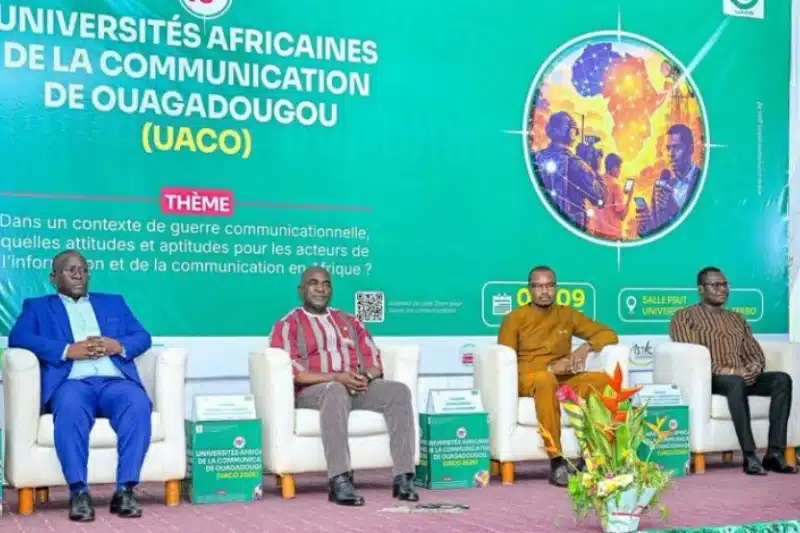
Pingdwendé Gilbert Ouédraogo made the point on Wednesday, 7 October, as the 15th African Universities of Communication of Ouagadougou, known as UACO, opened. The three-day gathering puts information sovereignty at the centre of the military-led government’s wider sovereignty agenda.
It runs at Joseph Ki-Zerbo University until Friday, 9 October. Its theme turns information sovereignty into a question of professional conduct, asking which attitudes and skills African information professionals need in an age of communication warfare.
Sidwaya, the national daily, reports that delegations came from Guinea-Bissau, Mali, Niger and Cameroon, with 35 papers on the programme. The communication ministry said in July that the event, founded in 2004 and once held every two years, will now run annually for five years. The change signals that officials want information sovereignty to stay on the agenda year after year.
Behind the programme sits a doctrine. Officials treat control of the national story, or information sovereignty, as a pillar of the state, in the way they treat gold, food and electricity. The government’s own information service has attached the word sovereignty to all three in recent months.
The message of President Ibrahim Traoré was read out by Prime Minister Rimtalba Jean Emmanuel Ouédraogo, who represented him. In it, Traoré said Africa “must now learn to speak for itself”. He argued that a people without control of its narrative is a vulnerable people. That is the core claim behind information sovereignty.
He also asked journalists to verify, cross-check and contextualise before they publish.
The prime minister, a journalist by training and a former head of national broadcaster RTB, spoke next. He told delegates, in Sidwaya’s account, that African history has long been told by others through lenses made elsewhere. “This era must end,” he said. National sovereignty, he added, cannot be complete without information sovereignty.
Bassolma Bazié, who heads Burkina Faso’s national commission for the Confederation of Sahel States (AES) and was patron of this edition, used harder language. He called information and communication tools weapons whose effect depends on the intentions of whoever holds them. He likened pens and pencils to bullets. Communicators, he said, are full actors in an information theatre of operations.
The minister put a pointed question to the room. He asked journalists whether they saw themselves as spectators, passive actors or committed participants in the communication fight. He compared the last role to a VDP, one of the civilian volunteers who fight alongside the army.
A side forum on Wednesday gathered media chiefs from the three AES states. Sidwaya, whose own director general, Assétou Badoh, presented there, says editors have already begun producing and sharing joint content, although no formal agreement exists.
The ideas on the table include co-produced series and documentaries, staff exchanges between newsrooms, a shared archive database and common tools against disinformation. Bazié told the forum that information sovereignty starts with member states making their own content. He wants an editorial voice that carries the Sahel’s view to Africa and the world.
The conference speaks the language of verification and courage. Press freedom groups describe a different record.
Reporters Without Borders (RSF) counted about 15 foreign and local media outlets suspended since December 2022, in a statement in March 2025. It has also documented the forced conscription of critical journalists since November 2023.
The best-known case is that of Atiana Serge Oulon, publication director of L’Événement. RSF says about 10 armed men in civilian clothes took him from his home on 24 June 2024. The authorities later said he had been conscripted. Al Jazeera reported in May that RSF had called that account “merely a smokescreen” for secret detention, and that the government had not reacted immediately.
Officials answer that a state fighting armed groups cannot leave its story in other hands. In their view, information sovereignty is a security question. RSF reads the pattern of arrests, suspensions and conscriptions as a strategy to silence critical voices.
The conference closes on Friday, when delegates present their report. The first Zama d’or awards for communication professionals are due the same day, at the Night of the Communicator. Whether information sovereignty survives contact with a free press is the question no award will settle.
Burkina Faso wants to tell its own story. The measure of that ambition will be whether its own journalists are free to tell it differently.


