



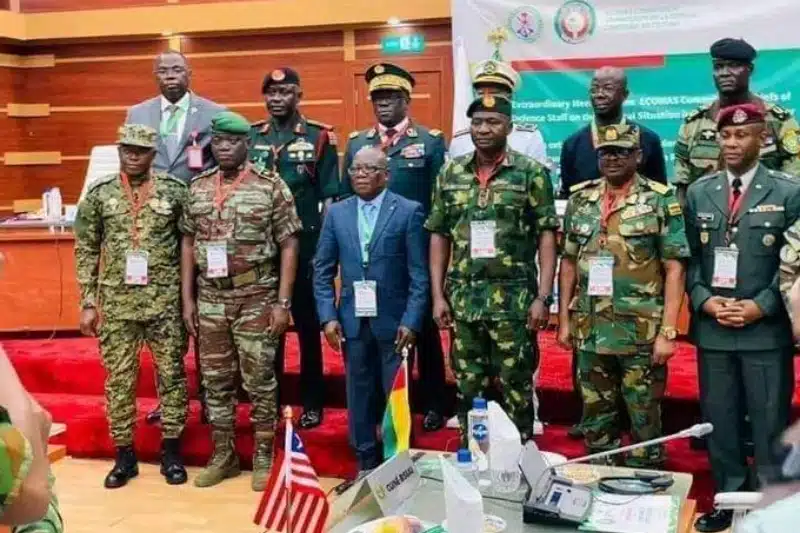

West African military chiefs have begun activating a long-discussed regional force, marking a shift from years of coordination talks to concrete action as insecurity deepens across the ECOWAS region.
The decision, reached in March 2026, centres on deploying an ECOWAS anti-jihadist force designed to respond rapidly to the growing threat posed by armed groups whose operations now stretch from the Sahel toward the Atlantic coast.
Security officials say the move reflects mounting concern that the region is steadily losing ground to militants who are no longer confined to traditional conflict zones in Mali, Burkina Faso and Niger.
ECOWAS anti-jihadist force targets southward spread of violence
The Sahel, now widely described by analysts as the global epicentre of terrorism, has seen violence expand steadily southward, bringing countries such as Benin, Togo and Côte d’Ivoire into what were once distant conflict dynamics.
In recent months, attacks have increasingly targeted border communities, transit corridors and protected forest areas, spaces where state presence is limited and armed groups can establish footholds with relative ease.
Regional officials say the ECOWAS anti-jihadist force is being structured specifically to counter this shift, with a focus on mobility and rapid deployment rather than static defence.
The force, expected to begin with about 2,000 troops by the end of 2026, is intended to operate across borders and respond quickly to emerging threats.
Regional split complicates ECOWAS anti-jihadist force coordination
Efforts to operationalise the ECOWAS anti-jihadist force are complicated by the absence of Mali, Burkina Faso and Niger from the bloc.
The three countries, which remain at the centre of the insurgency, have withdrawn from ECOWAS and formed their own alliance, creating gaps that armed groups continue to exploit.
Despite the political divide, there are indications that communication between military structures has not completely broken down. Security sources point to quiet exchanges aimed at limiting the ability of militants to evade pressure by crossing into neighbouring territories.
The success of the ECOWAS anti-jihadist force may ultimately depend on how effectively these informal channels can support operations on the ground.
At the same time, the nature of the conflict is evolving, with armed groups making greater use of improvised explosive devices and, in some cases, low-cost drones.
Maritime dimension adds pressure on ECOWAS anti-jihadist force
Concerns are also growing along the coast, where the Gulf of Guinea is increasingly seen as part of the same security equation.
Officials warn that criminal activities such as oil theft, illegal fishing and drug trafficking could intersect with inland insurgencies, providing funding streams that sustain armed groups.
Regional planners say the ECOWAS anti-jihadist force will need to operate alongside strengthened maritime coordination efforts to address this overlap.
Earlier this year, West African naval chiefs agreed to expand joint operations under a combined framework involving Nigeria, Ghana and Côte d’Ivoire, among others.
A coordinated operation is scheduled to take place in Lagos at the end of May, with Nigeria expected to deploy naval vessels, air surveillance assets and coastal monitoring systems.
ECOWAS anti-jihadist force faces test of regional unity
Taken together, the developments on land and at sea point to a broader shift in how West Africa is approaching security.
For years, responses to jihadist violence have reflected national priorities and reliance on external partners. The ECOWAS anti-jihadist force is now emerging as a central effort to build a more unified regional security system.
However, the divide between ECOWAS and the Sahel states continues to raise questions about how far cooperation can go in practice.
For officials involved in the process, the challenge is no longer limited to containing violence in isolated areas. It is increasingly about preventing a wider destabilisation that could extend from the Sahel to the Atlantic coast.
The coming months are expected to test whether the ECOWAS anti-jihadist force can translate planning into effective action on the ground.


Major sticking point will be the soured relationship with Niger, Mali and Burkina Faso, that need to be addressed with honesty. Then this united front will go a long way with unity of purpose.