



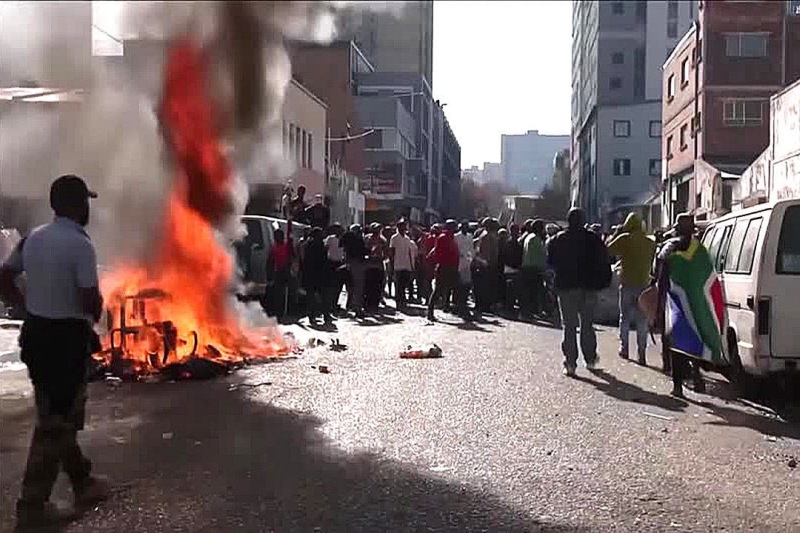

South Africa has sent more than 3,400 soldiers onto its streets to back up police as the South Africa anti-migrant protests spread into a second week.
President Cyril Ramaphosa confirmed the deployment in a letter to the parliamentary speaker, seen by Reuters. He said 3,405 members of the South African National Defence Force began operations on 28 June. The exercise will cost an estimated 54.6 million rand, or roughly $3.37 million.
“Members of the SANDF will be on standby for any eventualities,” Ramaphosa wrote in the letter, which was published by parliament.
Why the soldiers were sent in
The South Africa anti-migrant protests have run since April, when small gatherings by anti-immigrant groups began to grow into nationwide marches. Reuters counted no fewer than 120 separate demonstrations on Tuesday alone, with thousands of participants draped in national flags and some carrying wooden weapons.
Most marches passed off peacefully. Twelve turned violent, according to Reuters, forcing police to step in as the South Africa anti-migrant protests spread to five of the country’s nine provinces overnight.
Soldiers were sent specifically to Hillbrow, an inner-city district of Johannesburg where many migrants live, after shootings left at least one person dead in nearby Alexandra, Zee News reported.
Arrests pass 900
Police have arrested more than 900 people since the unrest intensified, Al Jazeera reported. The charges span immigration violations, public violence, robbery and harbouring undocumented migrants.
At least four deaths had been confirmed by Wednesday morning, Breitbart reported, citing local accounts. One victim, a foreign national in Durban, reportedly fell from the eighth floor of a building after fearing he had been targeted by vigilantes.
Zee News put the overall death toll since the campaign began at five.
A deadline that never had legal force
The South Africa anti-migrant protests built around an unofficial deadline of 30 June, set by vigilante groups for all undocumented migrants to leave the country. Al Jazeera reported that the groups falsely claimed foreigners who stayed past that date would face arrest and deportation.
South Africa’s government rejected the threat. Ramaphosa said on the Monday before the deadline that the right to protest “does not allow people to threaten or intimidate others, or to engage in acts of vandalism or violence,” according to Al Jazeera.
The warning did little to slow the exodus. Thousands of migrants from Malawi, Zimbabwe, Nigeria and other neighbouring states left the country before the deadline, Zee News reported. Ghana, Mozambique, Nigeria and Zimbabwe organised repatriation flights and buses to bring their citizens home.
The BBC reported on 17 June that around 3,500 foreigners had already volunteered to leave.
Xenophobia claims without evidence
Organisers of the South Africa anti-migrant protests argue that foreigners take jobs from South Africans, strain public services and drive up crime. Musa Hlongwa, president of the group United South Africa, told journalists on 24 June that citizens were tired of competing with migrants for hospital beds, school places and jobs, Zee News reported.
Social scientists dispute the claims. Zee News reported that official crime data shows foreign nationals commit only a small share of offences, and that South Africa’s immigrant population sits at roughly 3 million people, close to 4 to 5 per cent of the total population, a modest share by global standards.
South Africa’s unemployment rate remains among the highest in the world, with about a third of working-age adults out of a job. Economists interviewed by Zee News trace the pressure on hospitals and schools mainly to underinvestment and corruption rather than to migration.
Diplomatic fallout spreads
The campaign group behind the South Africa anti-migrant protests, March and March, has distanced itself from the violence. Its leader, Jacinta Ngobese, told reporters in Durban that the group could not be held responsible for the actions of individual protesters, CBC reported.
Ngobese said the marches would continue weekly for the next six months until undocumented migrants are removed “from building to building.”
The South Africa anti-migrant protests have already strained relations between Pretoria and its neighbours. CBC reported that the wave of xenophobic attacks, recurring in the country since 2008, has tarnished South Africa’s post-apartheid reputation as a defender of human rights.
Politicians have also been accused of stoking the South Africa anti-migrant protests ahead of local elections due by November, CBC reported.
For now, the SANDF deployment stands as the clearest sign yet that Pretoria expects the South Africa anti-migrant protests to continue rather than fade.


