



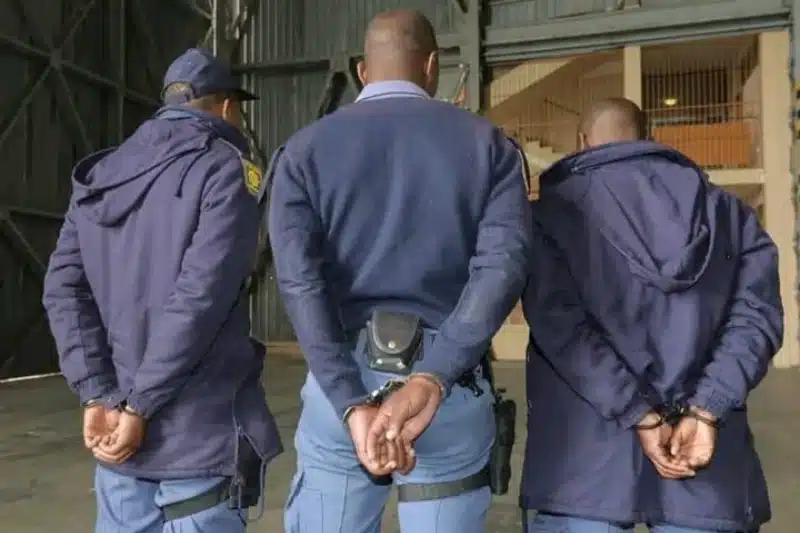

The arrest of 12 senior officers in the South African Police Service has pushed a long simmering crisis into full public view. Framed around what is now widely referred to as the “Dirty Dozen” scandal, the case is not simply about misconduct inside the force. It is about whether organised crime has moved beyond influence and into the operational core of policing itself.
For years, allegations of South Africa police corruption arrests have surfaced in cycles, often followed by commissions, testimony, and slow moving legal processes. What makes this moment different is that enforcement has begun while the system is still under investigation. That shift signals urgency. It also suggests that authorities believe the risks of inaction may now outweigh the risks of acting too early.
The contract that triggered the arrests
At the centre of the case is a R360 million contract awarded to Medicare24, a company tasked with providing health services to police personnel. On the surface, the agreement covered routine needs such as medical assessments, wellness programmes, and injury on duty evaluations. Beneath that surface, prosecutors argue, the process was compromised from the start.
The officers arrested are alleged to have played roles in evaluating and approving the bid, with prosecutors confirming the charges in a statement. According to investigators, key warning signs were ignored and standard procurement safeguards were bypassed. The result was a contract awarded not on merit, but through a process that may have been deliberately steered.
This is where the significance of the South Africa police corruption arrests begins to sharpen. Procurement inside a security institution is not just an administrative function. It shapes capacity, influence, and access. If that process is compromised, the consequences extend far beyond financial loss.
The figure at the centre
Much of the attention has focused on Vusimuzi Matlala, the businessman behind Medicare24. His situation adds a layer of complexity that has elevated the case from corruption to something more serious.
Matlala is currently in custody on separate charges linked to attempted murder. Investigators allege that his business dealings intersect with organised criminal networks and that he may have acted as a bridge between those networks and individuals inside the police.
This connection is central to understanding why the South Africa police corruption arrests are being treated as more than a procurement scandal. If the allegations hold, the issue is no longer about officials taking advantage of a system. It becomes a question of whether external criminal structures have gained influence over that system.
A system already under scrutiny
The arrests do not exist in isolation. They sit within a broader inquiry led by Mbuyiseli Madlanga, whose commission has been examining allegations of corruption and interference within the police.
Testimony emerging from the inquiry has begun to outline a far more troubling internal reality. Senior figures are alleged to have maintained ongoing links with individuals connected to organised crime, raising questions about how far influence may have reached inside the system. Units originally set up to confront criminal networks are said to have been weakened or quietly pushed aside, while whistleblowers describe an environment in which the boundary between enforcement and complicity has steadily eroded.
Within that wider context, attention has also turned to Senzo Mchunu, who was suspended over allegations of political interference, and Shadrack Sibiya, where questions remain about his alleged links to individuals already under investigation. At the same time, Nhlanhla Mkhwanazi has emerged as a key voice describing how deeply criminal networks may have penetrated the system.
Within this context, the South Africa police corruption arrests begin to look less like a starting point and more like the first visible outcome of a much larger process.
Why timing matters
South Africa has seen major anti corruption efforts before, most notably through the Zondo Commission. In that case, years passed between testimony and meaningful legal consequences. By the time prosecutions began, much of the public momentum had faded.
This time, authorities appear to be taking a different approach. Arrests are being made while investigations are still ongoing. The intention is clear. By acting early, prosecutors aim to prevent interference, preserve evidence, and disrupt any networks that may still be operating within the police.
That approach is not without risk. Move too quickly and cases can fall apart under scrutiny. Wait too long, and the very structures under question may keep operating as if nothing has changed.
The decision to move now suggests that the stakes attached to the South Africa police corruption arrests are considered too high for delay.
From corruption to possible capture
There is a deeper question running through the case, one that goes beyond individual guilt or innocence. It concerns the nature of the problem itself.
At its most basic, corruption is about individuals using their positions for personal gain. It tends to be transactional, often contained. What investigators are now looking at feels different, and more embedded.
If organised networks can influence procurement decisions, build ties with senior officers, and quietly shape how investigations are handled, then the problem is no longer just corruption. It starts to look like parts of the institution itself are being bent from within. In that scenario, the system is no longer merely being exploited. It is being reshaped from within.
The South Africa police corruption arrests have brought that possibility into sharper focus than at any point in recent years.
What is at stake
The implications extend beyond the police service itself. South Africa is already dealing with high levels of violent crime and deeply rooted organised networks. In that environment, public confidence in the police is not optional. It is part of what keeps the system functioning.
If that confidence slips further, the effects will not stay contained. Communities may start to pull back from cooperating with investigations, while businesses quietly adjust to higher security risks. And once the idea takes hold that institutions are slipping, it tends to travel fast, shaping both internal stability and how the country is seen from the outside.
Beyond its borders, the case carries weight in quieter ways too. South Africa has long been seen as having relatively stronger institutions than many of its peers. What is emerging now puts that assumption under pressure, and points to vulnerabilities that are likely more widespread than often acknowledged.
The moment ahead
What happens next will determine how this story is ultimately understood. Court proceedings will test the strength of the evidence. The Madlanga Commission will continue to uncover details that may widen the scope of the case. Further arrests remain a possibility.
More important, however, is whether this moment leads to structural change. South Africa has confronted corruption scandals before. What has often been missing is sustained reform that addresses underlying weaknesses rather than individual cases.
The South Africa police corruption arrests have created a rare point of convergence between investigation and enforcement. Whether that convergence produces lasting impact will depend on what follows.
This is not just a story about 12 officers or a single contract. It is a test of whether a system under pressure can correct itself while still functioning.
If the allegations are proven, the case will stand as one of the clearest indications yet that organised crime has moved closer to the centre of state power than many had assumed.
If the system responds effectively, it may mark the beginning of a reversal.
If it does not, the arrests will be remembered not as a turning point, but as a warning that came too late.


