



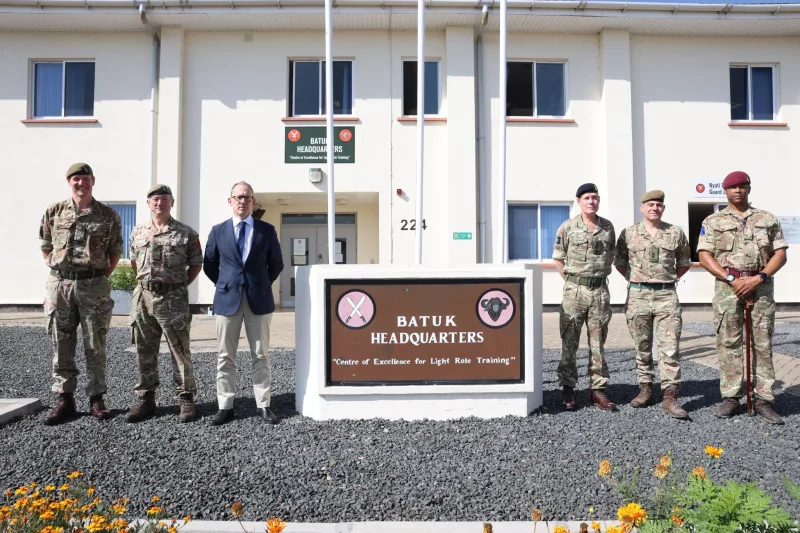

Kenya and Britain have agreed to resume Kenya-UK military training in the East African nation, ending a delay that had put their defence partnership under strain. The announcement came on Tuesday, days after the arrangement was thrown into doubt over an unsigned defence cooperation agreement.
Kenya’s foreign affairs minister, Musalia Mudavadi, confirmed the resumption in a statement reported by the Associated Press. He said the decision followed a partnership “built over decades on mutual respect, constructive engagement, and a shared commitment to peace and security.” Neither government addressed allegations of human rights violations linked to earlier training exercises.
Why Kenya-UK Military Training Was Paused
The pause traces back to 23 July, when the UK Ministry of Defence relocated a planned September training exercise out of Kenya. According to The Standard, the move followed delays in issuing operational licences during the parliamentary renewal process for the new Kenya-UK Defence Cooperation Agreement.
Lawmakers on the National Assembly’s Defence, Intelligence and Foreign Relations Committee had withheld swift approval. The committee’s chairperson, Nelson Koech, said Parliament was not against the cooperation itself. He insisted, however, that accountability over unresolved human rights concerns had to be addressed before confidence in the partnership could be fully restored, The Star reported.
Those concerns are tied in part to the case of Agnes Wanjiru, a 21-year-old woman whose body was found in a septic tank near the British army training ground in Nanyuki in 2012. Witnesses said she had last been seen leaving a bar with British soldiers, and the case has remained a point of public anger in Kenya for over a decade.
Scale of the Defence Partnership
Britain keeps roughly 200 military personnel permanently stationed in Kenya, according to the Associated Press. Through BATUK, the British Army Training Unit Kenya, London trains more than 1,000 Kenyan soldiers each year before their deployment to Somalia, where they help combat al-Shabab, al-Qaida’s East African affiliate.
Dawan Africa reported that BATUK, headquartered in Nanyuki, facilitates exercises for up to 10,000 British soldiers annually, making Kenya one of Britain’s most significant overseas training locations. The terrain closely resembles operational environments British forces may face elsewhere, which is part of why the site matters so much to UK defence planning.
Britain has invested more than 1.1 billion Kenyan shillings, about $9.6 million, into the partnership each year, the Associated Press reported. Dawan Africa also noted that the earlier suspension carried economic weight locally, with hotels, transport operators, food suppliers and casual workers around Nanyuki dependent on business tied to BATUK exercises.
The resumption of Kenya-UK military training restores one of Britain’s most important overseas defence partnerships and allows scheduled exercises to proceed.
Kenyan Officials Push Back on Talk of a Rift
Kenyan authorities had earlier denied local media reports suggesting Britain was weighing a move of some training activities to neighbouring Tanzania. The Standard reported that Mudavadi dismissed claims the Kenya-UK military training partnership had collapsed, stressing that the BATUK arrangement remained active even as the new cooperation agreement sat before Parliament.
Mudavadi’s ministry said the framework “has significantly contributed to capacity building, professional military training, security cooperation and economic opportunities for communities hosting training activities.” He added that Kenya expected an amicable conclusion to the parliamentary process while the existing bilateral defence framework continued.
Partnership With a Longer History
The current framework builds on a defence cooperation agreement first signed in 2021 by then UK Defence Secretary Ben Wallace and Kenya’s then Cabinet Secretary for Defence, Monica Juma, according to a UK government record. That deal was designed to deepen coordination against al-Shabab and expand training exchanges, and it laid the groundwork for the arrangement now being renewed.
Capital FM Kenya reported that Mudavadi described the resumption as proof that longstanding partners can resolve disagreements through dialogue rather than confrontation. He said the renewed Kenya-UK military training would strengthen the operational capabilities of the Kenya Defence Forces while continuing to deliver economic benefits to communities near the training sites.
For now, the immediate crisis appears resolved. But the underlying tension between security cooperation and unresolved accountability questions has not gone away, and it is likely to keep shaping how the Kenya-UK military training relationship is scrutinised going forward.


