



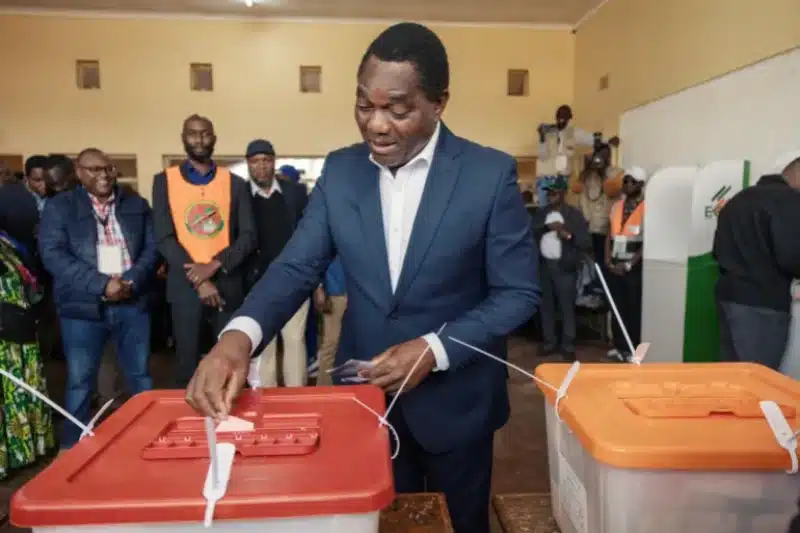

Zambia’s presidential election has been shaken by claims of intimidation, abductions and a six hour halt to vote counting, international observers said on Saturday.
Missions from the European Union and the Southern African Development Community raised the alarm after a tense week at the polls. They urged politicians on all sides to tone down inflammatory language while ballots from Thursday’s vote were still being tallied.
President Hakainde Hichilema, 64, is chasing a second term. His closest rival is Brian Mundubile, 55, a former minister under the previous Patriotic Front government who now leads the National Reconciliation Party for Unity and Prosperity.
The count in Zambia’s presidential election was paused for around six hours on Friday. The Electoral Commission of Zambia said the suspension followed reports of violence against polling staff and the alleged theft of ballot papers in isolated areas.
Officials later said the count resumed once the security threat had been brought under control.
Samuel Tembenu, a former Malawian justice minister who led the SADC observer mission, said the pause had caused uncertainty and anxiety among voters and party agents alike. His team had received, though could not independently verify, reports of intimidation, assault, abduction and property damage in five provinces.
Some submissions to the mission mentioned injuries and at least one death. Such claims, if confirmed, would mark a troubling turn for Zambia’s presidential election.
Police confirmed that nine suspects had been arrested after a 57 year old polling agent was killed in a township outside Lusaka on voting day. Officers maintained that the wider process had generally been peaceful despite the isolated attack.
Reinhold Lopatka, who headed the European Parliament’s observer delegation, described the counting pause as disproportionate. He noted that only a small fraction of Zambia’s more than 13,000 polling stations had reportedly been affected by the unrest that triggered the suspension.
Michael McNamara, the European Union’s chief observer, said the vote had unfolded against a backdrop of constrained democratic space. He pointed to the advantages of incumbency and what he called heavily biased state media coverage during the campaign.
The tension has added a security layer to what was already shaping up as a closely fought race. Zambia’s presidential election is proving unusually close on the numbers so far released.
The Electoral Commission has confirmed results from 49 of the country’s 226 constituencies. Hichilema is polling 438,708 votes against Mundubile’s 351,281, a gap of 87,427.
Turnout across the declared constituencies stood at 55.45 per cent, well below the levels recorded in the previous general election. Election officials said 26,103 ballots were rejected during tallying, out of more than 833,000 votes cast in the areas counted so far.
Commission chairperson Mwangala Zaloumis told reporters in Lusaka that the remaining constituencies were still being processed. She said the commission aimed to finish the count within the constitutional window of 72 hours from the closure of the final polling station.
Zaloumis appealed for calm as officials work through the outstanding results, insisting that no final outcome would be declared until every constituency had reported. That message matters given how fraught this stage of Zambia’s presidential election has become.
Eleven other candidates are also standing in Zambia’s presidential election, among them Given Katuta, the only woman in the race. None has come close to challenging the two frontrunners in the constituencies declared so far.
Zambia’s presidential election is being watched closely across the region as the copper rich southern African nation weighs whether to hand Hichilema a second term or turn to Mundubile’s opposition alliance. Vote counting continues, with the final result expected once all 226 constituencies have reported to the commission in Lusaka.
Also check or more on the Zambia Election


