



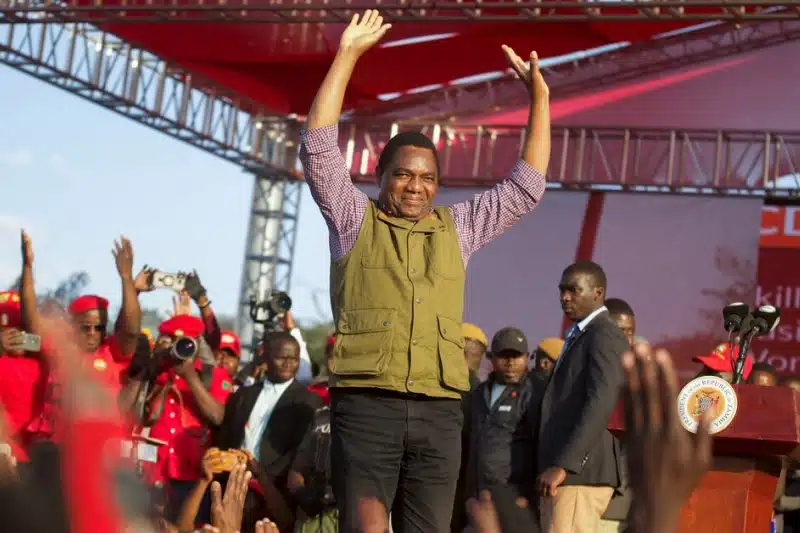

Zambia is heading into an August election that has turned into a referendum on President Hakainde Hichilema’s economic record.
After the 2021 vote that ended Edgar Lungu’s presidency, Hichilema inherited a country reeling from a sovereign debt default, a battered currency and inflation above 20%. Restructuring that debt under the G20 Common Framework became one of the defining tasks of his first term, and the outcome now sits at the heart of Hichilema’s economic record.
Annual inflation slowed to 6.5% in June, its lowest level in more than eight years, a figure Reuters says underscores Zambia’s economic recovery even as many households continue to struggle with the cost of living. The International Monetary Fund projects the economy will grow by 4.3% this year, up from 3.8% in 2025, and foreign investment has picked up as copper prices climb. Copper remains central to the story of Hichilema’s economic record, since Zambia is Africa’s second largest producer of the metal, and its fortunes rise and fall with global demand for it.
Hichilema pointed to this progress at his campaign launch in Lusaka in June, telling supporters, according to Reuters, that families still need support beyond what the government is currently delivering, though he insisted their struggles have been heard.
That admission speaks to a gap between macroeconomic recovery and lived experience. Africanews reports that more than 70% of Zambians still live in poverty, according to World Bank figures, a statistic that opposition leader Brian Mundubile has seized on to challenge Hichilema’s economic record. At a rally last month, Mundubile asked how the government could boast of building $6.5 billion in foreign reserves when, in his words, “your people are going hungry.
Mundubile, who leads the challenge to Hichilema this August, argues that the recovery captured in official statistics has not reached ordinary households. He also accuses the government of narrowing space for dissent, telling Reuters that opposition meetings have been disrupted by police and that dissenting voices are treated as enemies of the state.
Civil society groups have raised similar concerns. A cyber crimes law passed in 2025 has been criticised as vaguely worded, with rights groups warning it could discourage Zambians from speaking freely online. Constitutional changes signed into law in December, which expand the size of parliament, have also drawn scrutiny, with critics arguing the move could favour Hichilema’s ruling United Party for National Development.
Even so, defenders of Hichilema’s economic record argue that recovery from a debt default rarely happens overnight, and that criticism of the pace of change overlooks how deep the 2021 crisis actually was. Hichilema retains clear advantages heading into polling day.
Lee Habasonda, a political science lecturer at the University of Zambia, told Reuters the opposition should not be dismissed despite starting late, though incumbency still counts for a great deal in Zambian politics. Hichilema has access to state resources and aircraft for campaigning, while his rivals must travel by road across a country three times the size of Britain.
Polling carried out by the Zambia Election Research Network late last year, before Mundubile formally launched his campaign, found that 55% of respondents intended to vote for Hichilema and 51% expected the election to be free and fair. Those numbers may have shifted since the opposition began mobilising in earnest.
What ties all of this together is that Hichilema’s economic record has become the single biggest issue of the campaign, eclipsing the ideology and personality battles that shaped past Zambian elections. Voters appear less interested in rhetoric than in whether falling inflation and rising growth figures translate into cheaper food, better wages and steadier jobs before polling day in August.
Hichilema’s economic record over the past five years also includes a sharp decline in inflation, which fell from around 24% to single digits during his first term, alongside improved rankings on Transparency International’s corruption index. Foreign direct investment rose from 1.7% to 4.7% of gross domestic product between 2021 and 2024, according to the Africa Center for Strategic Studies, evidence that investor confidence has returned even if ordinary wages have not kept pace.
For a government that inherited a debt crisis and a collapsing currency in 2021, the turnaround captured in this year’s inflation and growth numbers is real. Yet Hichilema’s economic record will ultimately be judged not by IMF forecasts but by whether ordinary Zambians feel the difference in their pockets, and that verdict rests with voters in August.


