



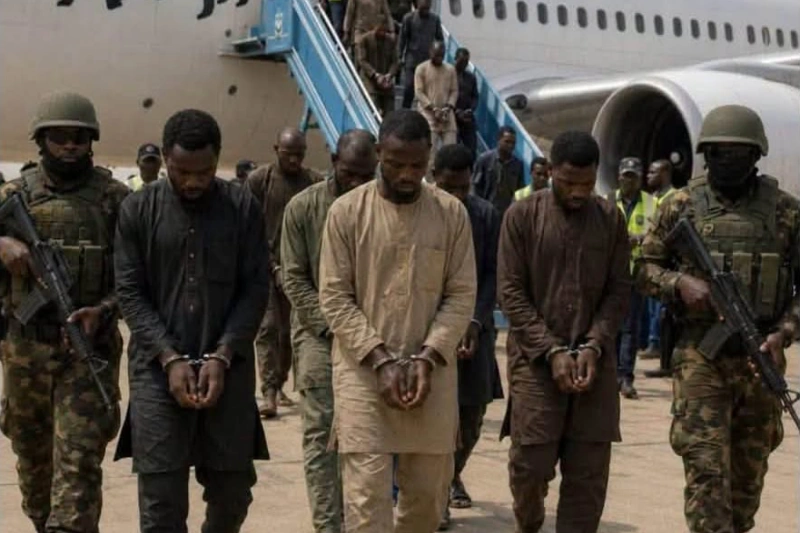

The suspects, described by the Federal Government as commanders linked to Boko Haram and the Islamic State West Africa Province, were pulled aside quietly at the Umaru Musa Yar’Adua International Airport in Katsina as they cleared immigration after the 2026 pilgrimage. Families waiting to welcome relatives home saw no commotion. The men were simply separated from the crowd, placed under armed escort and flown to Abuja, where they were handed to the State Security Service.
Minister of Interior Olubunmi Tunji-Ojo disclosed the arrests days later, shortly after President Bola Tinubu signed the National Identity Management Commission Act 2026 into law at the Presidential Villa. He said the suspects were intercepted the previous Thursday and credited the breakthrough to the integration of the NIMC database with the Nigeria Immigration Service and Interpol’s systems, a reform he said had finally closed loopholes in a previously fractured identity framework.
As of publication, neither the Federal Government nor the SSS has released the identities of the seven men or confirmed any formal charges against them. That silence has done little to quiet public debate over the suspected terrorists returning from Hajj, particularly among Katsina residents who watched the operation unfold at close range.
What has drawn sharper scrutiny is how these suspected terrorists returning from Hajj managed to leave Nigeria at all. According to an investigation published by Premium Times on 22 July, immigration officials confirmed the men travelled on valid Nigerian passports issued in their own names, and had completed every official stage of the Hajj registration process before departure.
That process, the very one the suspected terrorists returning from Hajj passed through without being stopped, begins at state level. Bodies such as the Katsina State Pilgrims Welfare Board register intending pilgrims and forward their details to the National Hajj Commission of Nigeria, known as NAHCON, which sets the annual fare, now between seven and eight million naira, and uploads pilgrim data to Saudi Arabia’s electronic Hajj portal for visa clearance. Biometric data and National Identification Numbers are embedded directly into each applicant’s passport by the Nigeria Immigration Service during enrolment.
NAHCON spokesperson Fatima Usara told Premium Times that her agency does not conduct background checks on individual travellers, insisting that responsibility for screening and manifest compilation, the very safeguard that should have caught these suspected terrorists returning from Hajj, rests with the state welfare boards rather than the federal commission. The Katsina State Pilgrims Welfare Board’s executive director, Yunusa Dankama, declined to explain what safeguards exist at the grassroots level, describing the registration workflow as classified information reserved for registered pilgrims alone.
Immigration sources who spoke to Premium Times anonymously said the suspects had already been flagged and watchlisted by the NIS Integrated Operations Centre in Abuja before their return, and that a directive to intercept them was issued once the intelligence picture matured while they were still in Saudi Arabia. That explanation, however, does not resolve when these suspected terrorists returning from Hajj first came under suspicion, or whether that intelligence existed before they were cleared to travel.
The case has also stirred local controversy in Katsina. Security analyst Bashir Kurfi alleged that some of those arrested may have been beneficiaries of state-facilitated Hajj travel tied to community peace and disarmament initiatives, reportedly worth about ten million naira each. The Katsina State Ministry of Internal Security and Home Affairs rejected the claim outright, with Commissioner Nasir Mu’azu describing it as baseless and politically motivated. Premium Times found no documentary evidence supporting the sponsorship allegation.
Civil society groups in the north have used the case of the suspected terrorists returning from Hajj to press for reform. Abdulrahman Abdullahi of the Coalition of Civil Society Organisations in Katsina State argued that the months-long nature of Hajj logistics makes the absence of early detection hard to justify, while Jamilu Charanchi of the Coalition of Northern Groups called for an independent committee to review the entire pilgrim vetting architecture.
This is not the first time pilgrimage has intersected with counter-terrorism operations in Nigeria. In May 2025, the SSS arrested two wanted kidnap suspects, Yahaya Yakubu and Sani Galadi, at Hajj camps in Abuja and Sokoto before they could travel. In September 2022, Tukur Mamu, who later faced terrorism charges, was intercepted in Cairo while travelling for Umrah. The Katsina case stands apart because, unlike those earlier interceptions, the suspected terrorists returning from Hajj this year were allowed to complete the pilgrimage in full and were only stopped on their way back into the country.
The SSS declined to comment when approached over the timeline of when the suspects first became persons of interest. Until that gap is addressed, the arrest of these suspected terrorists returning from Hajj will keep raising a harder question than how they were caught: how they were allowed to leave.


