



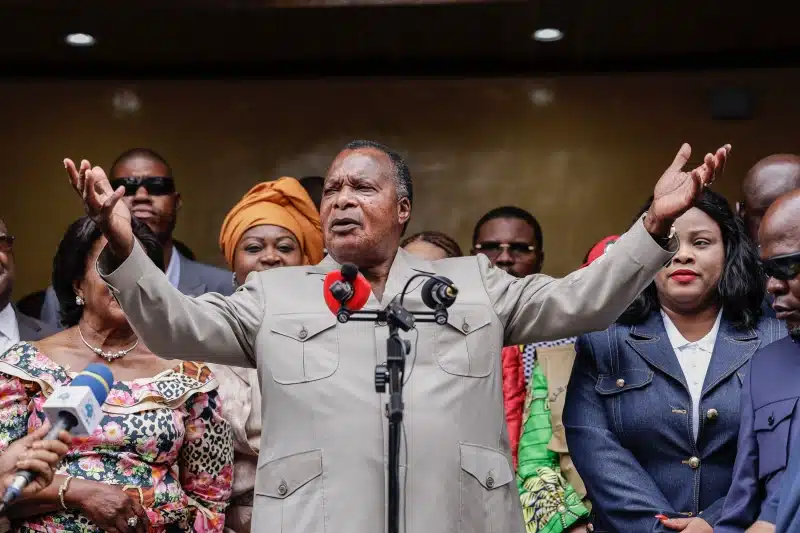

BRAZZAVILLE, Republic of the Congo – Voting concluded on Sunday evening in the Republic of Congo presidential election, with long-serving leader Denis Sassou Nguesso widely expected to retain power and extend a political era that has shaped the oil-producing Central African nation for decades.
Ballot counting began shortly after polling stations closed across the country following the Republic of Congo presidential election, with election officials beginning the collation of results in the capital Brazzaville and other regional centres.
Authorities have not yet released provisional tallies. Initial results are expected within the next 48 to 72 hours, while final confirmation of the presidential vote could take up to two weeks, according to electoral officials and local media reports.
More than 3.2 million registered voters were eligible to participate in the Republic of Congo presidential election.
A Presidency Spanning Four Decades
At 82, Denis Sassou Nguesso is among the world’s longest-serving political leaders.
His influence over the country’s politics spans more than four decades:
-
He first assumed power in 1979 during the country’s Marxist-aligned political era.
-
He lost office during the early 1990s democratic transition.
-
He returned to power following the Republic of the Congo Civil War.
-
He has governed continuously since 1997.
If confirmed by the electoral commission, the latest vote would extend his leadership well beyond 40 years in total, making his presidency one of the longest in modern African politics.
Republic of Congo Presidential Election Marked by Low Turnout and Internet Disruptions
Observers said the Republic of Congo presidential election unfolded in a subdued atmosphere across several major urban centres.
In both Brazzaville and the coastal economic hub Pointe-Noire, polling stations appeared quieter than expected, with analysts citing widespread public scepticism about the competitiveness of the race.
Civil society groups also reported significant internet disruptions during the vote.
Digital monitoring organisation NetBlocks said connectivity across the country dropped sharply during the election period, raising concerns among activists that communication restrictions could limit the reporting of irregularities during the Republic of Congo presidential election.
Authorities in several African countries have historically imposed temporary internet restrictions during elections, arguing that the measures help prevent misinformation and maintain public order.
Fragmented Opposition and Boycott Claims
The political landscape entering the Republic of Congo presidential election heavily favoured the ruling Congolese Labour Party, which has dominated national politics for decades.
Several opposition parties criticised the electoral framework and chose not to participate, arguing that the electoral commission is closely aligned with the government.
Among the candidates who did contest the vote were:
| Candidate | Party / Affiliation | Key Platform |
|---|---|---|
| Denis Sassou Nguesso | Congolese Labour Party (PCT) | Stability, infrastructure development, continuity |
| Mathias Dzon | Patriotic Union for National Reconstruction (UPRN) | Economic reform and fiscal accountability |
| Joseph Kignoumbi Kia Mboungou | La Chaîne | Governance reforms and social services |
Analysts say the opposition’s fragmentation significantly reduced the likelihood of a unified electoral challenge to the incumbent.
Oil Wealth and Economic Reality
The Republic of Congo presidential election is unfolding against a complex economic backdrop.
Although the Republic of the Congo is one of sub-Saharan Africa’s significant oil producers, poverty remains widespread in many communities. International financial institutions have repeatedly noted the gap between the country’s petroleum revenues and the living conditions of large parts of the population.
Infrastructure expansion and oil-funded development projects have remained central themes of government policy, though critics say economic diversification remains a long-term challenge.
Succession Questions Within the Ruling Party
Beyond the immediate election result, discussion about the country’s long-term political leadership has also surfaced in political circles.
Among the figures frequently mentioned in those discussions is Denis Christel Sassou Nguesso, a cabinet minister and the president’s son.
Other senior figures within the ruling Congolese Labour Party also remain influential within the party’s leadership structure.
With ballot counting underway in the Republic of Congo presidential election, electoral authorities are expected to release provisional results in the coming days.
The outcome will determine whether President Denis Sassou Nguesso secures another term in office, extending a presidency that has shaped the country’s political landscape for decades.
Last Updated: 16 March, 2026
Sources and Reporting
This report was compiled using information from election observers, local media reports in Brazzaville, and monitoring data from NetBlocks on internet connectivity during the Republic of Congo presidential election.


