




Across Mali, Burkina Faso and Niger, the military governments now in power have made a deliberate choice. Rather than rebuild police forces from the top down, they have leaned on the people already keeping order in villages and markets.
Sahel security groups, from vigilante patrols to the councils of local chiefs, sit at the centre of a sovereignty project built on cooperation with communities rather than distance from them.
In Burkina Faso, that cooperation has a name and a history. The Koglweogo, a Mooré phrase meaning roughly guardians of the bush, first grew prominent around 2014. Rural communities organised then to stop livestock theft and motorbike robbery. The state noticed, and it acted. From 2019, officials began working with these Sahel security groups directly. That partnership led to the formal creation of the Volunteers for the Defence of the Homeland in January 2020.
President Ibrahim Traoré has treated that force as more than a security tool. Research published in the Journal of Modern African Studies describes how Traoré received wounded VDP fighters in audience at the presidency. He framed the volunteers as the embodiment of ordinary people’s commitment to defend the homeland and wrest back its sovereignty. Recruitment topped 50,000 in a single drive, which the government presented as proof of popular support it could not claim through elections.
That approach echoes an older playbook. Traoré’s policy towards Sahel security groups draws on ideas of endogenous development rooted in grassroots participation, a model associated with Burkina Faso’s 1980s leader Thomas Sankara. The same logic shapes food policy. Ouagadougou has pushed local production drives for rice, maize and vegetables, framing self-sufficiency in farming as part of the same sovereignty story as self-sufficiency in security.
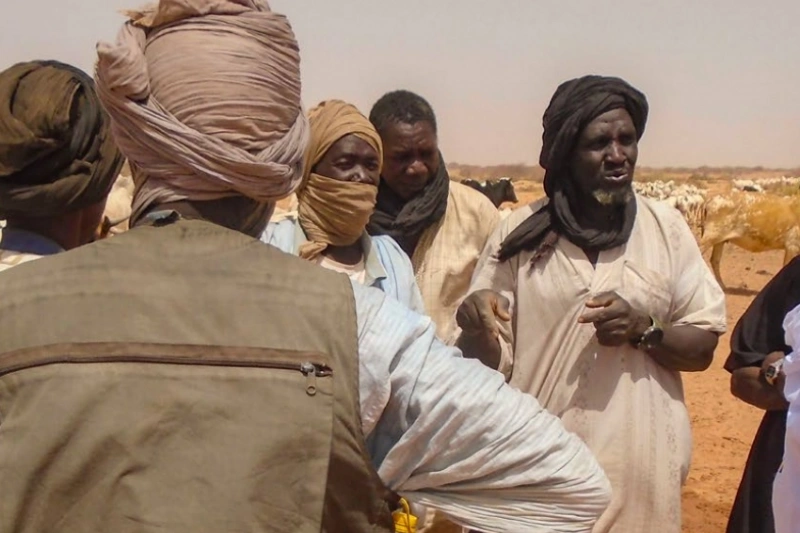
Village chiefs remain woven into this cooperation too. In the Tillabéri and Fada Ngourma regions straddling Niger and Burkina Faso, land chiefs and lineage heads oversee access to grazing land and farmland shared by herders and farmers. Their rulings on everyday disputes complement the patrols that Sahel security groups such as the koglweogo and VDP now run. Together they form a layered system of local authority that state forces alone could not deliver.
That local authority also comes at a cost. Jihadist groups have frequently targeted traditional leaders who remain influential in contested areas. Chiefs who mediate disputes over land, grazing routes and community relations often face threats, extortion or assassination. Where they flee or are killed, armed groups can move in to impose their own courts and taxation systems, weakening the local structures that have long helped communities manage conflict.
This local cooperation among Sahel security groups sits inside a wider regional architecture. Mali, Burkina Faso and Niger signed the Liptako-Gourma Charter in September 2023, forming the Alliance of Sahel States and committing to collective defence. The three countries withdrew from the Economic Community of West African States on 29 January 2025.
They then launched a unified AES military force at a ceremony in Bamako on 20 December 2025. This week, the alliance opened a confederal parliament in Niamey, giving its sovereignty project a legislature to sit alongside its joint force and its village-level defenders.
The sovereignty project has also reshaped domestic politics. Niger dissolved political parties earlier in 2026, while Burkina Faso announced similar restrictions. Supporters argue such measures protect national unity during wartime, while critics contend they concentrate power in military-led governments. The debate reflects a broader question facing the Sahel: how to balance security, sovereignty and political participation during a prolonged insurgency.
The approach is not without strain. Analysts at the International Crisis Group note that self-defence groups, while helping entrench messages around sovereignty and territorial integrity, sometimes operate with limited training and unclear command structures.
Fulani communities in particular have been wary of joining Sahel security groups such as the VDP, fearing that membership exposes them to reprisals from jihadist groups rather than protecting them. Chiefs who mediate disputes in contested villages also face threats and, in some cases, assassination.
Even so, the strategy has reshaped how trade moves. Cross-border commerce between the three countries has continued despite the ECOWAS split. Burkina Faso alone exported close to 130 million US dollars worth of goods to Mali in 2024, according to United Nations trade data. Much of that trade, salt, cement and fuel among it, passes through markets that Sahel security groups now help secure as a matter of state policy rather than accident.
What emerges is a model in which Sahel security groups are not a stopgap but a stated pillar of how these military authorities govern. Chiefs mediate. Vigilante patrols and volunteer fighters secure roads and markets.
Military governors provide the political framework and international alliance that ties the pieces together. Whether that cooperation can survive a widening jihadist insurgency will say as much about the durability of Sahelian sovereignty as any summit in Niamey.


