



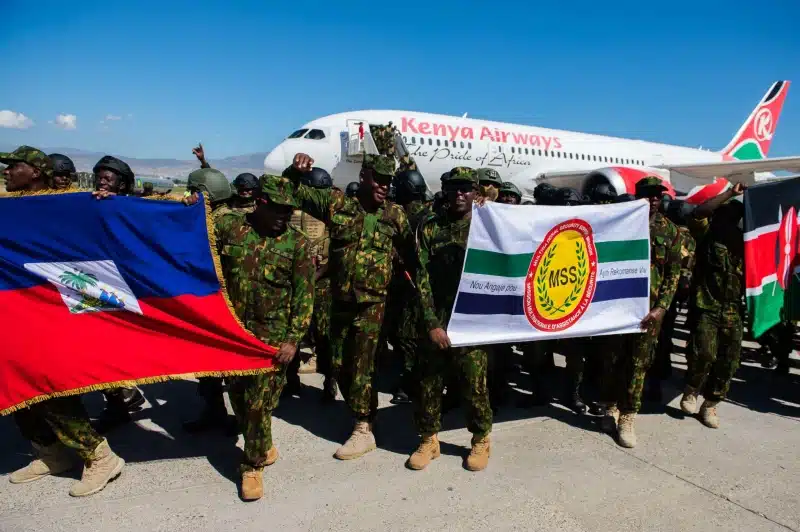

Residents in central Haiti are physically stopping Kenyan officers from leaving, fearing a return to gang terror once the multinational security mission scales back
Across parts of central Haiti, something extraordinary and desperate has been happening in recent weeks. Ordinary civilians have been throwing up roadblocks to stop Kenyan police officers from leaving their communities.
The Haiti Kenyan police withdrawal, which is unfolding as part of a broader transition between two international security missions, has triggered raw fear among populations that have lived through what happens when armed protection disappears.
These are not protesters. They are people who know what comes next.
A Thin Line Between Order and Chaos
The Kenya-led Multinational Security Support (MSS) Mission, which has been operating in Haiti under a United Nations Security Council mandate, has provided what many describe as the only credible deterrent against the Viv Ansanm gang coalition, a powerful alliance that controls large parts of the country including significant areas around the capital, Port-au-Prince.
In the Artibonite region and along the Central Plateau, Kenyan forces have held that line, however imperfectly. The MSS mission, which Kenya leads with contributions from several other countries, has been the primary international security presence on the ground since its deployment began in 2024.
Now that presence is drawing down.
The Haiti Kenyan Police Withdrawal and the Transition at the Heart of the Crisis
The MSS mission is being phased out to make way for a new UN-coordinated structure called the Gang Suppression Force (GSF), which is expected to take a more aggressive posture against armed groups. Planned troop contributions to the GSF include approximately 750 personnel from Chad.
But the handover is not happening smoothly.
A Dangerous Security Gap
According to observers monitoring the situation, the MSS is scaling back faster than the GSF is arriving. That gap, even if it lasts only weeks, is exactly where security collapses begin. This phase of the Haiti Kenyan police withdrawal is where the risks are most acute.
‘We Cannot Afford for You to Leave’
The Haitian National Police, which is the country’s domestic law enforcement body, numbers only around 9,000 active officers for a population of more than 11 million people. That ratio leaves enormous stretches of territory effectively unpoliced, and communities in gang-affected areas know it.
The civilian blockades of Kenyan police vehicles are, in that context, a form of calculated survival strategy. Residents understand the pattern. Security forces leave, gangs move back in, and those seen as having cooperated with authorities face retaliation.
Blocking the road is the only leverage they have.
Pressure and Allegations Behind the Drawdown
The Haiti Kenyan police withdrawal is also being shaped by factors beyond the formal transition timeline. Allegations of misconduct involving some MSS mission personnel have created diplomatic sensitivity for Nairobi. Kenya has faced pressure at home and abroad over aspects of the mission’s conduct, even as it has publicly committed to seeing the mandate through its transition phase.
Those pressures appear to be accelerating a process that humanitarian and security analysts on the ground believe is moving too quickly relative to what the GSF can realistically absorb.
When a State Can No Longer Protect Its Own
What makes the civilian blockades significant beyond their immediate drama is what they reveal about institutional collapse.
When a population physically surrounds foreign security personnel and begs them not to leave, it is a signal that the state itself, its police, its courts, its local governance structures, is no longer seen as capable of providing basic protection.
That breakdown of trust is, in many respects, the deeper crisis that the Haiti Kenyan police withdrawal has exposed rather than caused.
What a Failed Transition Would Mean
If gangs move swiftly into the vacuum left by the MSS drawdown before the GSF establishes a credible presence, the consequences could be severe and fast-moving. Retaliatory attacks against communities that co-operated with Kenyan forces would likely follow. Displacement of civilians from already fragile areas could accelerate. Control of key transit routes and regional centres could shift within days.
Beyond Haiti, the stakes extend further. Kenya’s leadership of the MSS mission has been closely watched across Africa as a model for African-led international security engagement. A chaotic or perceived failed withdrawal could damage confidence in that model and make future deployments harder to assemble and sustain.
For the United Nations, a botched MSS-to-GSF handover would expose serious weaknesses in how international missions plan and execute transitions in active conflict environments.
The People on the Road
None of that strategic calculus is abstract to the people standing in the road in Artibonite.
They have seen the gangs before. They have seen what happens in the hours and days after security forces move out. They are not making a political statement. They are trying to stay alive.
The Haiti Kenyan police withdrawal is, at its core, a story about what it means to be left behind in a collapsing security order. And for the civilians blocking those roads, the question of who will protect them when the Kenyans are gone remains entirely unanswered.


