



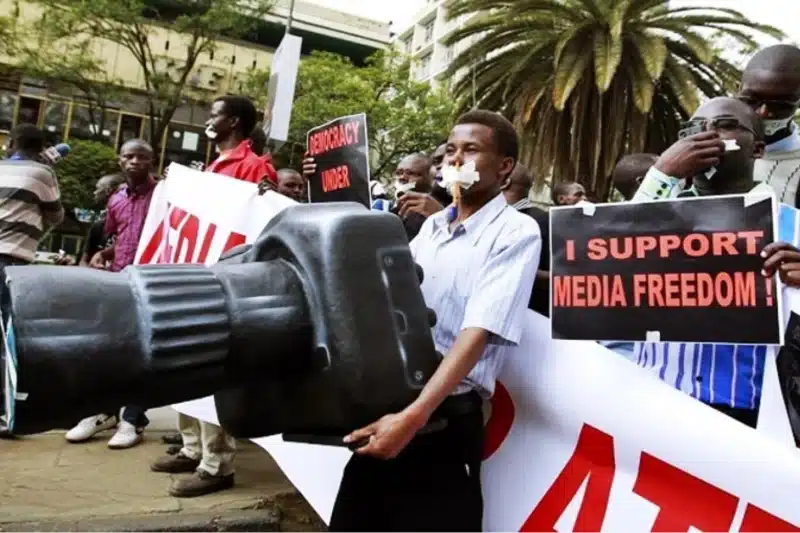

Journalists and media organisations in Côte d’Ivoire held an emergency briefing on Wednesday to warn that Ivory Coast press freedom is deteriorating, pointing to a pattern of government interference in their profession that mirrors a wider regional crackdown.
The alarm comes on a day when West and North Africa’s media communities were already reeling from fresh blows to independent journalism elsewhere on the continent.
A union under siege
At the heart of the Ivorian complaint is what media groups describe as an assault on their own professional structures, a development that now threatens Ivory Coast press freedom.
The government has been attempting to impose a new leadership on the National Union of Ivorian Journalists, known by its French acronym UNJCI, in what reporters have called an “unprecedented” bid to control the country’s main press trade union.
In March, the International Federation of Journalists condemned the move as “blatant interference,” after the Abidjan Public Prosecutor issued a summons to UNJCI president Jean-Claude Coulibaly without clear grounds, according to the IFJ.
The IFJ and the Federation of African Journalists said at the time that the summons constituted “unacceptable pressure and a clear attempt to intimidate the entire journalistic community in Côte d’Ivoire.” Media advocates warned that such actions could have lasting consequences for Ivory Coast press freedom.
“Freedom after expression doesn’t exist”
Ivorian journalists say the problem runs deeper than the union dispute and reflects broader concerns about Ivory Coast press freedom.
“In Ivory Coast, we journalists like to say freedom of expression exists but freedom after expression doesn’t,” veteran editor Cesar Etou of the opposition paper La Voie Originale told AFP.
Etou said his newspaper had faced more than 50 sanctions, including warnings, fines, publication suspensions and summonses.
A government official pushed back, saying: “We do not kill journalists in Ivory Coast. We do not imprison them. It’s normal for them to be questioned as part of legal proceedings, provided they are questioned freely.”
Critics say that framing misses the point. Prolonged interrogations, financial pressure on newsrooms and systematic harassment of editors who cover the opposition amount to a slow erosion of Ivory Coast press freedom, even without formal imprisonment.
The economics of compromise
The financial precarity of Ivorian journalism is making that erosion worse and further weakening Ivory Coast press freedom.
Journalist Noel Yao, the UNJCI’s founder, says reporters make a precarious living as the print media is highly politicised and in decline, with some journalists going unpaid at the end of the month or receiving only partial payments. Journalists rarely receive the salaries they are entitled to under the profession’s collective agreement, which ranges from roughly $480 a month for an editor to $1,000 for an editor-in-chief.
As a result, it has become common for journalists to accept per diems from event organisers, which can skew coverage in the organisers’ favour.
Ivory Coast press freedom has shown some improvement on paper. Reporters Without Borders moved the country up ten places in its 2026 World Press Freedom Index, to 54th out of 180 nations, from 64th the previous year. But the watchdog warns that journalists there still face prosecutorial summons, physical and verbal attacks, and routine newspaper suspensions. These findings continue to fuel debate over the state of Ivory Coast press freedom.
A Beninese journalist caught in the crossfire
The emergency briefing also raised concern over the arrest and extradition of a foreign journalist from Ivorian soil.
Reporters Without Borders has filed a complaint against both Ivory Coast and Benin over the case of Beninese journalist Hugues Comlan Sossoukpe, a critic of former Beninese president Patrice Talon. Sossoukpe was prosecuted in his home country, arrested in Ivory Coast last July and extradited to Benin, despite holding political refugee status in nearby Togo.
Rights groups say the episode signals that Ivory Coast can no longer be treated as a safe haven for journalists fleeing persecution elsewhere in the region.
What happened today in Mali
The Ivorian briefing was called, in part, in response to events unfolding just across the border.
Rights groups on Wednesday condemned the arrests of two prominent Malian journalists within 24 hours, Chahana Takiou, a well-known television presenter and editor-in-chief of the newspaper 22 Septembre, and a second journalist — representing the latest crackdown on freedom of expression by Mali’s military leadership.
Takiou had recently attended a Pan-African Media Forum in Bamako where he said he regretted that a fellow journalist was being tried under a cybercrime law rather than the country’s press laws. That comment was enough to trigger his arrest.
Human Rights Watch senior Sahel researcher Ilaria Allegrozzi said the arrests illustrate precisely the problem Takiou had identified, that authorities are increasingly using cybercrime legislation to punish peaceful criticism and sidestep protections that press laws afford journalists.
The arrests follow the conviction in March of Youssouf Sissoko, editor-in-chief of the weekly L’Alternance. Mali’s National Cybercrime Unit sentenced Sissoko to two years in prison and a fine of one million CFA francs after he published an article that challenged claims made by Niger’s junta leader about an attack on Niamey’s airport.
Mali’s 2019 cybercrime law uses broadly defined offences including alleged threats and insults to restrict free expression.
Tunisia’s parallel crackdown
The same pattern has taken hold in Tunisia.
Tunisia’s government has used Decree-Law 54 on cybercrime as a primary instrument of repression against journalists, bloggers and activists, with its vague prohibition on spreading fake news resulting in convictions and, in one case, a death sentence.
The government targeted independent media outlet Nawaat with financial investigations, summoning more than thirty people and imposing a one-month court suspension in October 2025. Three journalists; Mourad Zeghidi, Borhen Bsaises and Zied el-Heni remain behind bars.
Tunisia’s Decree-Law 54, introduced in 2022, a year after President Kais Saied’s power grab, stands in direct conflict with Decree 115, the country’s pre-existing press law, which prohibits prison sentences for media offences and guarantees press freedom.
A continent-wide trend
The developments in Mali and Tunisia, echoed by the concerns now being voiced over Ivory Coast press freedom, fit a pattern that Reporters Without Borders says is accelerating globally.
The 2026 World Press Freedom Index found that global press freedom is at its lowest level in the Index’s 25-year history, with more than half of the world’s countries now falling into the “difficult” or “very serious” categories. The legal indicator recorded the sharpest decline of any of the five indicators used to assess press freedom.
RSF has documented a clear trend of national security and cybersecurity laws being weaponised against journalists across the African continent, particularly in Sahel states under military rule. Observers fear that Ivory Coast press freedom could face similar pressures if legal protections for journalists are weakened.
For Ivorian journalists, Wednesday’s briefing was a warning that Ivory Coast press freedom is at a critical juncture, with the country risking a slide toward the same destination if current pressures go unchecked.


