




By AfricanQuarters Newsdesk
Civilians in northern and eastern Burkina Faso are increasingly caught between Islamist insurgents and a militarized state response, according to a new report from Human Rights Watch detailing a series of brutal attacks carried out by fighters from the Al Qaeda-linked group Jama’at Nusrat al‑Islam wal‑Muslimin.
The report highlights how the Burkina Faso insurgency is increasingly targeting civilians suspected of cooperating with government forces or militia groups.
The insurgency, which began in 2016, has expanded across Burkina Faso, and has left vast areas outside state control forcing millions from their homes. As the Burkina Faso insurgency spreads across rural regions, ordinary communities are finding themselves trapped between militant reprisals and the government’s expanding militia campaign.
The Shadow of the Siege
In the northern village of Sollé, daily life has become a struggle for survival.
Residents say the village has lived under an effective blockade imposed by militants linked to JNIM for several years, a pattern that has become increasingly common across areas affected by the Burkina Faso insurgency.
Food, fuel, and other basic supplies have steadily disappeared.
On January 29, nine women aged between 29 and 51 left the village to gather firewood after supplies ran out. According to testimony cited by Human Rights Watch, armed fighters intercepted them and forced them to an abandoned settlement outside the village.
There, the women were interrogated about their husbands and sons. The militants suspected that some of their relatives had joined the government-backed militia known as the Volunteers for the Defense of the Homeland.
A senior militant commander eventually ordered the women released the following day, but the warning was stark: they were told to wear veils and never return to the area again or face death.
Human Rights Watch says the episode reflects the growing brutality surrounding the Burkina Faso insurgency, where civilians are frequently accused of aiding one side or the other.
The Massacre at the Market
Two weeks later, violence struck the northern town of Titao.
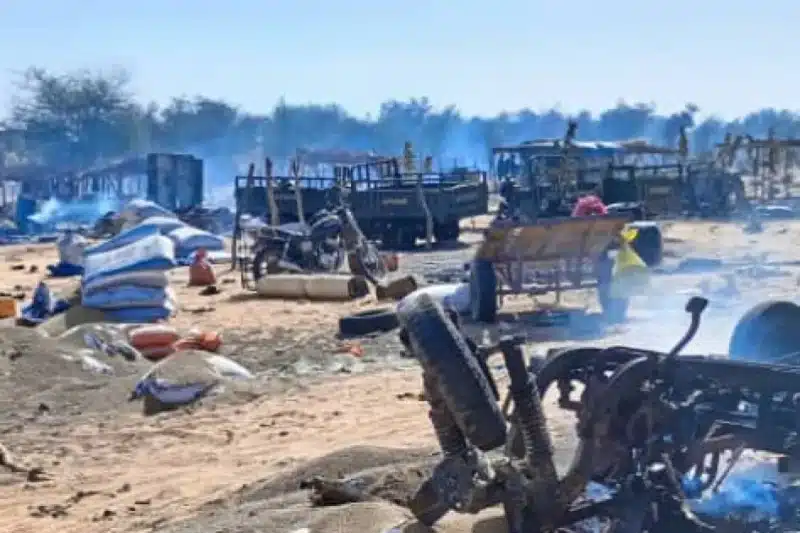
On the morning of February 14, hundreds of fighters linked to JNIM entered the city on motorbikes and pickup trucks.
Witnesses say the militants shouted accusations at residents, warning them against supporting the VDP militia that has become central to the government’s strategy against the Burkina Faso insurgency.
Men were singled out and shot in several parts of the town.
By the time the attackers withdrew, at least 34 civilians were dead. Among them were seven traders from Ghana who had been selling tomatoes in the market, showing broad effect of the conflict on the West African region.
Before leaving, the militants destroyed the town’s telecommunications tower, effectively cutting Titao off from outside contact.
Such attacks, Human Rights Watch says, are part of a broader campaign within the Burkina Faso insurgency aimed at punishing communities believed to support the state.
Targeted Revenge in Manni
Days later, another town experienced a similar pattern of violence.
On February 22, fighters surrounded the market in Manni while trading was underway.
Witnesses say the attackers moved quickly and appeared to have specific targets.
Four shopkeepers aged between 47 and 61 were executed outside their stores, which were then set on fire.
Residents believe the men were targeted because their sons had joined the VDP militia.
A nurse who overheard militants speaking on a radio described the operation as fast and deliberate, suggesting the killings were planned in advance.
For communities caught in the middle of the Burkina Faso insurgency, the message was clear: family ties alone can now make civilians targets.
A Nation Between Two Fires
Human Rights Watch says the incidents highlight a dangerous dynamic emerging in the conflict.
Militants from JNIM increasingly treat civilians suspected of supporting the government as legitimate targets. At the same time, authorities have expanded their reliance on civilian militias to help the army fight the Burkina Faso insurgency.
That strategy, analysts say, has blurred the line between civilians and combatants in many parts of the country.
Since the military seized power in 2022, the government has struggled to regain territory lost to insurgent groups across large sections of the country.
Today, significant areas remain outside effective state authority as the Burkina Faso insurgency continues to reshape the country’s security landscape.
Researcher Ilaria Allegrozzi warned that the violence reflects a growing disregard for the basic rules of war.
For many residents of northern and eastern Burkina Faso, the distinction between civilian and combatant has effectively disappeared.


