




By AfricanQuarters Newsdesk
ABIDJAN – France returns sacred talking drum looted more than a century ago from Ivory Coast, marking an important moment in efforts to repatriate African cultural heritage held in European museums.
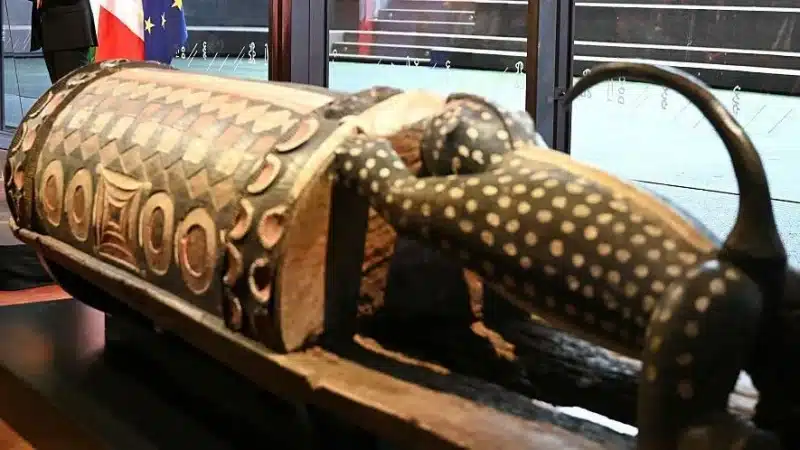
The instrument, known as the Djidji Ayôkwé, according to the Guardian was seized in 1916 during a period of resistance to colonial rule. After decades in France, the drum has now been transferred back to Abidjan, where it is expected to be preserved at the Museum of Civilisations of Côte d’Ivoire.
Officials say the moment carries symbolic weight for a country reclaiming an important piece of its cultural history. The fact that France returns sacred talking drum after more than a century reflects a broader reassessment of colonial-era collections across Europe.
A Drum That Carried Messages Between Villages
Among the Ebrié (Atchan) communities around what is now Abidjan, the Djidji Ayôkwé served a practical role. It allowed messages to travel from one settlement to another across the lagoon region.
Talking drums imitate the tonal structure of spoken language. By adjusting tension on the cords and striking different parts of the drum, experienced drummers could reproduce rhythms that listeners understood as speech.
In earlier times, the instrument relayed urgent information between villages. Messages might warn of approaching danger, announce deaths or ceremonies, or summon communities during periods of tension.
Long before telephones or radio networks appeared in the region, this form of signalling helped communities remain connected across considerable distances.
There is a proverb common among the Igbo of Nigeria and in parts of other West African nations that captures the cultural weight of such instruments:
“It is easy to steal the village drum, but where are you going to beat it?”
The saying reflects a simple truth – cultural objects derive meaning from the communities that created them.
For many observers, the moment France returns sacred talking drum to Ivory Coast echoes that idea.
Taken During Colonial Tensions
Historical records place the drum’s seizure in 1916, during strained relations between French colonial officials and local communities.
Residents in the area were resisting labour demands imposed for road construction projects. Colonial administrators recognised that the talking drum allowed villages to warn one another quickly when patrols were approaching.
Removing the instrument therefore disrupted a communication network that had helped communities organise and share information.
After its confiscation, the drum was eventually transported to France and entered the collection of the Musée du quai Branly – Jacques Chirac in Paris.
More than a century later, France returns sacred talking drum through a formal restitution process.
An Impressive Cultural Artifact
Beyond its historical meaning, the Djidji Ayôkwé is notable for its scale and craftsmanship.
The instrument measures more than three metres in length and weighs several hundred kilograms. Carved from a single piece of wood, it carries decorative motifs associated with Ebrié cultural traditions.
Originally located in the Adjamé area, now a busy district of Abidjan, the drum once served both ceremonial and practical roles within the community.
The Long Road to Repatriation
Momentum for returning African artefacts gained renewed attention after a 2017 speech by French President Emmanuel Macron, who said African heritage should no longer remain “prisoner” in French museums.
Because objects in France’s national collections are legally classified as state property, a special law was required to authorise the drum’s permanent transfer.
Only after that legal step could the agreement proceed that saw France returns sacred talking drum to Ivory Coast.
A Meaningful Return
For members of the Atchan community, the drum’s homecoming carries meaning beyond the object itself.
Community representatives say the instrument symbolises a link to earlier generations who used rhythm and oral communication to preserve history and maintain social ties between villages.
Its return is therefore viewed not only as the recovery of an artefact, but also as a restoration of cultural memory.
Part of a Wider Debate Over Colonial-Era Artefacts
The moment France returns sacred talking drum comes as European museums face growing scrutiny over the origins of many African objects in their collections.
Large numbers of artefacts entered museum holdings during the colonial period. Some were removed during military campaigns, while others were acquired under circumstances shaped by unequal power relations.
Pressure for restitution has increased in recent years. Several governments and institutions have begun returning items taken during colonial expeditions, including the widely discussed Benin Bronzes.
For Ivory Coast, the return of the Djidji Ayôkwé may open the door to future discussions about other artefacts still held abroad.


