



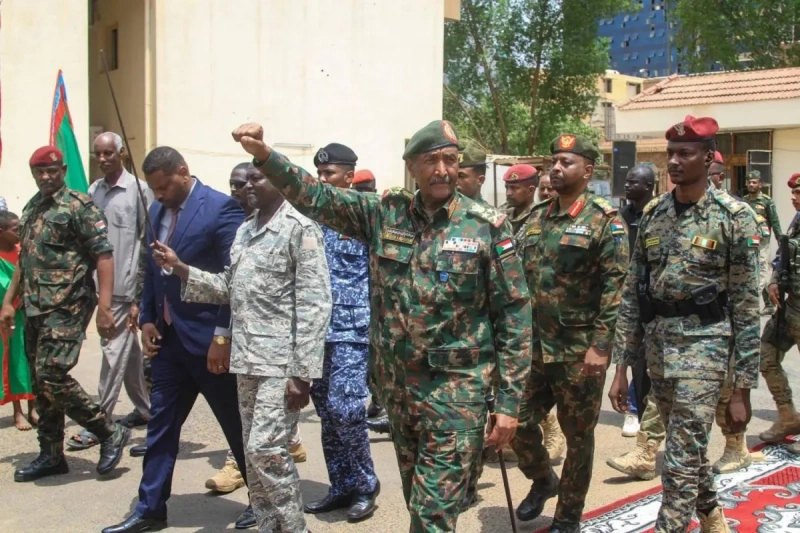

Eleven villages. One week. That is the tally the Sudanese military itself put out on Thursday, and it tells you where this war is heading.
Sudan’s army offensive in North Kordofan has clawed back ground west of El Obeid, with the military announcing on 18 September that it had retaken Kajmar, Sharshar, Al-Bunya al-Kariniya, Al-Qali’at, Awlad Hazma and seven other areas after fighting the Rapid Support Forces, according to a statement carried by Darfur24.
The push continued with combing operations towards Darfur, chasing what the army called RSF “remnants”.
Middle East Monitor placed the gains in a longer arc, noting that the army has been advancing in North Kordofan since late July, when it captured Bara and the areas around Jabrat al-Sheikh and Umm Sayyala.
That earlier breakthrough reopened the export road linking Khartoum to El Obeid, a supply artery that had been choked for months.
The breakthrough also marked a significant phase of Sudan’s army offensive, restoring one of the most important transport corridors linking central Sudan with the western theatre of the war.
The success of Sudan’s army offensive in reopening the route has strengthened military logistics between central Sudan and the Darfur front, where fighting remains intense.
Sudan’s army offensive is not confined to Kordofan.
On the same day the Kordofan gains were announced, Asharq Al-Awsat reported that local authorities in Kurmuk locality, Blue Nile state, said they had repelled an RSF attack on Al-Kaili after the attacking force crossed in from Ethiopian territory.
The army claimed a pre-emptive strike killed a number of RSF fighters and destroyed nine vehicles, although the route the attackers took and the casualty figures could not be independently verified.
Here is where the picture gets murkier, and more revealing.
Sodari, a town along the road linking North Kordofan to Darfur, has become the quiet fulcrum of Sudan’s army offensive.
Whoever holds the roads around it controls how troops and supplies move west, which is why field sources cited by Asharq Al-Awsat described movements towards Al-Farshaya and Al-Dibaybat as more than routine skirmishing.
Blue Nile tells a different kind of story, one written in the sky rather than on the roads.
Since late August, Sudan’s air defences have reported shooting down a string of drones crossing from Ethiopian territory.
Sudan Tribune reported that on 27 August the army intercepted a hostile drone north of Sarkam, the third such interception reported in a matter of days, following two others downed on the Sunday and Monday before it.
The military gave the aircraft no named operator and no confirmed origin, only the direction it came from.
That pattern hardened rather than faded.
On 13 September, Sudan Tribune reported a wave of explosive-laden drones striking Ed Damazin, the Blue Nile state capital, with air defence units engaging a drone over the town of Balang.
Days later, the Eastleigh Voice reported Sudanese air defences intercepting drones aimed at the Upper Atbara and Setit dam complex, alongside separate strikes that killed four people in the same region.
Khartoum has repeatedly accused Ethiopia of hosting training camps and airstrips used against it, an allegation Addis Ababa has denied.
There is a contradiction worth sitting with here.
Sudan’s army offensive is, by its own telling, winning on the ground in Kordofan, road by road and village by village.
Yet the sky over Blue Nile keeps getting more dangerous, not less, with each week bringing a fresh drone claim.
Momentum on one front does not appear to be buying quiet on the other.
Into that contradiction walks General Abdel Fattah al-Burhan, who is due in New York this week to lead Sudan’s delegation to the 81st session of the UN General Assembly.
Sudan’s Foreign Minister, Ambassador Mohieddin Salem, has already travelled ahead of him, according to Sudan Horizon, with meetings lined up with UN humanitarian chief Tom Fletcher and other officials tracking the Sudan file.
Burhan is expected to address the General Debate on 24 September.
The timing places Sudan’s army offensive squarely on the world stage at the very moment it is trying to prove that battlefield gains can translate into diplomatic leverage.
Diplomats will be watching whether Sudan’s army offensive can deliver enough battlefield momentum to support Khartoum’s political objectives beyond the battlefield.
Whether the gains achieved through Sudan’s army offensive can be converted into diplomatic leverage depends on an audience that has heard similar arguments before at previous General Assembly sessions while the war continued unabated.
As Sudan’s army offensive expands across North Kordofan, Burhan has continued to lean on key battlefield allies.
Darfur governor Minni Minawi accompanied him on an inspection of newly secured positions in late July alongside Sudan Shield Forces commander Abu Agla Keikel, according to the Sovereign Council.
Minawi has since pursued a parallel diplomatic campaign, meeting French lawmakers and urging support for efforts to designate the RSF as a terrorist organisation.
None of this settles the war.
It only sharpens the question hanging over Sudan’s army offensive.
Can ground taken village by village outpace a drone campaign that keeps finding new targets?
And can a speech in New York change anything for the people still counting explosions in Ed Damazin tonight?


