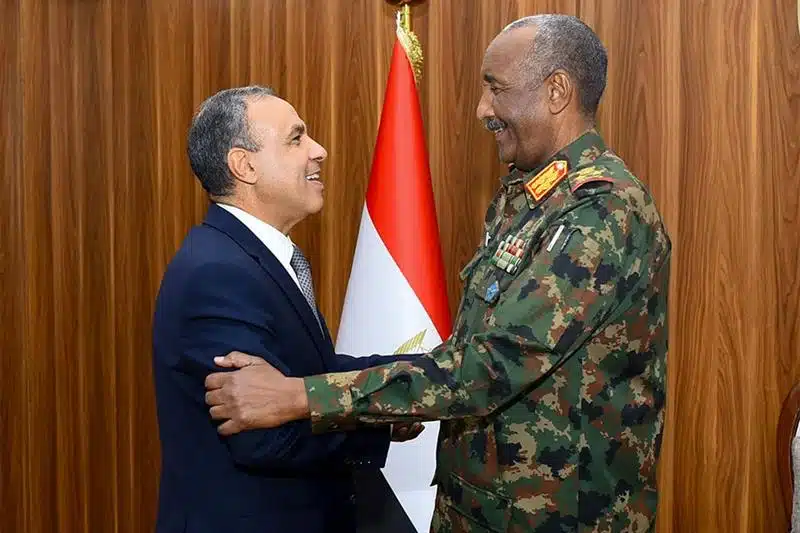
Egypt’s Foreign Minister Badr Abdelatty spoke by phone with his Sudanese counterpart Mohieddin Salem on Monday. Cairo reaffirmed its support for Sudan’s unity, sovereignty and national institutions, according to a statement carried by Egypt Independent.
Abdelatty told Salem that any lasting settlement must follow a Sudanese-led political process. It is a position Cairo has repeated at nearly every high-level exchange between the two countries this year.
The call formed part of what Egypt’s foreign ministry described as ongoing consultation between Cairo and Khartoum. Abdelatty stressed that neighbouring countries must respect Sudan’s sovereignty and security. The remark was widely read as a reference to outside actors accused of fuelling the conflict. He also affirmed that Egyptian firms stand ready to help rebuild Sudan once the fighting ends. He cited decades of Egyptian expertise in post-conflict reconstruction.
Salem praised Cairo’s consistent backing of Sudan’s unity and stability. He briefed Abdelatty on his government’s efforts to manage the country’s mounting challenges. He underlined the importance of keeping close consultation with Egypt in the period ahead. Both nations, he said, share an interest in keeping a Sudanese-led political process on track.
Monday’s exchange builds on a pattern of frequent contact between the two foreign ministries. Sudan’s civil war broke out in April 2023, pitting the Sudanese Armed Forces against the paramilitary Rapid Support Forces. Abdelatty and Salem met in Cairo in February. The Egyptian minister condemned what he called horrific atrocities in Darfur and Khartoum.
He called for an immediate, comprehensive ceasefire. The two ministers met again in June. Abdelatty affirmed Egypt’s rejection of any parallel governing entities in Sudan. It was a pointed reference to Rapid Support Forces efforts to set up a rival administration in areas it controls. Cairo says the move undermines a genuine Sudanese-led political process.
Cairo has positioned itself as one of the most consistent voices insisting that Sudan’s future must be decided by Sudanese actors, not imposed from outside. In February, Abdelatty chaired informal African Union Peace and Security Council consultations on Sudan.
He argued that any settlement must proceed alongside an inclusive Sudanese-led political process. Cairo also called for support for the Quad and better coordination between competing regional tracks.
The Quad groups the United States, Saudi Arabia, Egypt and the United Arab Emirates. It has spent much of the past year pushing a roadmap first floated in September 2025. The plan envisages a three-month humanitarian truce giving way to a permanent ceasefire, followed by a nine-month transition towards civilian rule.
US presidential advisor Massad Boulos said in February that a peace document acceptable to both warring parties had been reached. Cairo welcomed the step, provided it left room for a Sudanese-led political process.
Analysts monitoring the talks caution that deep mistrust between the army and the Rapid Support Forces has kept a durable ceasefire out of reach. Diplomats continue to push for a Sudanese-led political process to take shape alongside any truce.
The war has displaced roughly twelve million people. It has pushed parts of Sudan into famine, according to humanitarian agencies tracking the crisis. The Rapid Support Forces captured El Fasher, the last major army stronghold in Darfur.
The European Union condemned the assault over allegations that civilians were deliberately targeted. It featured prominently in Abdelatty and Salem’s most recent in-person talks in Cairo. Both men said the episode underscored the need for a Sudanese-led political process, not a battlefield resolution.
Egypt hosts more than a million Sudanese nationals who fled the conflict. Consular support for that community has become a recurring theme of talks between the two ministries. Abdelatty has previously directed Egyptian authorities to ease bureaucratic obstacles facing Sudanese missions and citizens. Cairo frames this support as part of a broader commitment to a Sudanese-led political process rather than a settlement dictated by outside powers.
Egyptian backing carries particular weight in Khartoum given Cairo’s historic ties to Sudan. Egypt has hosted successive rounds of dialogue among Sudanese civil and political forces, including a forum that held its first session in July 2024. Egyptian officials have also used recent meetings to reject unilateral measures on shared Nile water resources, tying regional stability to cooperation between the two neighbours.
Whether Monday’s call translates into fresh momentum for peace remains uncertain. Previous rounds of Quad-brokered diplomacy have produced preliminary agreements that failed to hold on the ground. Researchers who follow the negotiations argue that a genuine Sudanese-led political process will only take root once outside backers scale back support to both warring sides.
Until then, Cairo’s calls for a Sudanese-led political process are likely to remain a diplomatic marker rather than a settled fact on the ground. For Abdelatty, Monday’s call was another step in a long campaign to keep that principle at the centre of Sudan diplomacy.