



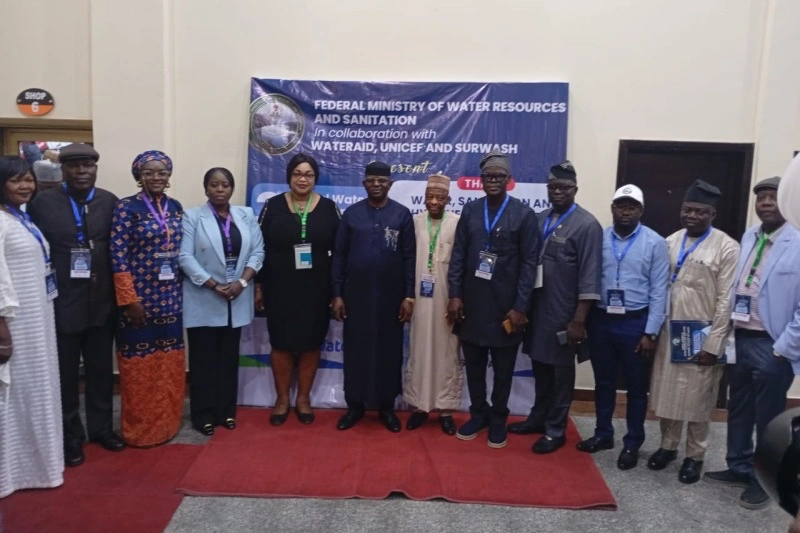

Nigeria’s drive to embed climate-resilient WASH systems into its updated national climate plan dominated discussions at a conference held at Rockview Hotels, Abuja, on Monday, with the Minister of Water Resources and Sanitation, Engr. Prof. Joseph Terlumun Utsev, declaring that the climate crisis is fundamentally a water crisis.
The event, themed Water, Sanitation and Hygiene Systems at the Frontline of Climate Action, brought together government officials, donor agencies and community representatives to align Nigeria’s NDC 3.0 with national adaptation priorities. The conference focused on how Climate-Resilient WASH Systems can strengthen Nigeria’s adaptation strategy.
Utsev told the gathering that Nigeria must strengthen climate-resilient water infrastructure capable of withstanding extreme weather, while expanding climate-smart sanitation solutions that protect public health. He said the federal government would also improve integrated water resources management, strengthen hydrological monitoring and mobilise increased climate finance for WASH adaptation projects.
The minister said community participation and gender inclusion remained central to building climate-resilient WASH systems across the country, noting that floods and droughts already shape how millions of Nigerians access safe water. He also described climate-resilient WASH systems are essential for protecting vulnerable communities from climate shocks.
Kolawole Banwo, Head of Advocacy, Policy and Communications at WaterAid Nigeria, said the organisation was encouraged that more partners had joined the conversation this year, including UNICEF and the World Bank, after WaterAid stood as the sole convening partner with the ministry in the first two editions.
Banwo said deepening climate-resilient WASH systems would require stronger institutions, sustainable financing and reliable data, and called for similar conferences to be replicated at state level so that solutions remain specific to local conditions.
Stakeholders were in agreement that, expanding Climate-Resilient WASH Systems will require sustained investment and policy support.
A goodwill message from UNICEF, delivered by Mr Obinna Ogi on behalf of the agency’s Nigeria country representative, who could not attend because she had travelled to Borno State, linked WASH directly to the country’s third Nationally Determined Contribution. Obinna said integrating WASH into the NDC protects public health, safeguards livelihoods and eases the burden faced by women and girls, who carry the heaviest weight of water scarcity.
A representative of the Centre for Water and Sanitation, NUSAN, told the conference that WASH must be strategically and financially integrated into national climate commitments rather than left in policy silos, and proposed innovative financing mechanisms such as sanitation impact funds to close the sector’s funding gap.
Amudi Chioma Felistas, Desk Officer for NDC and Long-Term Low-Emission Development Strategies and Assistant Director at the National Council on Climate Change, traced how WASH evolved from a sector largely omitted in Nigeria’s earliest climate pledges to one of the seven priority adaptation sectors under NDC 3.0. She outlined four pillars guiding the shift toward climate-resilient WASH systems: resilient infrastructure, health and sanitation, renewable energy integration, and ecosystems and data.
Officials described climate-resilient WASH systems as a key pillar of NDC 3.0 implementation.
Michael Bello of the Department of Water Resources and Environmental Engineering told delegates that Nigeria’s climate pledges have evolved through three stages since 2015, starting with the Intended NDC of 2015 and the second NDC submitted in 2021, before the current NDC 3.0. He said the latest pledge, which carries a foreword from President Bola Ahmed Tinubu describing it as a strategic shift toward ambitious, economy-wide emissions cuts, moves away from a theoretical business-as-usual baseline and instead targets an absolute reduction of 29 percent by 2030 and 32 percent by 2035, both measured against 2018 levels, with a pathway to net zero by 2060.
Bello said NDC 3.0 corrects a gap in the previous pledge by deepening subnational inclusion in climate governance and elevating adaptation from a secondary objective to a core priority that reinforces emissions reduction efforts. He said the plan’s adaptation priorities target drought, flooding, sea level rise, heatwaves and erosion, with northern Nigeria facing desertification and the drying of traditional water bodies, while the central and southern zones contend with flooding, coastal erosion and outbreaks of waterborne diseases including cholera, malaria and typhoid.
He added that the proposed National Water Resources Bill is expected to harmonise legislation supporting climate-resilient WASH systems, alongside coordination led by the Department of Climate Change under the Federal Ministry of Environment and closer integration with the Climate Change and Health National Adaptation Plan. Bello also said postgraduate diploma and master’s programmes in climate and hydrology are being developed to build specialised human capital for the sector.
During the panel session, one discussant called for aggressive deployment of solar-powered, climate-resilient water and irrigation infrastructure, citing research showing desert encroachment from the Sahel advancing at between 0.6 and 1 kilometre annually, affecting about 43 percent of Nigeria’s land mass. The panellist also noted that Nigeria invests just 0.32 percent of GDP in the WASH sector, against an international benchmark of 1.3 percent.
A representative from the Federal Ministry of Finance, Budget and Economic Planning said implementing NDC 3.0 requires substantial funding, with roughly 20 percent expected from domestic sources and 80 percent from international finance, and pointed to the Climate Budget Tagging system now used to track climate-relevant spending across ministries.
A Federal Ministry of Environment official said NDC 3.0 prioritises sectors including power, industry, energy, oil and gas, and WASH, and confirmed that progress would be tracked through Nigeria’s Measurement, Reporting and Verification system, with biennial transparency reports submitted to the UNFCCC.
The Federal Ministry of Agriculture and Food Security highlighted climate-smart practices such as mixed cropping, agroforestry and a farmer soil health card scheme designed to cut indiscriminate fertiliser use, alongside solar-powered irrigation and cold storage projects in Nasarawa and Wukari aimed at reducing post-harvest losses.
In a breakout presentation, Umar Usman Al-Hajib of Yobe State, representing the Northern States working group, said groundwater depletion across the region made aquifer recharge, drip irrigation and watershed catchment management urgent priorities, alongside climate-proof reservoirs and early warning systems for flood-prone communities.
Bello recommended that Nigeria strengthen carbon market activation policies to attract climate finance already flowing to other African countries, alongside tighter regulatory frameworks, regular monitoring and evaluation of WASH projects, and stronger community engagement through non-governmental and civil society organisations. He said advanced flood management systems are also being implemented across Nigeria’s three river basin development authorities as part of wider efforts to revive watersheds and prevent downstream flooding.
Conference organisers said the recommendations from the sessions would feed into ongoing work by the National Technical Working Group on Climate-Resilient WASH Systems as Nigeria finalises implementation plans for NDC 3.0.
Participants agreed that climate-resilient WASH systems should remain central to Nigeria’s long-term climate adaptation plans.


