



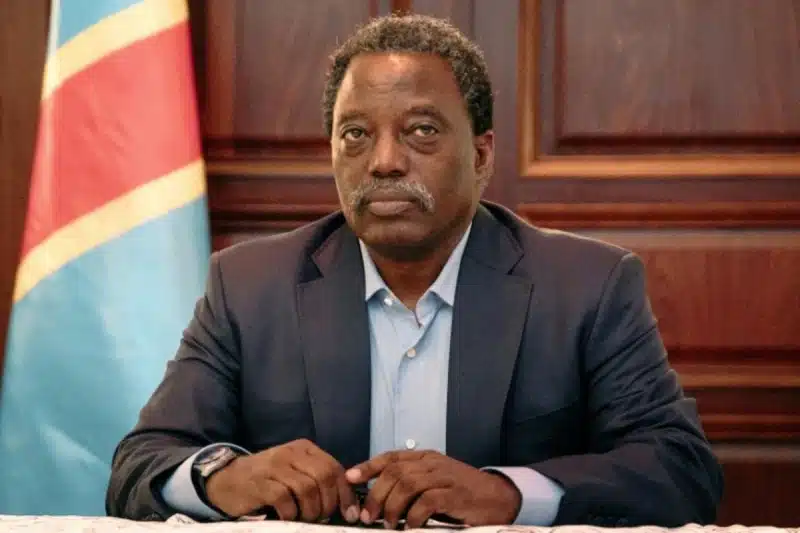

For months, Joseph Kabila denied any link to the M23 rebels. On Monday, he publicly took the lead of a new political-military coalition that brings together the movement’s senior figures.
The new Kabila-led group is called the Front for the Refoundation of the Nation, or FRN. It was unveiled at a press conference at Kabila’s residence in Goma on 12 October 2026, succeeding the Congo River Alliance (AFC), the political-military coalition previously linked to M23.
Adviser Claude Ibalanky announced the leadership line-up. Kabila is president. Corneille Nangaa and Bertrand Bisimwa, who led the AFC and M23 respectively, are vice-presidents. Sultani Makenga, the M23 military commander, becomes chief of general staff. Freddy Kaniki is secretary-general.
The Kabila-led group says it will end what it calls “tyranny” by any means, “including force”.
Reuters reported that Congolese authorities had accused Kabila for months of backing AFC/M23, allegations he had denied.
The road to Monday was long. Kabila ruled Congo from 2001 to 2019. The first M23 uprising began under his government in 2012 and was defeated the following year.
The rebels returned in January 2025 and took Goma. Bukavu followed in February. By late May, Kabila was in Goma himself, just as the Senate voted to lift his immunity.
On 30 September 2025, a military court sentenced him to death in absentia for treason, war crimes and crimes against humanity. Kabila has described the case as political.
The United States imposed sanctions on him on 30 April 2026 for supporting M23 and the Congo River Alliance. Kabila is challenging the listing in a US court and says the allegations are unsubstantiated.
In June, UN experts told the Security Council that sources within AFC/M23 expected a major reshuffle, including a new name and a prominent role for Kabila. Monday’s announcement brought that anticipated restructuring into the open.
The same report offered an explanation for the change. The experts said Kabila’s rising profile appeared intended to obscure Rwanda’s role and present the rebellion as a Congolese movement tackling a Congolese problem. They named James Kabarebe, a senior defence adviser to President Paul Kagame, as the official coordinating with both the rebels and Kabila. Rwanda denies backing the insurgency.
The report also identified a potential fault line within the movement. It said Nangaa and Kabila harboured ambitions to seize power in Kinshasa, while most M23 leaders opposed fighting beyond North and South Kivu.
Makenga now serves as chief of general staff under the new leadership. Whether the commanders will follow a former president towards Kinshasa remains an open question.
Three days before the launch of the Kabila-led group, the former president set the tone himself. In an address shared on social media on 9 October, he said Congo was “in peril”. Reuters reported that he accused the government of corruption, poor governance and military setbacks, and criticised its minerals deal with the United States. He also called for an inclusive national dialogue.
Government spokesman Patrick Muyaya hit back the same day. He called Kabila a “man of the past” and said he had nothing to offer but chaos. Muyaya also pointed to Kabila’s American sanctions, which the US Treasury confirmed in its public listing.
Others in President Félix Tshisekedi’s camp had anticipated announcement of the new Kabila-led group. Peter Kazadi, a member of the president’s UDPS party, predicted on 10 October that Kabila would lead a wing of the rebellion. He said it would change nothing.
The government gave no immediate response to the launch, according to the Associated Press. Yvon Muya, a researcher at the University of Ottawa, told AP that “we will likely witness an escalation on the military front”. He also questioned how the Doha peace process could work under the new circumstances.
The announcement comes at an awkward time for diplomacy. The Congolese government and AFC/M23 agreed a roadmap for the Doha talks in Switzerland in August, according to a joint statement from the Swiss government. UN experts found that ceasefire and withdrawal pledges under the Washington and Doha frameworks had been only partly implemented.
Moïse Nyarugabo framed the launch of the new Kabila-led group as an ultimatum. A former senator, he is described by UN experts as a key member of Kabila’s inner circle. His message to Tshisekedi was that “he must make a choice”. Peace was on offer, he said, and so was war.
For 18 years, Kabila stood at the top of Congo’s state. On Monday, he took the lead of a coalition that includes senior figures from the rebellion and has vowed to end what it calls tyranny. His public role has changed. Whether that change will bring the conflict closer to a political settlement or deepen the fighting remains to be seen.


