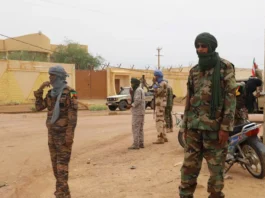
Jihadists and Tuareg separatists have struck General Assimi Goïta’s government at its very heart, launching simultaneous assaults on the capital and three major cities in what analysts are calling an unprecedented Mali coordinated attacks.
AfricanQuarters | 25 April 2026
Bamako Wakes to Gunfire
Two explosions and sustained gunfire rang out shortly before 6am GMT near Kati, Mali’s main military base on the outskirts of the capital Bamako, and shots were still ringing out in the area more than four hours later as army helicopters flew overhead.
This was no isolated skirmish.
Heavy gunfire and explosions rocked Mali’s capital and other key cities in one of the most significant Mali coordinated attacks in years, as armed groups including jihadist insurgents and separatist rebels exploited worsening insecurity in the country.
The streets of Bamako emptied fast. Residents stayed indoors. The sound of helicopters circling overhead mixed with sporadic bursts of heavy weapons fire.
The Airport Under Fire
An AP journalist in Bamako heard sustained heavy weapons and automatic rifle gunfire coming from Modibo Keita International Airport, around 15 kilometres from the city centre, and saw a helicopter patrolling over nearby neighbourhoods. The airport is adjacent to an air base used by Mali’s air force.
A resident living close to the airport told the AP that three helicopters were circling overhead and gunfire was audible from the direction of the military section of the facility. All flights into and out of Bamako were suspended.
The General’s Backyard Hit
Kati, the military town 15 kilometres from Bamako where General Goïta resides, was struck with particular violence.
Two witnesses quoted by Reuters said the house of Defence Minister General Sadio Camara was hit and destroyed. His staff said he was not at home at the time and was safe.
Fighting was ongoing in the neighbourhood of Mamaribougou, as Malian soldiers scrambled to hold their own seat of power.
Embassies Order Shelter in Place
The US Embassy in Bamako issued a security alert citing reports of explosions and gunfire near Kati and the international airport, and urged US citizens to shelter in place and avoid travel there.
Kidal Falls, Gao Shakes
While Bamako burned, the Mali coordinated attacks unfolded simultaneously hundreds of kilometres to the north.
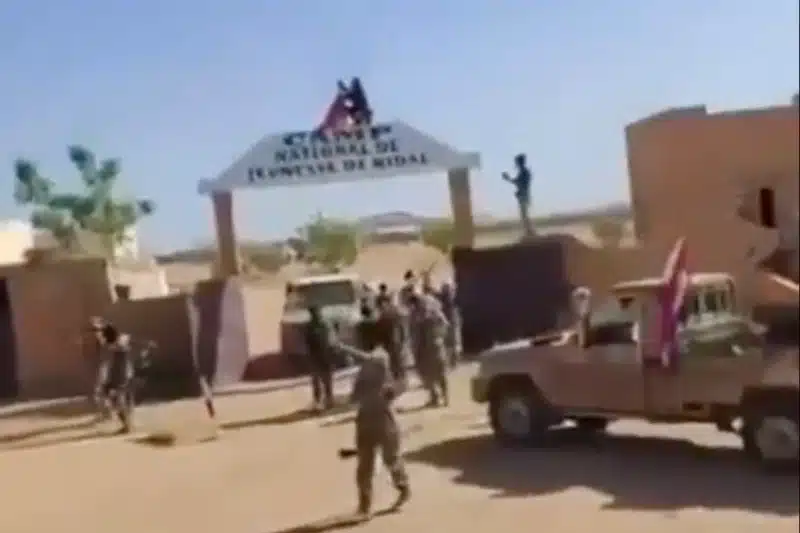
A spokesperson for the Tuareg-led Azawad Liberation Front (FLA) said its forces had taken control of Kidal and some areas in Gao. Al Jazeera could not independently verify the claim.
Yet the evidence on the ground told its own story.
FLA Spokesman Mohamed Elmaouloud Ramadane claimed to have taken control of locations in Kidal and Gao. He later claimed to Agence France-Presse that the FLA had taken control of most of Kidal, with the governor taking refuge in a former MINUSMA camp. According to The Independent, a former Kidal mayor confirmed that gunmen took control of neighbourhoods in the city, leading to clashes with the army.
In Gao, a resident told the Associated Press he was too frightened to give his name. The force of the explosions, he said, was making the doors and windows of his house shake. “I’m scared out of my wits,” he added.
Similar scenes were reported in Sevare, in central Mali, and in Mopti further west.
Two Enemies, One Offensive
The scale of the Mali coordinated attacks pointed to something that had long worried security analysts: cooperation between two groups with very different ideologies but one shared target.
Four security sources told Reuters that al-Qaeda affiliate Jama’at Nusrat al-Islam wal-Muslimin (JNIM) was involved in the attacks and appeared to have coordinated with the FLA. Al Jazeera’s Nicolas Haque, who has extensively reported from Mali, said the scale and coordination of the attacks “appear to be unprecedented”.
JNIM is Mali’s most powerful jihadist group, linked to al-Qaeda and responsible for years of guerrilla warfare and roadside bomb campaigns across the Sahel. The FLA is a Tuareg-led separatist coalition that has long sought an independent northern state called Azawad. On most days, the two groups have little ideologically in common. On Saturday, they fought together.
The FLA also claimed responsibility for the Bamako attacks and called on the authorities of Burkina Faso and Niger to stay out of ongoing events in Mali.
Russia’s Africa Corps Fights Back
Standing between the junta and collapse is the Africa Corps, Russia’s state-controlled successor to the Wagner Group.
Al Jazeera’s Nicolas Haque said witnesses confirmed that Russian mercenaries were fighting in Bamako, around the airport, where they have one of their headquarters.
Their presence, however, may no longer be what it was.
Haque noted that because of pressure on the Russia-Ukraine front, some of these Russian mercenaries were being pulled out, a development analysts believe may have created a window the attackers chose to exploit.
Mali’s junta turned to the Wagner Group, now known as Africa Corps and under the direct control of the Russian defence ministry, to address the country’s worsening insecurity. The UN and others have accused the force of waging a “climate of terror and complete impunity.” Despite those deployments, security across Mali, Burkina Faso and Niger has continued to worsen, analysts say.
A Promise That Has Not Been Kept
The Military came to power on a very specific promise.
Mali’s military government, led by Assimi Goïta, took power after coups in 2020 and 2021, pledging to restore security, but has struggled to do so. The country is battling rebellions by West African affiliates of al-Qaeda and ISIL, as well as the Tuareg-led rebellion in the north.
To tighten its grip, the junta expelled France, its former colonial partner, and in 2023 ended a decade-long United Nations peacekeeping presence. It then turned to Moscow. In July 2025, the junta granted Goïta a five-year presidential term, renewable “as many times as necessary” and without an election.
According to the Global Terrorism Index published this year, the Sahel region remains the epicentre of terrorist activity worldwide and accounted for more than half of all terrorism-related deaths in 2025.
Saturday’s Mali coordinated attacks land squarely within that grim data point.
The Army Claims Control. Few Believe It.
Mali’s army said shortly after 11am GMT that the situation was under control but that “sweeping operations” were ongoing.
The Malian military’s official statement described the attackers simply as “unidentified armed terrorist groups” that had “targeted certain locations and barracks in the capital and the interior.” Soldiers, it said, were engaged in eliminating them.
France 24’s jihadism specialist Wassim Nasr said it was still “too soon to tell” whether the country’s military junta would survive the challenge, a rare note of professional caution from a reporter who has followed Mali closely for years.
What is not in doubt is the scope of what unfolded before dawn on Saturday. In a single morning, the Mali coordinated attacks reached the capital, the defence minister’s home, the country’s only international airport, and three major cities at once. For a junta that has staked its legitimacy on being tougher than those who came before it, the morning of 25 April 2026 is a reckoning that cannot easily be explained away.
Reporting draws on accounts from Reuters, the Associated Press, Al Jazeera, France 24 and NPR. Some claims by armed groups could not be independently verified at the time of publication.