



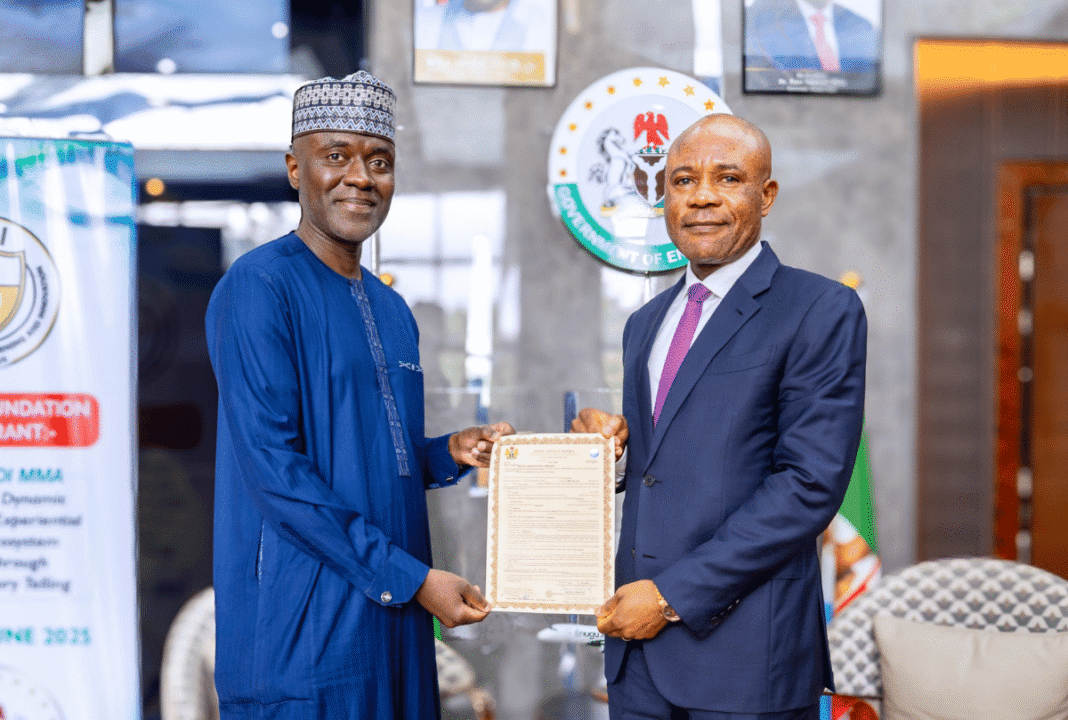

The Enugu Talent City and AI Institute has moved from paperwork to reality. The Nigerian Communications Commission has signed a 15 year lease agreement with the Enugu State Government to make it happen.
The deal was signed on 4 August 2026 at Government House in Enugu. It hands the state control of the NCC‘s Digital Industrial Park and Learning Centre. The site will now become the Enugu Talent City and AI Institute, a hub the state government says will anchor its digital economy push.
Aminu Maida, Executive Vice Chairman and Chief Executive Officer of the NCC, signed on behalf of the commission. He said the arrangement fits the federal government’s Renewed Hope Agenda. It supports the drive to grow Nigeria into a one trillion dollar economy powered by productivity, innovation and private investment.
Maida told officials at the ceremony that the commission is also converting its Digital Bridge Institute into a full AI institute. He said the NCC has been working with teams from Qatar on this. The goal is a continental certification centre for artificial intelligence. Nigeria’s brightest talents should serve global markets from home, he added, rather than emigrate.
The Enugu park is one of six digital industrial centres the NCC has built across Nigeria. These were meant to stimulate regional innovation. Maida noted that active state level management, not federal ownership alone, decides whether such facilities get used properly.
Governor Peter Mbah called the lease central to his digital economy agenda, tying the Enugu Talent City and AI Institute directly to that plan. He said artificial intelligence could add around 20 trillion dollars to the global economy by 2030. Enugu cannot afford to leave its young people out of that shift, he said. The state is also negotiating zero right of way fees for broadband expansion. This would ease the rollout of the National Broadband Alliance for Nigeria across Enugu.
The Enugu Talent City and AI Institute will not start from empty ground. Enugu already has a working digital education base. Much of that credit goes to homegrown edtech founder Alex Onyia.
Onyia is the chief executive of Educare. He has long argued that Enugu produces a disproportionate share of Nigeria’s engineering and learning talent. His platform serves more than a million students and over 300,000 parents across Africa. He has also personally funded Enugu students who represented Nigeria at international competitions, including this year’s STEM Olympiad in Rome.
Onyia has pushed for a dedicated STEM curriculum for Nigerian children. He travelled to Switzerland and the Netherlands to scout partners for the project. The plan covers algorithmic thinking, basic coding and cyber safety from an early age. That groundwork gives the Enugu Talent City and AI Institute a pipeline of learners already familiar with structured tech education.
Onyia has not been uncritical of government led digital schooling. Last year he questioned whether some state backed smart school projects built genuine capability or simply repainted old classrooms. His scepticism sets a useful benchmark. Buildings alone will not deliver an AI hub. The Enugu Talent City and AI Institute will need sustained curriculum investment and proper instructor training to match its ambitions.
For Enugu, the expected returns stretch beyond a renovated building. Officials are pitching the Enugu Talent City and AI Institute as a source of jobs, start up formation and export ready digital services. That positions Enugu as one of Nigeria’s clearer bets in the race to build local AI capacity, ahead of the continent’s wider digital skills gap.


