



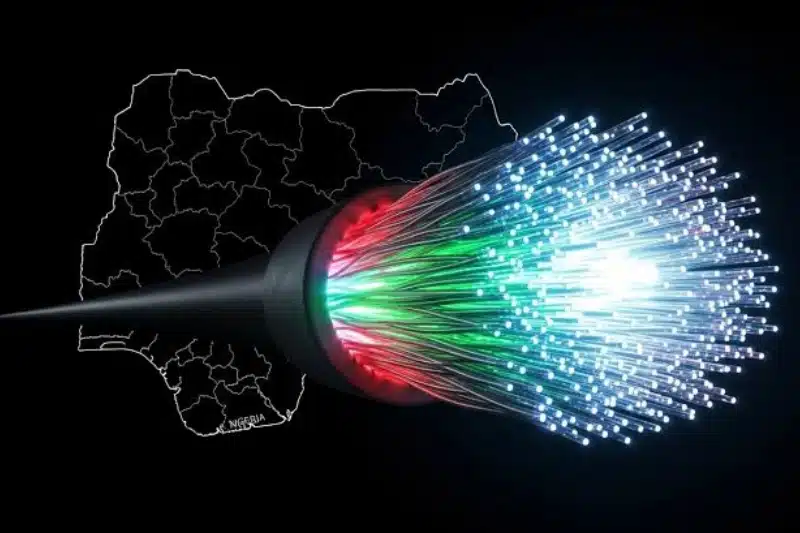

Nigerian infrastructure officials are widening their engagement with the European Bank for Reconstruction and Development. The EBRD Nigeria fibre investment now sits at the heart of that relationship, as Project BRIDGE moves from paperwork into active rollout.
Project BRIDGE, the federal government’s flagship fibre optic scheme, is the clearest expression of this push. It aims to lay 90,000 kilometres of cable across the country, stretching Nigeria’s fibre backbone from roughly 35,000 kilometres to about 125,000 kilometres.
Dr ‘Bosun Tijani, Minister of Communications, Innovation and Digital Economy, confirmed in February that the EBRD board had approved a $100 million investment for the scheme. He announced the approval on his official X account, at the close of a two week tour across six European countries.
Approvals Add Up
The EBRD Nigeria fibre investment builds on a larger financing base already in place. The World Bank Group had committed $500 million to Project BRIDGE under a pay for results agreement signed on 30 December 2025. Funds are only released once specific fibre deployment milestones are met.
The European Union has added weight to the pipeline too. Brussels pledged a €45 million digital economy package for Nigeria, with €22 million earmarked directly for Project BRIDGE, €18 million for digital public services and €5 million for the 3 Million Technical Talent programme.
That scale explains why the EBRD Nigeria fibre investment matters. Officials estimate the full Project BRIDGE rollout will cost around $2 billion. The plan rests on a Special Purpose Vehicle structure, with government holding a minority stake of between 25 and 49 percent, and private investors covering the rest.
A Widening Pipeline
The EBRD Nigeria fibre investment did not arrive in isolation. It followed months of quiet groundwork, and it has since accelerated into something broader.
Nigeria became an EBRD shareholder and country of operations in 2025. Since then, the bank has committed more than €150 million to Nigerian projects, including a $100 million trade finance facility.
That relationship reached a new stage in early July, when Matteo Patrone, EBRD Vice President for Banking, travelled to Lagos to open the bank’s first office in sub-Saharan Africa. Nigeria’s Finance Minister, Taiwo Oyedele, attended the opening alongside him.
Patrone was joined by Heike Harmgart, the EBRD’s Managing Director for Sub-Saharan Africa, and Hamza Al-Assad, the bank’s Country Director for Nigeria. Harmgart told the launch event that the bank was pursuing a demand driven approach, targeting at least $1.5 billion in Nigerian investment over three years.
Al-Assad said the bank was already in advanced talks with most of Nigeria’s Tier 1 and Tier 2 banks, largely around trade finance and senior debt. CNBC Africa reported that the bank’s initial public sector activity in the country centres on fibre optics, a sign that digital infrastructure has become an early priority.
Groundwork Already Underway
Away from the announcements, the technical work behind the EBRD Nigeria fibre investment has already begun.
The Ministry of Communications, Innovation and Digital Economy awarded a contract worth about $335,000 to a consortium led by Bluechip Technologies Limited in February. The firm is providing supply chain advisory services for the first 40,000 kilometres of cable routes.
Separately, the EBRD opened a tender in May for the preparation of low level designs covering that same 40,000 kilometre stretch, listed under EBRD project ID 56618. The exercise is financed through the European Union and run on the bank’s e-procurement portal.
The EBRD Nigeria fibre investment carries a staged disbursement schedule. An initial $6 million is expected this year to help set up the Special Purpose Vehicle. A further $155 million follows in 2027, once the vehicle is running and the first 5,000 kilometres of fibre meet technical standards, with later payments tied to 25,000 kilometre and 65,000 kilometre milestones.
A Regional Launchpad
The country’s position within the EBRD Nigeria fibre investment story extends beyond its own borders. Patrone told CNBC Africa that the bank plans to open further offices in Kenya, Benin, Senegal and Cote d’Ivoire, with Nigeria serving as the anchor market for that expansion.
For a country where more than 33 million people remain offline, the stakes attached to Project BRIDGE are considerable. Authorities project the scheme could raise internet penetration above 70 percent and create more than 20,000 direct jobs, alongside over 150,000 indirect roles, once complete.
The EBRD Nigeria fibre investment now stands as one of the clearest tests of that ambition.


