



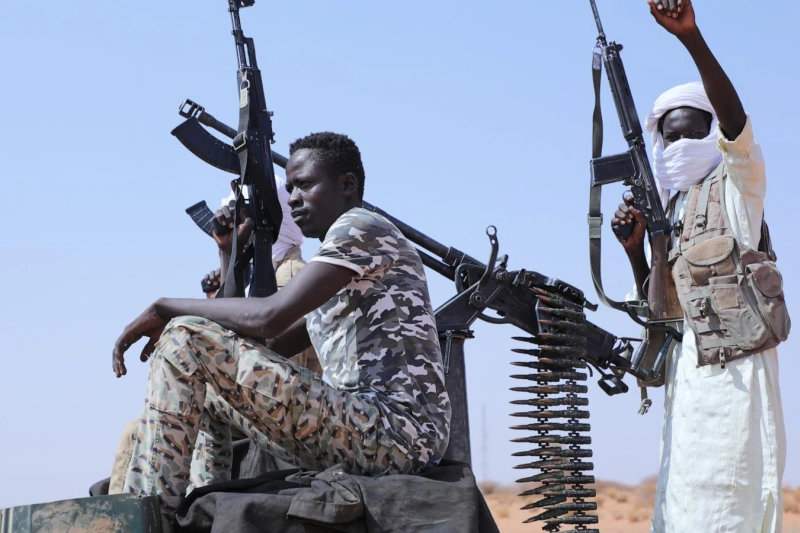

The United States has asked the UN Security Council to widen the Darfur arms embargo to cover the whole of Sudan. The move takes direct aim at the drones and outside funding that have sustained more than three years of war.
US adviser Massad Boulos told the council on Monday that Washington had tabled a draft resolution built around four measures, according to Radio Tamazuj. Top of the list was stretching the Darfur arms embargo beyond its current boundary to reach all Sudanese territory. The draft also seeks to bring drones, drone systems and related technology explicitly under its reach.
Boulos said the measures were meant to reflect the realities of Sudan’s war. He insisted they were not designed to tilt the battlefield toward either side, only to curb the external military support fuelling it. He told the council armed drones had killed more than 1,120 civilians in the first half of 2026 alone. That figure accounts for roughly 80 per cent of recorded civilian deaths in that period.
He pointed to specific attacks to make his case. The Rapid Support Forces had recently killed at least 14 civilians in Um Arda, North Kordofan, and displaced more than 4,000 people. The Sudanese army, meanwhile, had carried out drone strikes across North and South Kordofan in August, including one on Jabra al-Sheikh that killed five civilians.
The Darfur arms embargo has stood since 2005 under Resolution 1591, though it has only ever applied to the western region. It expires on 12 September unless the council agrees fresh terms. Darfur, a region roughly the size of France, has absorbed some of the worst violence of the war. Displacement camps there have been overrun, and mass killings along ethnic lines have been reported repeatedly since fighting broke out.
France backed extending the Darfur arms embargo nationwide. Denmark used the session to pledge a further $15.6 million in humanitarian funding, taking its total contribution since 2023 to roughly $105 million. Danish Foreign Minister Lars Lokke Rasmussen holds the council presidency this month. He called separately for a humanitarian truce and for widening the International Criminal Court’s mandate to cover all of Sudan.
Sudan’s own ambassador to the UN, Al-Harith Idriss, rejected the proposal outright. He argued that broadening the Darfur arms embargo to the whole country would place the national army on the same footing as the RSF. He called it a fundamental rewrite of the sanctions regime rather than a technical fix. As evidence of government progress, he pointed to the voluntary return of 5.8 million displaced people by the end of June.
China urged caution on any move to widen the Darfur arms embargo. Ambassador Li Song said sanctions should encourage peace rather than become an end in themselves. He warned that widening the scope and severity of measures on Sudan could undermine its long term stability and disrupt its economy.
Russia went further still. Ambassador Vassily Nebenzia rejected the push to expand the Darfur arms embargo, describing existing Western measures against Khartoum as a policy of economic strangulation. He accused Washington of drawing a false moral equivalence between an army fighting insurgents and an RSF he said was striking civilians indiscriminately.
Both Russia and China hold a veto on the fifteen member council, meaning either could block the draft outright. Peacebuilding activist Eva Khair told the council separately that outside actors were enabling the catastrophe even while denying involvement. Weapons, mercenaries and financial backing were reaching both the army and the RSF from multiple foreign channels, she said, according to France 24.
The war between the Sudanese Armed Forces and the Rapid Support Forces broke out in April 2023. It has since killed tens of thousands of people and displaced millions more, with famine conditions confirmed in parts of Darfur and Kordofan this year. Whether the Darfur arms embargo is actually extended now depends on that split. Washington wants tighter restrictions, while Moscow and Beijing remain reluctant to move against Khartoum before the current mandate lapses next month.


