



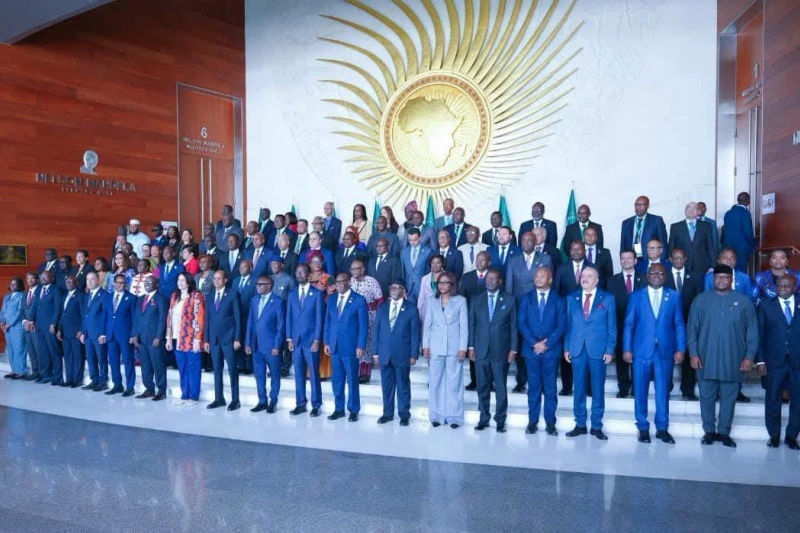

African Union foreign ministers wrapped up two days of talks in Addis Ababa on Wednesday, closing the 49th Ordinary Session of the African Union Executive Council with a set of decisions expected to shape continental policy for the rest of the year.
The session opened on Tuesday at the AU headquarters under the theme “Assuring Sustainable Water Availability and Safe Sanitation Systems to Achieve the Goals of Agenda 2063.” AU Commission Chairperson Mahmoud Ali Youssouf welcomed ministers of foreign affairs, members of the Permanent Representatives’ Committee, AU commissioners and heads of regional economic communities to the opening ceremony, according to the African Union Commission. He congratulated Burundi’s Édouard Bizimana on taking over the Executive Council chairmanship and pledged the commission’s support during his tenure.
Ethiopia’s foreign minister, Gedion Timothewos, told delegates in his opening remarks that the African Union must serve as the institution through which the continent articulates its priorities, noting that eight of the ten fastest growing economies projected for 2026 are African. His address also touched on rail connectivity, value addition to raw materials and the push for visa free travel across the continent.
Foreign ministers and senior officials travelled to the capital from across the continent ahead of the African Union Executive Council opening, among them the foreign ministers of Congo, Mozambique, Seychelles, the Central African Republic, Somalia and Benin, according to allAfrica.
Rwanda’s minister of foreign affairs and international cooperation, Olivier Nduhungirehe, joined the opening session on Tuesday, where ministers deliberated on Agenda 2063 implementation and prepared recommendations for the Assembly of Heads of State and Government, the New Times reported. The Sahrawi Arab Democratic Republic’s foreign minister, Mohamed Yeslem Beissat, also arrived in Addis Ababa to take part in the African Union Executive Council gathering, Sahara Press Service said.
This year’s session sat within the Mid-Year Coordination Meeting framework, a mechanism the bloc set up in 2017 to align the African Union, regional economic communities and member states on implementing Agenda 2063. The arrangement replaced the AU’s traditional June and July summit format.
Beyond water security and sanitation, the two day agenda before the African Union Executive Council covered governance priorities, the ratification and domestication of African Union treaties, and institutional matters referred by the Permanent Representatives’ Committee.
Executive Council sessions typically close with a package of decisions, declarations and resolutions covering budgetary oversight, institutional appointments and policy coordination across AU organs, based on the pattern set at February’s 48th Ordinary Session, where ministers reviewed the union’s financing framework and reinforced commitments to constitutional order and democratic governance.
Recommendations adopted by the African Union Executive Council now pass to the Assembly of Heads of State and Government for further consideration. The Assembly sits at the level of heads of state and typically finalises decisions on institutional appointments, treaty ratification timelines and budget allocations once ministers have completed their groundwork under the Executive Council process.
For African Union member states, the outcomes of this week’s African Union Executive Council session carry practical weight. Water security and sanitation infrastructure remain pressing concerns across the continent, with rapid urbanisation, climate pressures and population growth straining existing systems in several regions.
How the Assembly acts on the Executive Council’s recommendations in the coming months will indicate how much traction the 2026 theme of the year gains within national development plans.


