



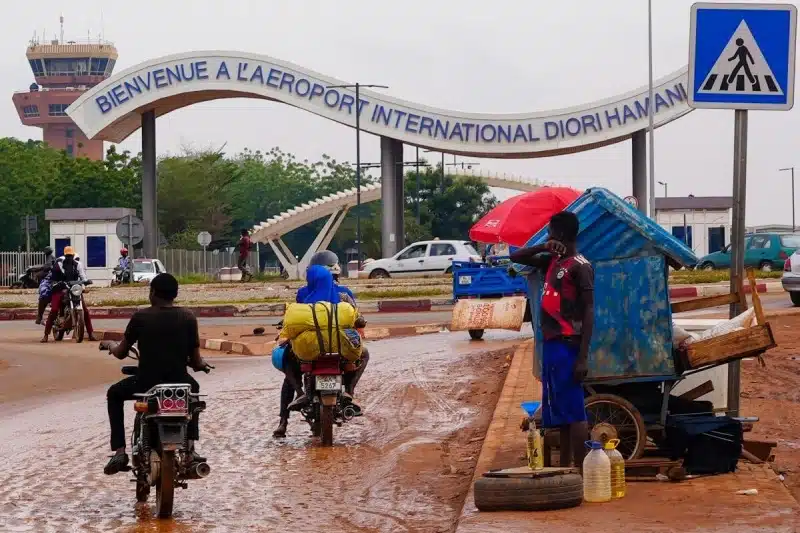

Niger’s military has launched a large-scale manhunt across Niamey after a Niger airport attack on Thursday left 11 soldiers and two civilians dead and exposed fresh security failures at the country’s most sensitive strategic site.
Soldiers in Niamey fought suspected rebels around Diori Hamani International Airport and a military airbase from around 6:00am local time (05:00 GMT). Gunfire rang out for hours. Residents near the facility described sustained shooting before a heavy military deployment moved in.
One airport employee who lives nearby told Al Jazeera he heard heavy exchanges of gunfire and saw a large military deployment as he drove towards work, and decided to turn back for safety.
A resident who spoke to AFP said gunmen had arrived at the security checkpoint by taxi before encountering what an airport source described as fierce resistance from security forces. A motorbike-taxi driver told AFP that locals had also joined in, hunting down fleeing assailants with sticks and machetes.
Niger’s defence ministry confirmed the death toll in a statement read on national television. Security forces killed 22 of the attackers during the fighting. Alongside the 22 attackers killed, four were wounded and about 20 suspects were arrested as a manhunt was launched after the violence settled by mid-morning.
A large-scale operation by the defence and security forces to track down and neutralise the remaining elements is underway,” the ministry said. “Niamey’s Diori Hamani International Airport, which is fully secure, remains open to air traffic.
Niger’s civil aviation agency separately confirmed that normal operations had resumed, though flight tracking site FlightRadar24 reported that many flights bound for Niamey were diverted or delayed.
JNIM claims the assault
By Thursday evening, Jama’at Nusrat al-Islam wal-Muslimin said it had carried out a suicide attack on Diori Hamani International Airport and on a neighbouring military base, in a statement posted on Chirpwire by its propaganda media foundation Az-Zallaqa. The group, widely known by its French acronym JNIM, said the Niger airport attack was aimed at both the airport and the adjoining military base.
The Niger airport attack is the second major assault on the facility within five months. In January, the airport and an adjoining military drone base were targeted in an attack claimed by the Islamic State in the Sahel, with 20 assailants killed and four soldiers wounded in that assault. Nigerien forces and their Russian allies repelled that strike. Security officials said the Niger airport attack on Thursday followed a similar assault in January.
The airport and military airbase sit in the same complex, with the military base positioned opposite the civilian terminal. The site hosts the G5 Sahel counterterrorism force, Russian forces, and the drone unit carrying out strikes against armed groups operating across Niger.
The airport also holds a stockpile of concentrated uranium oxide, which Al Jazeera noted could pose a serious environmental risk if targeted directly. The uranium has been at the centre of a dispute between the junta and French state-affiliated nuclear company Orano since the junta seized the cargo.
Security measures fell short
Hasret Kargin, an analyst at intelligence firm Mintel World, told AFP that the Niger airport attack had exposed the limits of the countermeasures put in place after January. “The fact that the attack once again started in the morning and lasted a long time indicates that the measures taken have not been effective so far,” Kargin said. He added that the ease with which the assailants operated suggested they may have had access to inside information.
Authorities had taken visible steps to harden the site in recent weeks. They tore down thousands of illegally built homes near the airport, a move that displaced 26,000 people living in four surrounding neighbourhoods.
The airport perimeter fence was extended and more than 350 security cameras were installed inside and outside the perimeter. Those measures failed to prevent the Niger airport attack, raising questions about their effectiveness and overall airport security
Niger has been ruled for three years by the military, that has struggled to contain jihadist violence gripping the country for a decade. Both the African Union and the European Union condemned the attack.
Niger’s junta leader Abdourahamane Tiani, who seized power in a 2023 coup, repeated claims through the defence ministry that the assailants were armed mercenaries acting on behalf of France. Paris has consistently denied the accusation.
Analysts at the Bloomsbury Intelligence and Security Institute assessed that additional Islamist militant attacks near the Nigerien capital were likely in the coming months, as JNIM and the Islamic State in the Sahel continue expanding their area of operation.
The Niger airport attack drew condemnation from regional and international bodies, but offered no sign of an end to the jihadist campaign that has now twice struck the heart of the country’s capital within one year. Analysts warn that another Niger airport attack or similar strike near Niamey cannot be ruled out


