



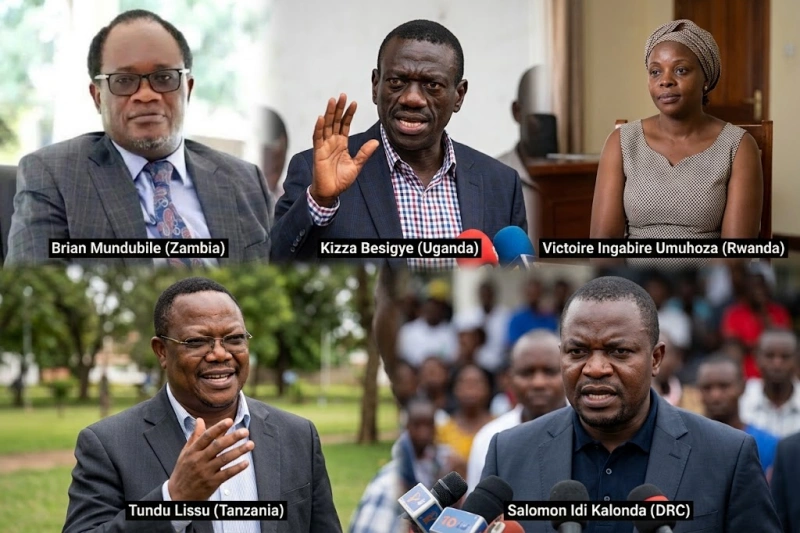

Across East and Southern Africa, a pattern keeps repeating itself. A strong opposition candidate emerges. An election is disputed. Then come the treason charges.
The latest case is unfolding in Zambia right now, where treason charges have once again become central to a post-election political dispute. Brian Mundubile finished second to President Hakainde Hichilema in the 13 August election. An armed raid on his home the following day left a former transport minister, Mutotwe Kafwaya, dead, and he fled to the United Nations mission in Lusaka.
On 24 August, armed police sealed off the High Court, the Supreme Court and the Constitutional Court in Lusaka without any credible explanation, according to Human Rights Watch. It was the last day he could lawfully file a petition against the result. Lawyers trying to lodge his challenge were turned away at the gates.
With that legal route closed, Mundubile surrendered to police on 27 August under pressure from the African Union, the Commonwealth and Human Rights Watch, among others. Three days later, he and his running mate Makebi Zulu were formally hit with treason charges and taken to Lusaka Central Police Station.
They are not alone. The case has widened to eighteen people, including businessman Valden Findlay and Patrick Mwansa, son-in-law of the late President Edgar Lungu.
There is a bitter irony here. Hichilema himself was arrested in 2017 and held for over a hundred days on treason charges. His convoy had allegedly failed to give way to former president Lungu’s motorcade. The man once targeted by the law is now the one presiding over its use.
Uganda offers the clearest long-running example of how treason charges function as a political weapon. Kizza Besigye, a four-time presidential candidate, was seized in Nairobi in November 2024 and brought back to Uganda. He first faced a military court, then a civilian one.
Prosecutors allege he tried to raise dozens of recruits for armed training in Kenya and sought surface-to-air missiles and ricin poison, a claim his lawyers reject as fabricated. He has been denied bail throughout the case.
In July this year he collapsed in the dock after months in detention, according to reporting picked up by the Washington Times. His lead lawyer, Erias Lukwago, was himself arrested on suspicion of failing to report an act of treason. That detail says something about how far the net is being cast.
Robert Kyagulanyi, better known as Bobi Wine, faced similar charges back in 2018 after his convoy in Arua was allegedly stoned. He has spent years under intermittent house arrest since. Critics argue that the repeated use of treason charges against opposition figures has blurred the line between national security and political competition.
Tanzania has taken the pattern furthest towards its logical conclusion, with treason charges becoming central to the state’s confrontation with the opposition Chadema party. Tundu Lissu, chairman of the Chadema party and a survivor of a 2017 assassination attempt, was arrested in April 2025. He had told a rally he would help “stop” that October’s election unless the government agreed to reform it first. He was charged with treason, a capital offence that carries an automatic denial of bail. His party was then barred from contesting the poll altogether.
President Samia Suluhu Hassan went on to win with a reported 98 percent of the vote. Lissu’s trial dragged through five postponements before a High Court panel ruled on 21 August 2026 that he has a case to answer. He must now mount a defence from custody. His co-chairman, Freeman Mbowe, went through a similar ordeal in 2021, spending eight months in detention on terrorism and sabotage charges that were eventually dropped.
The Democratic Republic of Congo shows how quickly treason charges can escalate once a country’s politics turn on the war in its east. In recent years, treason charges have increasingly been used in cases tied to the eastern conflict and the country’s deeply contested political landscape.
Moïse Katumbi’s closest adviser, Salomon Idi Kalonda, was pulled off a plane at Kinshasa airport in May 2023. He was preparing to travel with Katumbi at the time. He was accused of colluding with the Rwandan-backed M23 rebellion, then formally charged with treason that August and tried before a military court. Jean-Marc Kabund, once the interim president of the UDPS, was jailed the previous year for “insulting the head of state” after breaking with the ruling party.
The stakes rose further last year. Kinshasa stripped former president Joseph Kabila of his lifetime immunity, and a military tribunal, according to Al Jazeera, sentenced him to death in absentia for treason, war crimes and support for M23. Kabila has dismissed the case as an instrument of a government “desperately trying to survive.”
Rwanda’s record predates most of these cases and helped establish the template by showing how treason charges and related national security offences can be used against high-profile government critics. Victoire Ingabire tried to run for president in 2010 and was convicted of conspiracy and genocide denial, serving eight years.
Diane Rwigara was barred from the 2017 ballot, then arrested with her mother on forgery and treason-related charges. She spent over a year in detention before an acquittal. Paul Rusesabagina, the hotel manager whose story inspired the film Hotel Rwanda, was lured onto a flight to Kigali in 2020. He was convicted on terrorism charges before international pressure secured his release in 2023.
What links all five countries is the sequence rather than the crime itself. According to the International Center for Transitional Justice, candidates typically face administrative or legal barriers before a vote. Security raids follow once the result is disputed. Treason or terrorism charges usually come last, converting a political argument into a national security emergency. Treason is almost always classed as non-bailable. That means the charge alone can keep a rival off the streets for years, whatever a court eventually decides.
The template is already travelling. In Nigeria last week, a presidential media adviser invoked Rwanda while criticising Afrobeats star Davido, who had spent the August Osun governorship election publicly tracking the electoral commission’s results portal and flagging delays. Speaking on Symfoni TV, he said Davido could not have made the same claims in Rwanda. There, he said, “he will be picked up to come and provide evidence.”
Nigeria has not brought treason charges against a musician for monitoring an election. The presidential media adviser’s comment was framed as a hypothetical, not a real threat. But holding up Rwanda’s record as the standard a critic ought to fear says something about how normalised that record has become.
The recurring shape, a disputed vote, a raid, treason charges, then indefinite detention, is now familiar enough across borders that human rights groups treat it as a governing style rather than a coincidence. Zambia’s own history makes that argument better than any outside observer could. A president who once survived a treason charge is now signing off on one.


