



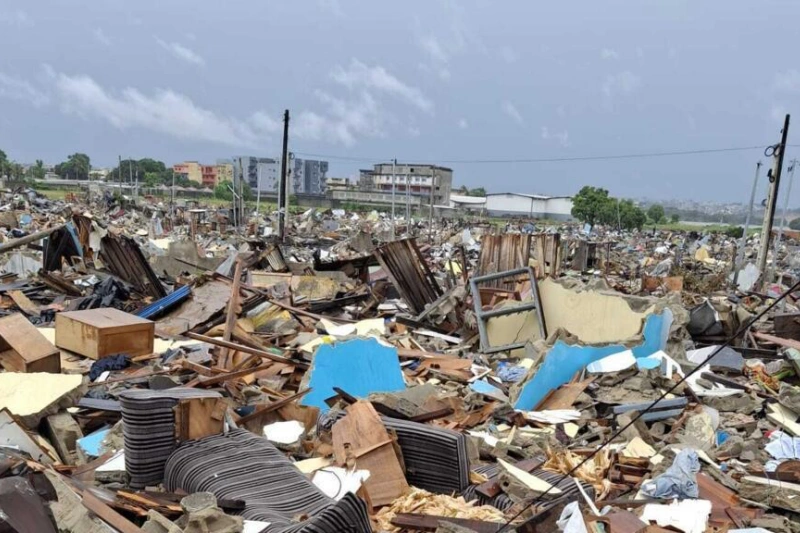

That gap is the heart of the Koumassi demolitions row, and four months on, families are still paying for it. A Linfodrome team counted more than 160 people inside EPP BAD primary school in Abidjan on 21 September.
They have been there since June. Classes restarted on 14 September anyway, with the families still in the buildings.
A week later, school officials and parents told them to be out by 3pm. They refused. “We did not want to stay in a school, but we have no choice,” one woman told Linfodrome. They want cash help or rehousing from the mayor and the government.
Two days after that, the government conceded the point. Spokesman Amadou Coulibaly said after the 23 September cabinet meeting that the families “cannot live alongside the pupils who have resumed classes”. He said homes are being built for those hit by the Koumassi demolitions, but permanent rehousing cannot be settled in a few weeks. He promised interim arrangements.
So how did a ruling for five homes become six hectares of rubble?
As pressure mounted over the scale of the destruction, investigators began examining whether the operation matched the court order that officials initially cited. Its statement on 3 June said the operation enforced a court ruling won by a private businessman, Alloui Brou Jacques. He later posted a video claiming the demolitions and citing that ruling.
The prosecutor’s checks found otherwise. Abidjan prosecutor Oumar Braman Koné told a press conference on 16 September that the businessman had asked the court for both eviction and demolition. The prosecutor said the court “authorised only the eviction of the five homes, without demolition”.
Brou Jacques was arrested on 18 June and remanded in custody on 29 June, after an inquiry opened on 10 June. Prosecutors say he admitted carrying out the demolitions. He is the only person reported to have been remanded over the Koumassi demolitions.
Then the case moved up the ladder. The prosecutor said investigators found a decisive role for the MP for Gouméré-Tabagne, whom he did not name. By his account, the MP supplied “coordination and main funding” for the Koumassi demolitions.
A financial services administrator told investigators he lent the MP 7 million CFA francs in 2024. The prosecutor said the money was meant to pay for clearing people off the plot. Brou Jacques’s eldest son said the MP kept urging his father to record a social media video owning the demolitions.
The MP has not been charged. The process to ask the National Assembly to lift his immunity has begun. No decision had been announced when the new session opened on 1 October. AfricanQuarters found no public response from him.
The District of Abidjan tells a different story about the Koumassi demolitions. Governor Ibrahima Cissé Bacongo told the Court of Appeal’s first president on 24 June that they fell under the ORSEC plan. That is the state’s framework for managing disasters such as lagoon-side flooding. He said the aim was to clear rights of way and irregular structures.
His chief of staff admitted supervising the operation, the prosecutor said. The District’s technical director said he had called in the police.
As RFI reported, the prosecutor says two parties present themselves as behind the destruction, a private individual and the District. Prosecutors are testing whether ORSEC applied to the operation at all. About thirty plots in the area were held in full ownership, and checks continue.
Abidjan has cleared districts before. Amnesty International reported in 2024 on evictions in Gesco, Banco 1, Boribana and Abattoir, citing excessive force, no census of residents and slow rehousing. The ruling party defended the clearances as a way to limit flood damage.
In the Koumassi demolitions, a prosecutor is now openly asking whether the clearance was lawful.
The land records complicate the Koumassi demolitions inquiry. The prosecutor’s checks found 250 plots across seven blocks, covering 6.88 hectares.
Of those plots, only 28 had a definitive concession order. Four held a property transfer certificate, eight had titles in the State’s name and five had subdivision files in progress. The remaining 205 had no land title.
Missing paperwork may explain why the land is disputed. It does not explain the Koumassi demolitions. The ruling the businessman cited did not authorise them, and whether ORSEC did is still an open question.
RFI reported on 22 September that the Collective of Victims of Koumassi Campement estimates more than 3,800 families were hit by the Koumassi demolitions. The prosecutor’s figures count plots, not households, so the two numbers do not line up yet.
Its president, Didier Kouamé Konan, told RFI that “no owner, no tenant, was notified of an eviction”. He also questions how title deeds were issued on a site now described as a risk zone.
He wants the site unsealed. The land is under judicial seal while the inquiry runs. Some families, he said, would build makeshift shelters on their old plots if they could get in.
A court allowed five homes to be emptied. Four months on, it is a classroom being emptied, and no permanent home has yet been named for the people inside.


