




For years, the men who financed Côte d’Ivoire’s illegal gold pits stayed several steps removed from the mud, the mercury and the police raids. On Wednesday, that distance closed.
Meeting at the presidential palace in Abidjan, the Council of Ministers adopted a bill that rewrites large sections of the country’s penal code. The headline change targets illegal gold mining in Côte d’Ivoire directly, but not in the way earlier crackdowns did. This time, the law reaches past the men digging in the bush and targets the financiers, the fences and the site owners who profit without ever touching a shovel.
Government spokesman Amadou Coulibaly laid out the shift after the meeting. New standalone offences will punish sponsors, buyers of illicit gold and complicit site owners, he said, while penalties can now be stacked rather than served concurrently. Where a public official is the offender, the maximum sentence rises to twenty years in prison.
That last detail may prove the most significant part of the reform. Illegal gold mining in Côte d’Ivoire has never lacked for manpower willing to dig. What it has lacked, according to years of complaints from artisanal miners’ groups and opposition figures, is a system capable of holding powerful beneficiaries accountable. The new bill seeks to close that gap by creating offences that can be applied to public officials accused of facilitating, protecting or profiting from illegal mining operations.
The numbers explain the urgency. Illegal gold mining in Côte d’Ivoire has evolved into one of the country’s most costly criminal economies, draining tax revenue and weakening state oversight of mining regions.
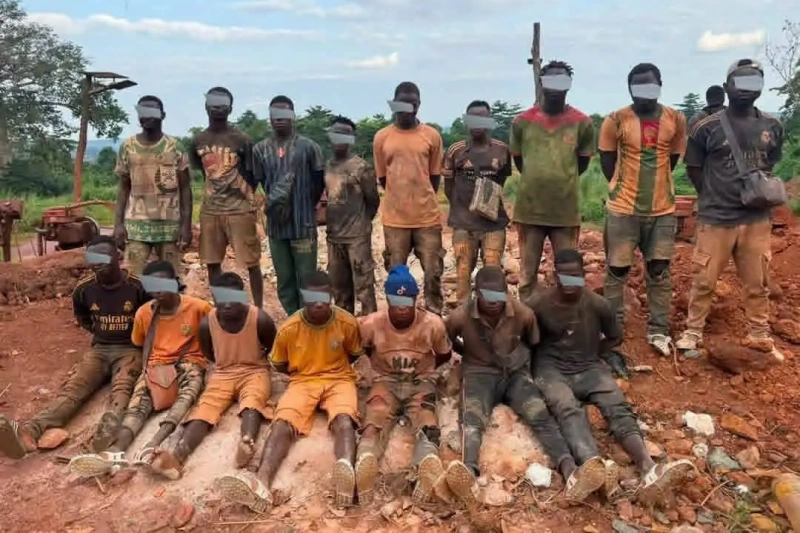
At a National Security Council session in July, the government’s special task force reported that more than 8,500 illegal sites had been dismantled since 2021, with 4,474 people referred for prosecution and around 136 kilograms of gold seized. Despite that record, the council still described the situation as highly concerning.
Mining ministry figures presented at the same session estimated that 142 tonnes of gold linked to illegal gold mining in Côte d’Ivoire leave the country through illegal channels every year, more than double the 59 tonnes Côte d’Ivoire legally exported in 2024.
The ministry estimated the resulting loss in tax revenue at roughly 744 billion CFA francs annually.
That contrast, thousands of arrests against a still-expanding shadow economy, helps explain why the government announced a six-month moratorium on new semi-industrial and artisanal mining permits on 17 September, alongside the deployment of 21 new river patrol units. Industrial mining permits were left untouched.
Wednesday’s penal code reform is the next step in the same sequence, aimed squarely at the financing layer that survived every previous raid. Authorities argue that illegal gold mining in Côte d’Ivoire cannot be reduced unless those financing operations face meaningful prison terms.
The bill also criminalises a quieter form of interference. Coulibaly described cases in which village chiefs refused to allow illegal miners onto their land, only to face pressure and threats of removal from local power brokers acting on the miners’ behalf. Anyone using influence to force a village chief’s hand will now fall under the law, he said.
Public officials face particularly severe penalties because, in the government’s view, they carry a greater responsibility to uphold the law. That is one reason punishments linked to illegal gold mining in Côte d’Ivoire are significantly harsher when public office is involved.
Whether the legislation changes realities on the ground is a separate question from whether it was adopted. Ivorian mining laws have been tightened several times since 2019, yet illegal gold mining in Côte d’Ivoire has continued to spread. According to mining ministry figures, the activity is now present in 29 of the country’s 31 regions. The Hambol region alone accounts for 45 known illegal sites.
A law that finally targets financiers and potentially complicit officials is only as strong as the willingness to prosecute people with influence. Previous enforcement campaigns succeeded in closing sites and making arrests, but they did not stop the wider expansion of the trade.
The bill must still pass through the National Assembly before taking effect, and nothing in Wednesday’s communiqué identifies any official who could face charges under the new provisions. Supporters say the legislation could become a turning point in the fight against illegal gold mining in Côte d’Ivoire, provided enforcement reaches beyond low-level operators. Côte d’Ivoire has written itself a sharper law. Whether it uses it on the people closest to power is the test that comes next.


