



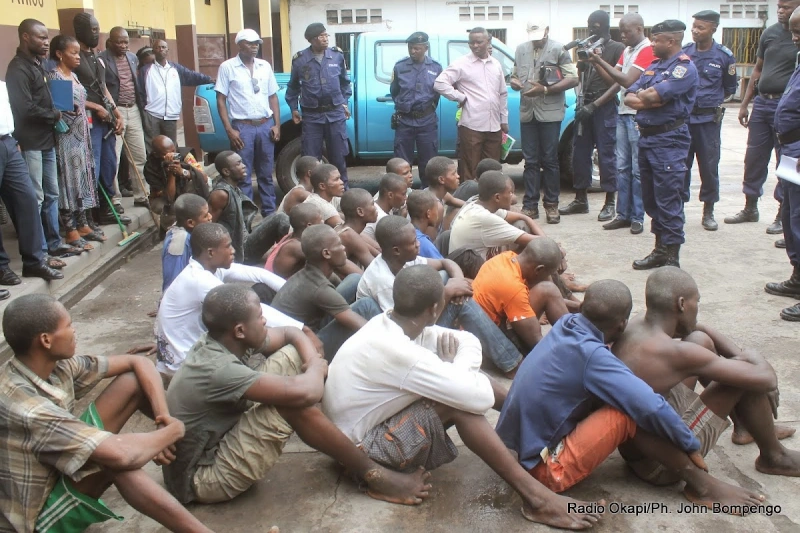

Julienne has not stopped waiting. For almost a year she has had no news of her son. No address to write to. No name of the place where he might be held.
She is one of hundreds of Congolese mothers caught in the fallout of Operation Zero Kuluna. It is the presidential guard’s crackdown on urban gangs. A leading rights group now says it has swallowed more than five hundred young lives without trace.
The Congolese Observatory for Human Rights, known locally as the OCDH, released a report on Tuesday. It documents 561 alleged disappearances linked to Operation Zero Kuluna since the campaign began a year ago. The figure was gathered from family testimonies across four cities: Brazzaville, Pointe-Noire, Dolisie and Nkayi, according to findings reported by RFI.
President Denis Sassou Nguesso handed Operation Zero Kuluna to the Direction Générale de la Sécurité Présidentielle. This is the elite unit that guards him and his family, not the ordinary police. That single decision sits at the centre of what the OCDH is now challenging.
Dieudonné’s account, gathered as part of the OCDH investigation, is one of hundreds like it. He was woken at night by gunfire inside his own house.
“The guns were going off through the whole house, crack, crack, crack,” he said. “That is when I put the light on and saw men in balaclavas. I asked what was happening, and they told me they were from the DGSP.”
His son was nineteen and due to sit his school leaving exams. He was seized under Operation Zero Kuluna that night and has not been seen since 22 April.
“They took him outside. There were other boys tied up like slaves,” Dieudonné recalled.
He is still asking the same question nearly a year on.
“We want these children handed to the courts, so a proper investigation can establish what they are accused of. Only then will we have peace, because this situation is destroying us.”
Julienne’s son was taken the same way, and she says he was not alone.
“I do nothing but cry, because I do not know what has happened to him, whether he is dead or alive,” she told the OCDH.
“Tell us the truth, tell us where our children are. There were at least three boys taken that night. All of them are gone.”
Operation Zero Kuluna began in September last year. Sassou Nguesso ordered it after years of street violence blamed on gangs known locally as kuluna, or bébés noirs.
The gangs trace back to around 2010, when young men displaced by conflict in neighbouring Democratic Republic of Congo settled in Brazzaville’s poorer districts.
Some turned to robbery and drug dealing, while videos of street fights spread online and fuelled public anxiety.
Ordinary police were seen as compromised, so the president turned to his own guard instead. Within weeks, human rights groups were reporting a different kind of violence. At least ten people were killed without trial in late September 2025 alone, according to the Global State of Democracy tracker.
By March this year, a second Congolese rights body had reached a similar conclusion. The Centre for Development Action, or CAD, documented at least two hundred extrajudicial killings under Operation Zero Kuluna.
CAD set out its evidence in a June report covering September 2025 to April this year. Most victims were aged between eighteen and thirty-five. One mother told researchers she heard gunfire moments after her son’s arrest and believed he had been shot dead in the street.
The authorities have not treated Operation Zero Kuluna as a secret. Sassou Nguesso confirmed in October 2025 that he had personally authorised the DGSP to act. He called it a permanent mechanism for restoring calm, not a temporary sweep.
Government officials have repeatedly argued that the operation was necessary to tackle violent gangs that had overwhelmed parts of Brazzaville and other urban centres, describing it as a security response to years of public complaints about robberies and street attacks.
He went on to win a fifth term in March 2026 with more than ninety-four per cent of the vote, extending four decades in power. The operation continued through the election and beyond it.
Families were also pressed to help identify suspects under Operation Zero Kuluna. Mobile users in Brazzaville received text messages offering rewards of up to a million CFA francs, roughly seventeen hundred US dollars.
The messages went out through MTN Congo, the country’s largest network, for tips leading to arrests. Homes belonging to relatives of suspected gang members were also torn down, according to rights researchers tracking the campaign.
Some residents have welcomed the toughness of Operation Zero Kuluna. Online videos show crowds cheering as DGSP patrols escort suspects away after years of theft and street assaults.
That public backing has made it harder for critics of Operation Zero Kuluna to gain traction. Two of the country’s most prominent rights defenders, including the OCDH’s own director, faced online intimidation after speaking out last October.
None of that changes what the DGSP still has to explain, the OCDH argues.
Parfait Moukoko, chairman of its board, put the demand plainly.
“We recognise the legitimacy of the fight against crime, but this country has laws,” he said.
This country wants to be governed by the rule of law. This country has institutions and competent services. Why hand the fight against crime to a unit whose only job is to protect the president and his family?”
Moukoko went further. He addressed the DGSP directly.
“The DGSP must answer for where the missing are held, and for the fate of those who have died,” he said.
He wants every arrest made under Operation Zero Kuluna sent to ordinary courts, where the accused could at least defend themselves.
The 561 names on the OCDH’s list have no such protection yet.
They are currently outside the protection of the law,” Moukoko said.
Julienne is not asking for Operation Zero Kuluna to end. She wants a court file, a name on a register, anything that confirms her son still exists somewhere.
Until then, she keeps to the routine the OCDH now knows well.
Waiting by the phone.
Crying when it does not ring.


