



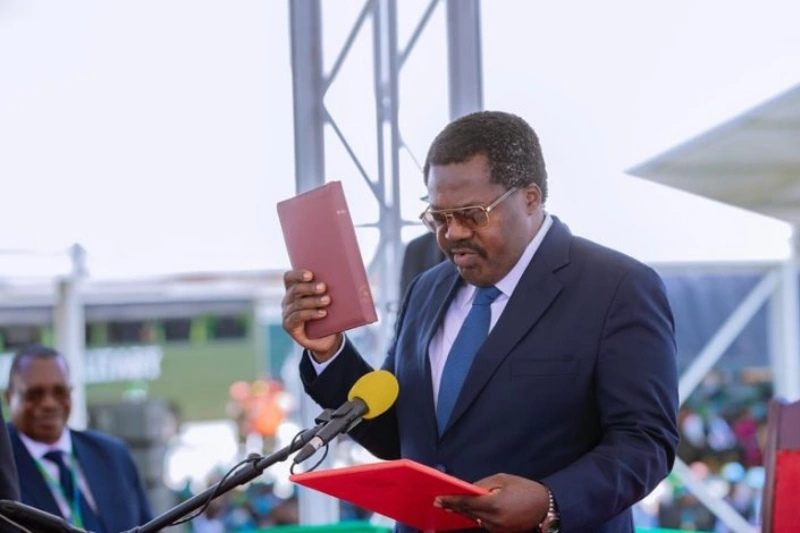

Tanzania’s Vice President Emmanuel Nchimbi is stepping down on 4 September. The timing of Nchimbi’s resignation is striking. It comes barely a month after he urged rights campaigners to fight for a new constitution.
Nchimbi’s resignation was set out in a letter to President Samia Suluhu Hassan on Tuesday. He told her he had chosen to retire from politics and public service altogether. According to the Kenya Times, he cited Articles 50(2)(c) and 149(2) of Tanzania’s Constitution as the legal basis for leaving. The Vice President’s Office had not published the letter on its own channels by Tuesday afternoon.
On the surface, Nchimbi’s resignation reads as a personal choice. Underneath, it caps months of friction inside the ruling Chama Cha Mapinduzi, known as CCM. That friction had steadily narrowed his room to manoeuvre.
The strain became visible in June. A Zanzibar based member of parliament used a speech in the National Assembly to accuse an unnamed “Judas” within government of betrayal. Many read the remark as aimed at Nchimbi.
Weeks later, on 24 July, Nchimbi addressed the Tanzania Human Rights Defenders Coalition’s general meeting in Dar es Salaam. He told citizens to fight for a constitution built on national consensus. He called it essential for strengthening democracy and human rights.
Five days after that speech, CCM’s National Executive Committee met in Zanzibar. The committee referred Nchimbi to the party’s ethics panel, The Chanzo reported. The referral came from a committee member who also serves as a cabinet minister. Party insiders say that detail hints at where the pushback against Nchimbi originated. The referral marked a significant turning point in the events that would eventually lead to Nchimbi’s resignation.
Pressure on Nchimbi’s allies mounted through early August. A CCM commentator who had defended the Vice President on social media, Kazungu Bakari Kazungu, said he was abducted from his home region of Tanga. His captors forced him to insult Nchimbi. They made him name people involved in organising demonstrations. He was dumped near his house a day later.
Tanzania’s Information Services Department then suspended the licence of the newspaper MwanaHALISI for six months on 19 August. The paper had published a report on mounting calls for Nchimbi’s resignation. Regulators faulted the story for failing to seek comment from Nchimbi himself. They also said it attributed claims to a CCM meeting without verifying them with senior party officials.
Seen against that timeline, Nchimbi’s resignation looks like the end of a slow moving contest. It does not read as a sudden rupture. He had been Samia’s running mate in the disputed 2025 election. That alliance helped secure her second term. It later frayed amid anger over deadly violence following the vote. African Union and Southern African Development Community observers judged the election to fall short of democratic standards.
In his letter, Nchimbi pointed to Samia’s wish for change as the reason behind his exit. That phrasing leaves open whether he left willingly or was manoeuvred out. Officials close to the presidency have not disputed that framing. The Vice President’s Office has offered no further explanation for Nchimbi’s resignation beyond the letter itself.
The fallout is likely to unfold on two fronts. The political impact of Nchimbi’s resignation is likely to be felt well beyond the vice presidency. Inside CCM, Nchimbi’s exit removes a figure once viewed as a possible future presidential contender. That could reshape the party’s succession calculations before 2030.
Publicly, it gives opposition parties such as Chadema fresh grounds. They can argue that Tanzania’s governing party punishes reformist voices. That claim will likely resurface once Samia names a replacement.
For now, the presidency has given no indication of who might take over the vice presidency. Tanzania’s second highest office stays unfilled until a successor is announced. Nchimbi’s resignation has closed one chapter of the story, but the search for his replacement is only just beginning.


